The visitors came in their thousands, staring intently at the Rembrandts, Rubens and Murillos in the hope that they would be able to spot the imposter hidden among the masters.
Now, three months since Dulwich picture gallery challenged the public to “spot the fake” after replacing one of their collection masterpieces with a Chinese replica, the gallery has finally revealed the counterfeit.
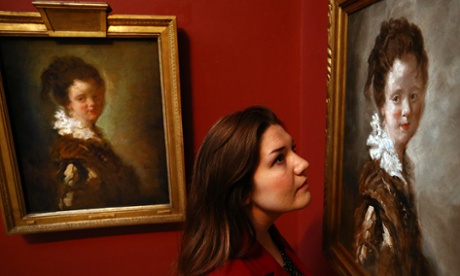
Since 10 February, Jean-Honoré Fragonard’s 18th-century work Young Woman has been replaced by hand-painted replica, produced in China and ordered over the internet for £70, which has hung in among 270 Old Master paintings.
The exhibition, titled “Made in China”, was conceived by American artist Doug Fishbone as a way to make people think about the way they look, appreciate and value such artistic masterpieces.
The gallery’s chief curator Xavier Bray described it as “an extraordinary experiment which has allowed people of all generations to reconnect with the collection and re-engage with it on a purely visual basis.”
He said: “It was certainly quite provocative because it turns everything you assume you know upside down. A museum is a temple of art and as soon as you cross the threshold you expect everything you are told on a label is correct. So suddenly having this intervention from a contemporary artist that makes you question every piece can be quite unnerving, but in a positive way.”
Yet of the 3,000 people who visited the gallery during the experiment, the majority of them are likely to be left mortified by the unveiling of the fake – only 10% guessed correctly.
Bray said the “treasure hunt” challenge had proved very popular with the public and the gallery’s visitor numbers have quadrupled over the past three months. Bray also admitted he had been impressed that 10% had accurately spotted the fake, though noted with amusement that at least 6% of visitors had been convinced the imposter was a recently restored female portrait by Rubens.
Bray added: “In the end it was in a very obvious place so most people would just walk past oblivious which would always make me giggle. Some initially accused us of dumbing everything down but I’m pleased to say it proved the opposite, it actually led people to look afresh.”
The key giveaways of the fake, he said, were instantly obvious to the trained eye. They ranged from the lack of warmth in the background canvas and the modern pigment of acrylic paints, to the expression on the face of the woman in the replica which Bray described as “lacking psychology, just empty and flat”.
The original will be put back in its frame on Tuesday and hung beside the replica, allowing people to compare the stylistic differences between the two.
But Bray said that he would miss the element of fun that the presence of the fake had injected into the gallery. “Weirdly, when it was hanging there, I almost got used to it” he said.