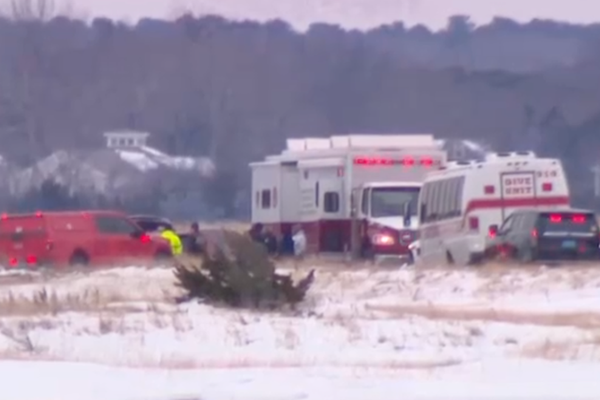
BELVIDERE, N.C. _ A Duke University Health System helicopter crashed Friday, killing four people in Perquimans County in eastern North Carolina.
The crash occurred around 11:45 a.m. EDT The Life Flight helicopter was returning to Duke from the Sentara Albemarle Medical Center in Elizabeth City, Perquimans County Sheriff Shelby White said.
North Carolina Highway Patrol spokesman Master Trooper Christopher Knox said the helicopter went down around near Belvidere, close to the Virginia border and about 160 miles east of Raleigh.
Authorities don't know what caused the crash, he said. The Federal Aviation Administration has been notified.
Another Highway Patrol spokesman, Sgt. Michael Baker, said the National Transportation Safety Board has also been notified. For now, Perquimans County authorities are leading the investigation, but federal officials will take over after they arrive.
White said law enforcement, fire, rescue and emergency personnel from Perquimans County responded, along with the Highway Patrol.
The crash site was in a field near some wind turbines.
Duke Health officials, through spokeswoman Sarah Avery, confirmed "with deep sorrow" that the helicopter had crashed near Belvidere, an unincorporated community about 12 miles from Elizabeth City between Albemarle Sound and the Chowan River.
A spokeswoman for the Sentara Albemarle hospital, Annya Soucy, said the helicopter had picked up a patient needing an inter-hospital transfer to Duke.
Though such taxi flights are common, "between our hospital and Duke (they) are not common," she said.
"There were no reports there were any issues" before the helicopter left, Soucy said, adding hospital staffers "have been in contact with the patient's family."
Reaction from local emergency personnel was swift.
"Heartfelt thoughts and prayers for all families affected by this tragic incident," Durham County Emergency Management Director Jim Groves said via Twitter. "The response community in Durham is saddened."
"We in emergency services know there are inherent dangers which come along with the job; nevertheless we answer the call," Orange County Sheriff Charles Blackwood said in a Facebook post. "Our brothers and sisters will be missed but never forgotten."
Duke Life Flight was the first hospital-based emergency transport service when it was founded in 1985. It has grown from that single helicopter to two, and seven ground ambulances, based in Durham and in Smithfield.
Each helicopter _ both Eurocopter EC145s _ can travel at about 150 mph and cover all of North Carolina and parts of South Carolina, Tennessee and Virginia. A typical flight includes two critical care providers, a pilot and a single patient. Team members work rotating 12-hour shifts.
Avery confirmed that the one that crashed bore the tail number N146DU. An FAA database indicates the twin-engine craft was manufactured in 2011.
Life Flight provides basic life support transportation for patients discharged from Duke Hospital, critical care transportation, and ferries crews for organ harvest and retrieval. The Life Flight staff includes critical care paramedics, advanced life support paramedics, emergency medical technicians, respiratory therapists and a dedicated neonatal/pediatric transport unit.
Friday's crash was the 10th fatal helicopter accident in the U.S. this year, and the second involving an air ambulance, the NTSB's accident-report database says. The previous air ambulance crash this year happened in May, and involved a Eurocopter EC135 belonging to the University of Pennsylvania. It crashed near New Castle, Del., while on a training flight, killing its pilot.
An Outer Banks Voice photograph credited to Tonya Byrd shows the weather at the crash site was near-cloudless, the sort of "visual flight rules" conditions FAA doctrine holds should give the pilot of a properly functioning airplane or helicopter ample time to "see and avoid" contact with the ground, an obstacle or another aircraft.
Regardless of the weather, Duke's helicopters are "outfitted with the latest in-flight instrumentation and safety features," Avery said.
Friday's crash isn't the first involving a Duke helicopter, though. Another went down in 2000 after developing mechanical problems on its way to Alamance Regional Medical Center in Burlington. Pilot John A. Holland was killed.
The NTSB's final report on that crash said an oil pressure warning light went off shortly before Holland landed the craft at the Burlington hospital. A mechanic checked it, but he thought the problem was an instrumentation fault. Instead, the main rotor gearbox's oil pump had failed. Leaving a patient and two nurses behind, Holland tried to ferry the helicopter back to Duke. A minute after takeoff, "oil starvation" triggered a gearbox failure and the crash.
The NTSB ruled that the probable cause of the 2000 crash was the mechanic's failure to follow the manufacturer's procedures for checking an oil pressure warning light.