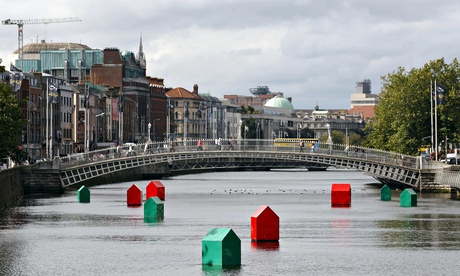
It was the price tag on an entirely mundane two-up, two-down Victorian house in Dalkey, south Dublin, that in 2006 confirmed to me that the Irish had lost all grip of reality when it came to property. Yes, Dalkey is nice, home to U2’s Bono, and maybe (at a stretch) on a par with Richmond upon Thames if it were in Britain. But at £1.2m, it was double the price a similar house would struggle to fetch in Richmond. Bonkers, I thought, as I joined everyone else in saying “this can’t be sustainable”. Homes in Dublin, on a per-square-foot basis, were selling at a considerable premium to London and New York, with only land in Tokyo priced higher. This, in a country with a population density a fraction of England’s, and which was also engaged in a frenetic construction boom.
It was, of course, unsustainable, as we now know, even if the harshest critics had no idea how violent the death of the Celtic Tiger would be. By 2010 almost every bank and building society in the country had collapsed, with the most swaggering property lender, Anglo Irish, leaving quite colossal debts on to the state’s shoulders.
But the tiger is roaring again. Ireland now has the world’s frothiest property market, according to global estate agents Knight Frank, with prices rising faster in Dublin than London, New York, or even Shanghai. And as someone who has spent the last 18 months trying to buy a home in Dublin, the figures come as no surprise.
Londoners will be wearily familiar with “open days” where estate agents try to create a buzz about a property, hoping that sealed bids will see the home sell for above asking price. In Dublin, it felt like Black Friday every time I turned up at an open day. At one home in Rathgar by the time I arrived there was a long queue of viewers stretching down the garden path, spilling into the road and grabbing at the agent as she went up and down the line handing out the property particulars. I think there were tears when she ran out half way through.
I made the schoolboy error of offering the asking price. Sherry Fitzgerald, Dublin’s dominant upmarket estate agency (it could teach Foxtons in London a thing or two about whipping up buyer sentiment) smiled at me benignly. I clearly did not understand the rules of the game. The asking price in the better postcodes of Dublin (ie D4 and D6) is just the starting gun. To have any chance of bagging a decent property, it was made clear that I would have to pay at least 10%, but probably 20% above the asking price.
The next few months were spent in fruitless bidding wars for homes across the capital, where each time I dropped out as the bids went to 25% above asking, and then some more.
Where the hell was the money coming from, my colleagues in London would ask. Like most Brits, they continue to see Ireland as an economic basket case, dependent on a mix of tax-dodging multinationals and EU bailouts to survive.
Their condescension became annoying. While George Osborne brags that Britain has the fastest growing economy among the G7 countries, it’s pygmy-like compared to the other side of the Irish Sea. The most recent economic growth figure for Ireland was an extraordinary 7.7%, the fastest of any country in Europe this year. Yes, some of it is multinationals running their profits through the country to avail themselves of its notorious 12.5% corporation tax rate. The Irish Revenue is plainly guilty of tax theft from other countries in Europe, and if the EU fines it billions for effectively giving illegal state aid to the likes of Apple, then it will be entirely deserved.
But the multinationals in Ireland are not just nameplate operations without any substance that you see in some tax havens. Intel, for example, has invested a staggering $12.5bn (£8bn) into its operations in Leixlip on the fringes of Dublin, creating the most technologically advanced industrial location in Europe. In November, more than 20,000 delegates turned up for Dublin’s Web Summit, an annual event that has become the Cannes film festival of the technology world.
Is this the start of another Irish economic bubble? While Dublin is buzzing, in parts, the reality is that few people outside the Irish capital will recognise the white-hot economic and property price figures. Ireland’s unemployment rate, though falling, stands at 11.4%, or nearly double that of the UK. The bank bailout has saddled a generation of young Irish – and the next – with an unbearable debt burden. Emigration (the UK is the number one destination) remains much higher than immigration. Taxes have risen considerably, with the introduction of water charges the final straw for many, coming after so many other impositions. The rebellion against the political elite, voiced in Britain through Ukip, in Ireland takes the form of an extraordinary surge in the polls for Sinn Féin.
Talk of a property boom will cause wry smiles in the “ghost villages” far from the capital, where whole estates were abandoned half-built the day the banks went bust. Next week, the auction house Allsop is aiming to sell one fully built, and 10 other “substantially completed” three to five-bed houses in Mullingar, 85km west of Dublin. The price? £630,000, for the lot.
Maybe the Dublin boom will seep through to the moribund counties in the midlands, but there are few signs of it yet. Politicans seize upon any hint of news about rising property prices, hoping it will rescue the huge numbers still trapped in negative equity.
Their hopes may, though, be dashed by the Central Bank of Ireland. From the new year it is imposing strict new lending multiples, limiting buyers to loans of no more than three and a half times their income – far more onerous than anything the Bank of England has tried here. Many in Ireland’s property industry fear the lending rules will bring the country’s nascent property boom to an abrupt end.
But in Dalkey, the boom times have returned (if they ever really went away). Sherry Fitzgerald is now marketing a lovely six-bed end of terrace Georgian with waterfront views. The price? A snip at just €12m (£9.4m).