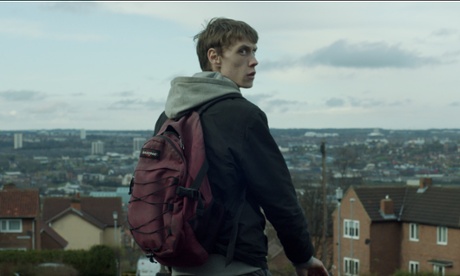
The kids aren’t alright in Bypass, Duane Hopkins’s hyper-lyrical take on the state of our nation. Amid glum estates in the north-east of England, a petty criminal is struggling to do right by the family he is far too young to be responsible for. He is pushed to the margins of modern England, living life without the chance of a livelihood, and is thus forced to find new ways to survive. Yet in a twist on usual kitchen-sink storytelling, this teen’s tale is depicted with sensually charged lens flares, ambient electro soundscapes and slow-motion ellipses. The kids may not be alright, but they sure look good.
Bypass achieved its modern realism by embedding itself in Gateshead, the old industrial town on the River Tyne. On a set visit, I’m driven around by a producer still in his twenties. He’s knackered, he admits, approaching the end of a nine-week shoot, for which the cast and crew appear to be testing out their own limits. Locals seem accommodating, if not indifferent, to the operation in their midst. Hopkins refuses to talk on the day. Sorry, I’m told, but he’s in his zone.
London-born actor George MacKay stars as Tim, a likable lad whose mother (Arabella Arnott) is terminally ill, whose father is absent, whose grandfather is in a care home and whose brother Greg (Ben Dilloway) is fresh out of the clink and on probation. Tim’s girlfriend is pregnant, the debt collectors are knocking, and he’s in deep with the local thugs. “He’s a decent guy in a guilty environment,” is how producer Samm Haillay sees it, before showing me a rough cut of a key scene: a tragic and breathlessly calibrated car chase through the motorways that surround Gateshead.
Hopkins has personal links with this area, and this familiarity feeds into the film. He grew up in a working-class community on the edges of the Cotswolds, and went north to learn filmmaking on a grant, the first of his family to go to university. “Academics don’t live in the real world, they are all either mentally or sexually frustrated,” his dad told him as he left. Hopkins eventually settled in Newcastle and launched his own production company, Third Films. He began returning to the communities of his childhood to find “what gets called the underclass” for his 2008 debut Better Things, a sombre look at smalltown drug abuse that made a stir at Cannes.
Bypass is an amped-up variation on the same theme. Its genesis came over five years ago, during a cold evening on a council estate in Coventry, not far from where Hopkins grew up. He was there, he says, to understand the changing face of Britain’s invisible cultures, and maybe to street-cast – to find someone who could help him explore the idea of whether the working class exists any more. “An aggressive, feral atmosphere now pervades in these communities,” he says when we finally speak on a phonecall from Norway, where he now lives with his family, adding that he was interested in portraying that. His earlier shorts, as well as Better Things, had been street-cast, and Hopkins was looking for real people to convey “the crisis of identity and purpose” faced by the UK’s most vulnerable children.
After chatting with one local kid he found himself in his flat, high up in a tower block. The kitchen was full of takeaway boxes, the living room was bare but for a sofa, and everything seemed orientated around the PlayStation. Two other lads, one hooded and wearing gloves, treated him with hostile indifference.
Hopkins asked them about their childhoods and their lives now. They didn’t have dads or settled work. One barely left the estate – he felt like it was his, the boy said, and he could do what he wanted. Hopkins, though, had friends from the same estate.
“I was meeting the kids I would have hung about with if I were 20 years younger,” he says. “So that made me connect with their lives.”
As he was fixing to leave, Hopkins asked them what their plans were that evening. “The atmosphere changed,” he says. The boys asked him if he was police, he convinced them he wasn’t, and they told him their plans for the night: they were going to wait until 3am and then break in to other homes on the estate.
“But the people they were going to burgle, they know who they are. They are almost friends,” Hopkins says, his voice rising a little, as if he can’t quite believe what he’s saying. “I used to know kids who did burglaries, but not at this level, when people are pitted against each other in this way. This was even less moral, and – even if they struggled with that – I realised there are no more rules any more.”
The same rule-eschewing instincts colour Hopkins’s film-making style. There’s a distinct type of cinema associated with these gritty realist stories; hard-edged, rigorously downbeat, unsparingly objective. But in Bypass, form is very consciously elevated over content; close and intrusive angles, disembodied voices, moments caught in slow motion and sun-bleached flashbacks accompany the characters at every turn.
The film depicts an atomised, almost Darwinian state of urban survival, and hurtles at full pelt into every emotion. “I wanted the camera as another character,” Hopkins says. “I’ve taken genre cinema and given it a whole new set of tools.”
Not everyone was so taken with his attempt to shake up the kitchen-sink genre. It was criticised at the Venice film festival last year for prioritising aesthetic tricks and expressionist stylings over the realities of Tim’s perspective. Yet Bypass is deserving of recognition; a modern refashioning of classic social realism that builds with the momentum of an American thriller.
“The reviews had a problem with the film’s style,” he says, “which is really, really strange.
“The form and content in Bypass is completely entwined. I think [critics] have a problem with a certain type of content presented in a certain way; it’s almost as if they expect a film about these themes to be shot in a set way.”
The film is now being self-distributed – a good fit for Hopkins’s insurgent style. In between press interviews, the screenings and the festivals, he returned to the estate to look for those boys. The flat was empty, and they were gone.
“Since then, I’ve started to see the film as about the dilemma they were going through,” he says. “And the country we are creating for them.”
Bypass is in selected cinemas from Friday 10 April