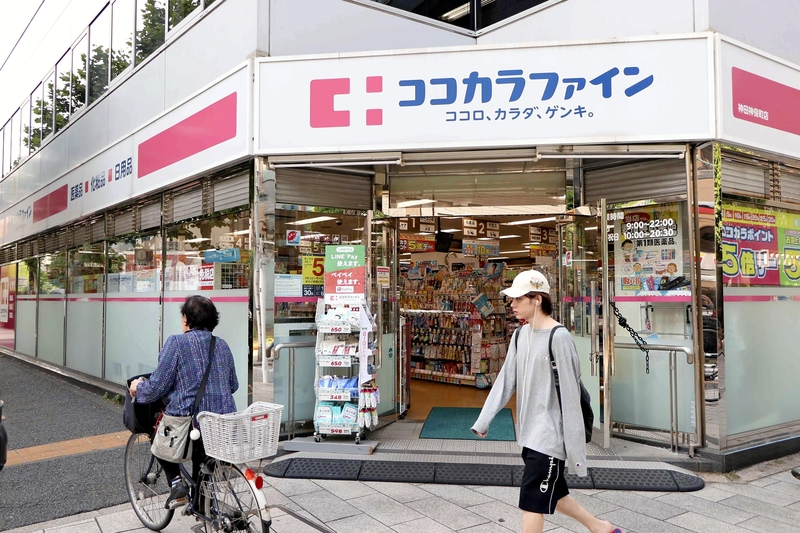
The upper ranks of the nation's drugstore industry could be in for a shake-up as two major players are seeking to tie up with drugstore chain Cocokara Fine Inc.
Cocokara Fine has entered talks with rival Sugi Holdings Co. to merge their operations, and if the merger is realized, they would create the largest drugstore chain in the country. Meanwhile, Matsumotokiyoshi Holdings Co. announced that it has sounded out Cocokara on the possibility of management integration.
Cocokara, which operates mainly in the Kanto and Kansai regions, is strong in its dispensing services, using information technology such as a counseling system via videophone.
Sugi Holdings is based in the Chubu region and has many suburban stores. So, the two companies have a mutually complementary relationship. In addition, Sugi hopes to take advantage of Cocokara's technology in order to expand its dispensing business.
On the other hand, Matsumotokiyoshi has mainly urban stores in the Tokyo metropolitan area. In a tie-up with Cocokara Fine, the company could not only cover regions where it has few stores, but also promote the development of private-brand products by reducing the procurement costs for cosmetics and daily necessities.
Matsumotokiyoshi commented on June 5, "We conveyed our intention [to the Cocokara side] to discuss all options, including management integration."
In late April, the two companies agreed to start talks on a capital and business tie-up, but Cocokara and Sugi later agreed to start talks on management integration. In response, Matsumotokiyoshi became alarmed and decided to propose the merger.
Behind these moves is intensifying competition with other drug stores and convenience stores, which have recently been given the green light to sell some types of medication.
Both Matsumotokiyoshi (sales of 575.9 billion yen) and Sugi (488.4 billion yen) have a chance to be the industry leader, surpassing Welcia Holdings Inc. (779.1 billion yen), if either of them succeeds in a merger with Cocokara (400.5 billion yen). The larger the scale, the easier it will be to cut procurement costs for products.
The drugstore industry typically makes money on high-margin drugs and cosmetics, while selling daily necessities and food at low prices. According to the consulting firm MAC Advisory, the market grew from about 5.6 trillion yen in 2010 to about 6.8 trillion yen in 2018.
However, growth has recently plateaued due to rising labor costs and sluggish consumption by foreign visitors.
"The companies' strategy is to expand their business by cooperating with rivals, primarily in the dispensing of prescriptions, an area expected to see growth. The trend is expected to continue," said Satoshi Hanaki, president of MAC Advisory.
Read more from The Japan News at https://japannews.yomiuri.co.jp/