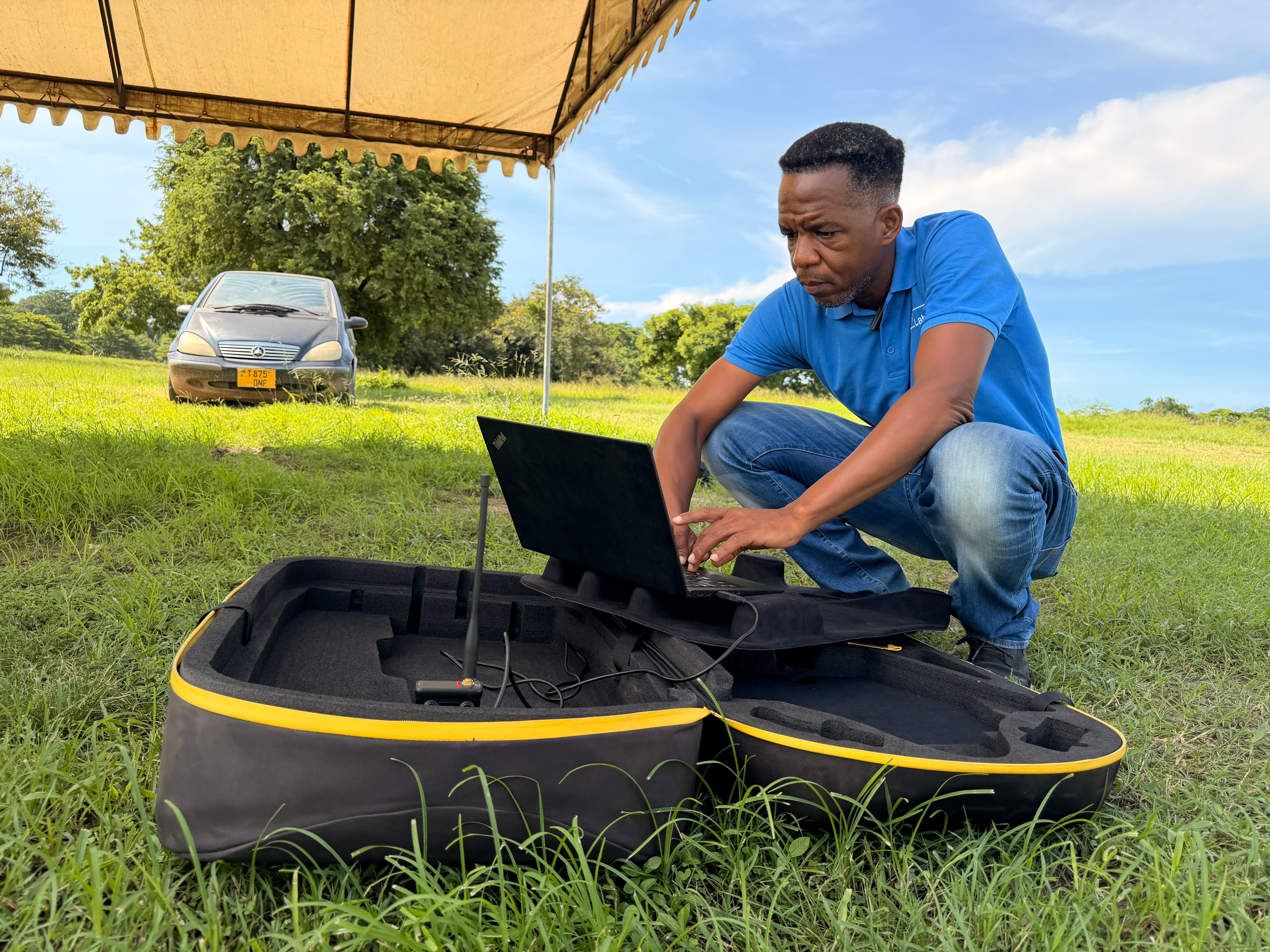
On an oppressively hot day in Tanzania’s largest city, Dar es Salaam, Leka Tingitana, the director of aerial research company Tanzania Flying Labs, walks out to the middle of a university cricket field and launches a drone into the bright blue sky.
The $20,000 (£15,000) Swiss-made device circles a patch of sky, precisely mapping out a 1km-square section of the city below. That map will, in turn, form a small section of a larger project mapping possible mosquito breeding sites across the city of roughly eight million people, with the final product becoming a key tool to fight malaria as climate change increases the risk of this deadly disease.
Warming temperatures are having a “catastrophic” impact on Africa’s malaria caseload, says Dr Sarah Moore, who works at Tanzania’s Ifakara Health Institute, evaluating mosquito-control products like bed nets and repellants. “The weather on the continent is expected to be wetter and warmer,” she says. “More water will mean more breeding sites for mosquitoes, while warmer weather will mean that the parasite [that causes the disease] can develop faster.”
Creating Dar es Salaam’s malaria map requires data to be collected on the ground of typical mosquito breeding sites – often a bucket of standing water – from several thousand locations across the city, explains Dr Yeromin Mlacha, a Tanzanian research scientist who is also of Ifakara, and who leads the project. This data is then fed into a machine-learning system along with the drone data by experts at the University of Copenhagen, with the result being a high-resolution map of all the possible sites where mosquitoes could be breeding around the city.
“With limited resources, we have been able to identify where malaria exists in scattered pockets across the city,” explains Dr Mlacha. “It has allowed us to find breeding habitats people had not known about before, like discarded tyres on people’s roofs that contain standing water. We can then introduce measures to address this risk, such as new rules about what people can use to hold their roofs down.”
There was a time when this kind of study would not be required after public health measures dramatically reduced Dar es Salaam’s caseload in the 2000s. But new risk factors – including a city population that has doubled in size over the past two decades, and the possible arrival of a more urban-dwelling mosquito, Anopheles stephensi, from Asia – have led public health officials to refocus their efforts on tackling malaria in the city.
.jpeg)
Crucially, climate change is also massively disrupting long-established patterns of the spread of malaria across all the places where it remains endemic, and is prompting research scientists to urgently reconsider how to tackle the disease.
According to researchers, there are two main ways that climate change increases the malaria risk. Firstly, the gradually warming temperatures’ disruptive impact on weather patterns makes it harder for health officials to track when and where exactly mosquitoes will be breeding in a country. In addition, the increasing likelihood of a major flooding event also increases risk, as such events provide prime breeding habitats for mosquitoes, while also making it difficult for health services to reach communities that are cut off. In the wake of the major Pakistan floods of four years ago, for example, there was a surge in malaria cases in the country from 2.6 million in 2021 to 3.7 million in 2022.
Malaria currently kills more than 600,000 people per year around the world. A further 550,000 people could be killed globally between 2030 and 2049 due to climate change, according to a landmark study published in 2024, which draws on more than 25 years of data, including malaria control records and socioeconomic factors, as well as future warming scenarios.
Prime spots for mosquitoes to breed
In Dar es Salaam, Dr Mlacha and his team have observed how the city’s increasingly common water supply challenges during times of drought – which led to widespread water rationing at the start of the year – are a major malaria risk factor for city inhabitants. At such moments, says Dr Mlacha, it can be observed that more and more families are storing water in buckets around their homes, providing mosquitoes with a prime spot to breed.
.jpeg)
“We can see with our research that this kind of water storage is influencing the prevalence of malaria,” he explains. “It is possible to tell residents to use something other than a tyre to anchor down their roofs, but it is hard to tell people to find another way of storing water during times of drought,” he adds.
The slum-like informal settlements, where most residents of Dar es Salaam live, are also particularly susceptible to floods as heavy rainfall becomes more common as the climate warms. “If there’s three hours of continuous rainfall in the informal settlements, you can expect flooding,” explains Dr Mlacha. “And then you have standing water for a week, and that is all the time that you need for mosquitoes to appear.”
The challenges faced by health authorities in tracking malaria’s spread as the climate warms are being replicated across the country, according to scientists working on other projects at the Ifakara Health Institute.
“In some parts of the country where malaria was very high, it is now low, and in some areas where it was very low, it is now higher, so ultimately the disease has become much more difficult to track and control [based on previous knowledge],” says Dr Aina-Ekisha Kahatano, who works overseeing malaria vaccine clinical trials.
It is also not just in Africa where a changing climate could influence the spread of malaria. “Back in Shakespeare’s time, before we drained the fens, we had malaria in the UK. There also used to be malaria in Scandinavia, and also in Italy until they decided to wipe it out in the 1930s,” says Dr Moore. “In a world of three degrees or more of warming [above pre-industrial times] it’s not inconceivable that malaria could return.”
There is hope that new tools to fight the disease – including malaria vaccines and mosquito genetic engineering – can go some way in curbing the threat of increased malaria cases during climate change. But with donors like the US and UK slashing foreign aid for health programmes in countries like Tanzania, there is real concern that the impact of such new capabilities may be limited.
This article has been produced as part of The Independent’s Rethinking Global Aid project
Rare weather pattern ‘Godzilla’ El Niño could make next year hottest on record
‘Massive’ funds needed to stop land around world turning to dust, UN warns
Climate crisis completely changing fight against poverty, says Christian Aid chief
Risk of drought in UK grows after unusually dry start to spring
All of the world’s 50 hottest cities in late April were in India
Warning climate change could threaten Britain’s beloved cup of tea