
There are so many anniversaries, celebrations, and reasons to crack open a bottle of something special this year that I’m ashamed to admit that a fair few have passed me by. I imagine it’ll be the same case for you.
So, somewhat early in the day, let’s raise a glass to 20 years of the Bentley Continental Flying Spur.
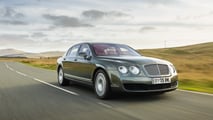
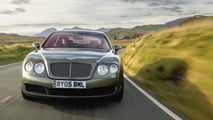
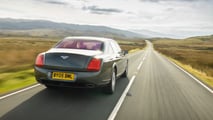
Launched in 2005, the OG Flying Spur was quite the thing. Hot on the heels of a hugely successful rebirth of Bentley under VW stewardship with the four-seat, two-door Continental GT, the imperious sedan was the car for the driver who wanted the new look, but space for all the family and their things.
It came with a turbocharged 6.0-liter W-12 motor that fired 545 horsepower and 479 pound-feet to all four wheels via a six-speed ZF gearbox, much like the GT. Here, there were rear doors, and space in the back for people over six feet to get comfy, as well as the sort of attention to detail you’d expect from a car with the Bentley wings on the nose. In 2008, a 600-hp Speed variant appeared for people who were often late to meetings.

Over the last two decades, the Flying Spur has worn a number of faces, each a pleasant evolution of the first car, offering smooth power and room for all. The original kicked around for eight years, with 2013 seeing a sharper (to look at) second-generation car with a slight name shift and a new engine option. It was no longer the "Continental" Flying Spur, as Bentley was keen to distance its two star pupils.
The W-12 was all present and correct, with (depending on which year ‘n trim you went for) up to 617 hp, but the team in Crewe thought that might be a bit too much for some, so it brought out a V-8. With 4.0 liters of turbocharged joy under the hood, the V-8 could kick out over 500 hp and sounded rather delicious at full chat (you could spot it from afar thanks to its red badging).
The end of the 2010s meant not only a world on the precipice of a pandemic, but also a third-generation Flying Spur. A new platform, new look, new tech, and some natty new 'B' rear lamps, and—for better or worse—a V-6.
Longer than before, it looked rather fine, if… firm. Initially available with the famed W-12, over the car’s life Bentley ended production of the motor, leaving it with a V-8 or a V-6 hybrid. That leads us neatly to today, and the latest car to take on the mantle. It’s got a fair bit to live up to.
When the original car came out, your options for a big ‘ol luxury barge weren’t as varied as they are today. SUVs had yet to take off quite as wildly (the L322 Range Rover was a few years old), and while the 7 Series, S-Class, or A8 were all options, they weren’t quite a Bentley, were they? That said, the Flying Spur, as lovely as it was, couldn’t quite go toe to toe with the then very new Rolls-Royce Phantom.
It opened up a new market: Cars for well-heeled people who weren’t quite Rolls-y, but who were a few steps up from the big three Germans. The Continental GT had the playboys covered; the sedan had everyone else. Dripping in British luxury, with a price tag and prestige to match, the Flying Spur was the start of a new era. Bear in mind, it was a good half-decade before Porsche and Aston came out with their own saloons.
Bentley was exploring new territory.
Dripping in British luxury, with a price tag and prestige to match, the Flying Spur was the start of a new era.
Today, the Flying Spur continues to be a thing of beauty. An imperious mass of metal, leather, and wood, mixed with an air of superiority that only the Brits can pull off. Today’s top spec Mulliner (or Speed) Spur comes with an ‘Ultra Performance Hybrid’ system hooked up to a 4.0-liter V-8 with 771 hp and 737 lb-ft.
You can, of course, have 671 hp (which is enough for most people, really) with the ‘High Performance Hybrid’ setup in the core or Azure trims, should you wish. It’s dripping in electric tricks to make sure your ride is as smooth and uneventful as possible, and the interior design is, frankly, exquisite.
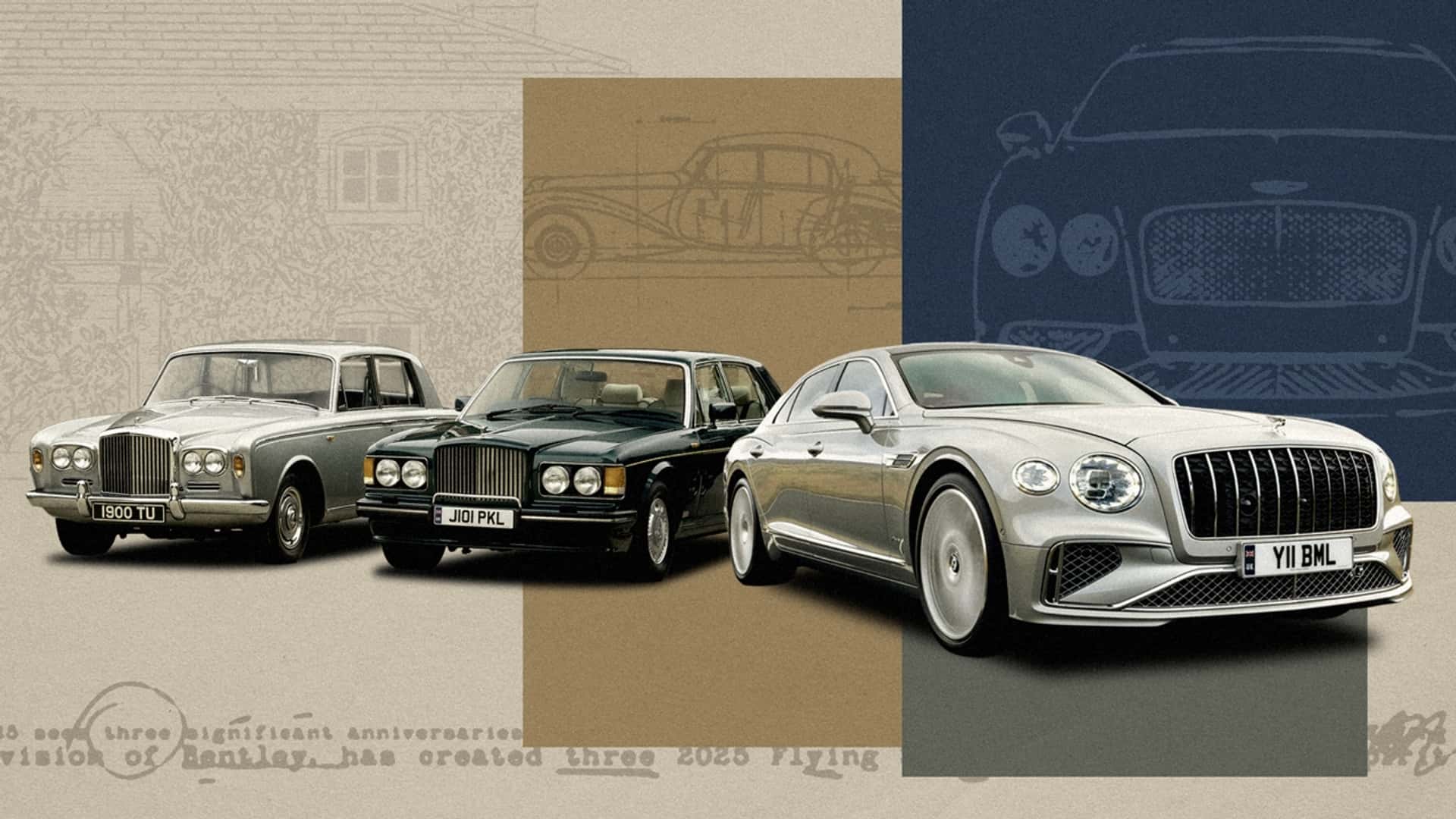
Putting the two side by side, you can appreciate how much Bentley’s design language has changed over the years. The original car, glorious in its day, now seems a little gawky from some angles. It also—and this will sound odd considering the subject matter—seems a touch small. That said, if I were the same size I was 20 years ago, I’d also be surprised. And probably quite ill.
Inside is where you’ll find the biggest tonal shift. In its day, the OG Spur was at the cutting edge of tech. Heated seats, electronically adjustable everything, and shiny GPS, amongst others, made it stand out, but today some of that tech is dated.
The GPS is the biggest offender—touchscreen tech was a distant dream, so big buttons surround the display to let you do… things to it. It’s surprising how quickly something that was once second nature has become so alien. A few prods and the very un-HD display switched from function to function, but I stopped pressing things for fear of breaking it. Analog dials are the stars of the show in the instrument binnacle, too, which shouldn’t feel ‘old school,’ but it increasingly does.
The new car is a feast of screens, hot stone massages, touch-sensitive controls, bum warmers, colon coolers, panels that flip, and everything you could possibly want. The spirit of what came before is there, but there are two decades of learning, customer expectation, and technological advances behind it. It’s rather wonderful. But also isolating. New tech means it’s awfully quiet in there, which is both a good and bad thing.
The hybrid powertrain comes with 50 miles of EV range, and it’ll pull away silently, which is lovely. But as you’re so insulated from the outside world, the lack of noise is quite strange. Usually, there’d be a hint of engine in there to add some ambiance, but not so here. Until you twist the drive select dial to ‘Sport’ and boot it, that is. With the full 771 hp on board, and dollops of EV torque to support your silliness, the speed the new Flying Spur gathers is rather incredible. The figures are ludicrous; 0-60 mph takes 3.3 seconds, and its top speed is 177 mph.
When the Spur first came out in 2005, the Bugatti Veyron became A Thing as well. That came with 1,000 metric horsepower and never-before-seen performance figures. Twenty years on, you can buy a sedan with almost the same amount of power.
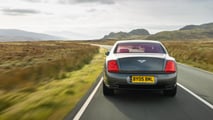
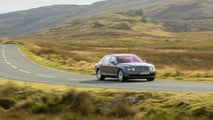
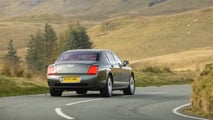
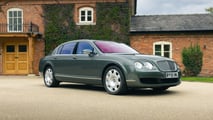
Making progress in the Spur is accompanied by a distant V-8 hum and a blurry view out the side windows. Power goes to all four wheels, so you can be, erm, childish, and get away with the sort of stuff a RWD car would eat you for. And while you’re doing all that, you can have a quiet conversation with the person having their ass massaged in the back seat.
Refined thuggery is excellent when it works.
The original Spur, while still quiet, isn’t as silent. Its W-12—never an engine known for aural deliciousness—gently woofles as you set off, and it will merrily, effortlessly cruise you around. It’s smooth, comfortable, and charmingly Bentleyish.
The steering isn’t quite as sharp as the latest car, but that’s not the end of the world. Waking its engine is entertaining; it’s quick from the get-go, but wait for it to get to the top half of the rev range. Once it’s there, the Bentley gathers pace at a ‘cling on and enjoy the ride’ rate. Numbers grow and buttocks clench. Bentley’s own example had fewer than 500 miles on the clock when I was thrown the keys, and it was pristine inside and out.
Playing in the two back-to-back is an eye-opener. Tech has moved on; what was considered the cutting edge of luxury then is now a far cry from what’s possible, and the under-the-skin stuff is, of course, far more advanced than it used to be. But there’s a commonality between the two. Hints of the first car lurk beneath the surface to let you know how deeply rooted the DNA is.
Today’s Flying Spur has more competition than the original, sure, but to spend time in it is to know that little else will match up. And after driving its grandfather, it’s good to know it was ever thus.