“Pre-loading” is a new term for a longstanding problem. You might not have heard it used before, but if you live in a British city you’ll probably be well aware of its effects.
With cheap alcohol available in any supermarket, the habit of drinking at home before going out for the night and drinking even more has become increasingly common, especially among younger people. And in Liverpool, where the night-time economy is a vital part of the city’s offer, pre-loading is a particular problem among the city’s 50,000 students.
Crime figures show that 97% of people arrested for a violent offence after 11pm have been drinking. But this should be happening a lot less. The Licensing Act 2003 clearly sets out that it is an offence to serve a person who is clearly already drunk. Likewise, it is also an offence to buy a drink for someone who is drunk. But how many people know that this is against the law?
Not many, it would seem. Katy Simic, behavioural insight and change executive with Liverpool city council’s public health team, says: “We know from local research that there was a lack of awareness of the law among bar staff. Work by Liverpool John Moores University’s centre for public health showed that in one north-west city 84% of attempts to purchase alcohol by actors pretending to be drunk were successful.
“But we also know that you can change people’s behaviour. A campaign in Sweden saw sales to drunk people fall from 95%, to 53% and then drop further to 30%. We are confident we can do the same in Liverpool.”
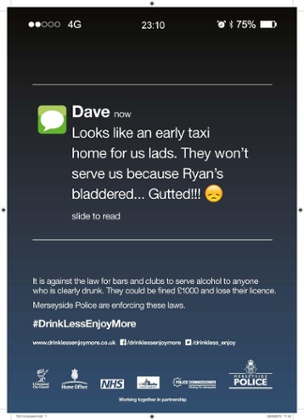
To achieve this, the public health team has developed the #DrinkLessEnjoyMore campaign which will run until January 2016. Supported by Liverpool clinical commissioning group, CitySafe and Merseyside police the campaign aims to raise awareness with both drinkers and bar staff of the risks they run if they sell to or buy alcohol for people who have clearly had a few too many.
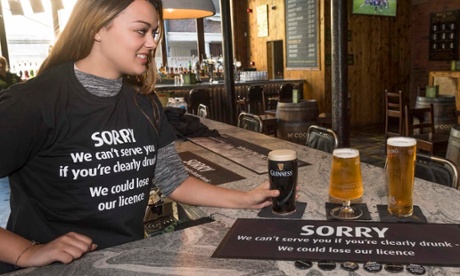
The campaign attacks the issue on two fronts. Firstly, drinkers will be made aware that they won’t be served if they are drunk and that the penalty for buying alcohol for someone else who is already drunk is a fine of up to £1,000.
Secondly, the council’s alcohol and tobacco unit is running training sessions to support bar staff to confidently refuse service. The penalty for serving someone who is drunk is also a fine of up to £1,000 for the worker, and the venue could lose its licence. Most importantly, these actions are backed by Merseyside police who will be putting on extra patrols in Liverpool city centre during the three-month campaign to enforce the laws.
Superintendent Mark Wiggins says: “We know that around 50% of all violent crimes committed are alcohol related and that if you drink at home, then go out, you are more likely to be involved in violence, either as a victim or as an offender.
“Liverpool’s night-time economy is rightly famous and the city has a well-deserved reputation as a safe and vibrant place to enjoy a night out. Every weekend at least 100,000 people visit to enjoy an evening out and we want to ensure those people leave with fantastic memories and are keen to come back time and time again.”
To get the message across, the campaign uses several tactics, including posters on city centre route bus stops and near off-licences, radio advertising, and social media. There will also be plenty of #DrinkLessEnjoyMore materials in venues including bar mats and t-shirts for staff.
Simic adds: “#DrinkLessEnjoyMore isn’t about telling people not to drink, it’s about helping people to understand the law and how their behaviour can impact other people and businesses. Liverpool is a great place to go out, we want as many people as possible to enjoy themselves and not to find themselves going home early.”
Follow the campaign @drinkless_enjoy.
Content on this page is produced and controlled by Liverpool city council, sponsor of the adult social care hub