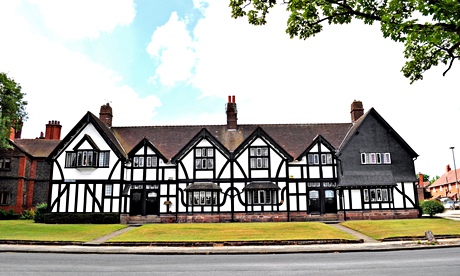
Jacqueline Yallop mentions in her book the problem of deciding what to call the places it covers. “Model villages” was the original nomenclature – model as in an exemplar for others to follow – but she finds other people assume she is referring to miniaturised villages, toys. Although she settled on “Village Utopias” instead, Yallop argues that the impulse behind the two kinds of model village can be pretty similar – a desire to create and tinker with an ideal community in microcosm, one over which the creator has absolute power, and whose population cannot answer back; a peculiar and very English combination of the despotic and the cutesy.
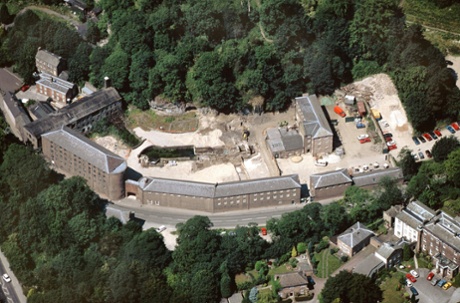
The tour takes in, among others, small-scale, large-ambition philanthropic settlements such as Cromford and Cresswell in Derbyshire, Port Sunlight in Merseyside, Saltaire in West Yorkshire and Nenthead in Alston Moor, Cumbria, where the author spent what appears to have been an unrewarding time as a tour guide in her early 20s. These are then interspersed with thematic digressions and excursions to New Lanark, Blaise Hamlet and a Moravian square in suburban Manchester. All are products of the industrial revolution, roughly from 1770 to 1930, and most were projects of enlightened philanthropists. Dreamstreets’s stall is set out, though, in an opening comparison between Cromford, a planned village created not far from the mill by the pioneering industrialist Richard Arkwright, and New Lanark, opened in Clydeside by his partner David Dale, and then revolutionised by his successor Robert Owen. The juxtaposition is of planning and speculation, utopianism and commerce, and their results in the place’s ease of living.
Cromford sounds as if it was a ghastly, apocalyptic place. The “model village” part was a speculation on Arkwright’s part, no more. New Lanark, on the other hand, was part of an imagined federation of industrial villages practising a “strict form of communism that made no concession to individual needs and desires” as a means for tending to the people Owen called his “vital machines”. They were given a compulsory atheistic education, sexual equality, equal wages, communal child rearing and lessons at an Institute for the Formation of Character, as well as going to drill and dance classes. The village’s layout put cottages on one side, the mills on the other, and Owen’s house in the middle. Yallop finds this disturbing – “Privacy is not accounted for, or considered necessary”. New Lanark’s “physical structure perfectly expresses the gap between those being watched and those doing the watching”. At Cromford, however, there was a hill between the cottages and the mill, and big, rangy gardens at the back of the houses. As a result, you could “step out of your role as a factory hand, and become something more … a mother or a father, a gardener, a musician, a craftsman or a raconteur”. This is unconvincing – I suspect that the drudgery of life under Arkwright made much of this impossible, and that self-realisation for the worker in the 1810s was actually far easier under the eye of Owen. Where she is clearly right, though, is that because of its informality, you can live, now, in Cromford – you, as a 21st-century person, could make the space your own. New Lanark is so tightly packed and obsessively designed that it can only be a museum.
Dreamstreets takes on a subject that could easily become twee and nostalgic with a fretful, haunted tone, aptly paranoid given the subject. The descriptions of place, surface and mood are sharp and tangible. Yet there is something oddly rigid about Yallop’s approach. Something of it can be seen in claims like (of Port Sunlight) that “playfulness, as we all know, as only possible from a position of power”, or her argument, discussing the “picturesque”, that “authority is expressed in the way sight is manipulated”, that there is something totalitarian in any “determined view”. Places that might complicate this – Chartist villages, London county council estates, co-operative housing, Tayler and Green’s modernist-picturesque postwar villages in Norfolk, to name a few – don’t feature. Planning is always done by the Boss. Tremadog in Gwynedd, for instance, is given a much less sceptical treatment than most, seemingly because it was a planned village intended as a market town rather than an industrial exemplar, its theatrical architecture and Coade stone figures “like finding a neon sign in a field”. Markets, as always, are considered more natural than utopias.
The benefit of this approach, though, is its hard scepticism towards what lies behind prettiness and philanthropy. Yallop describes her method as “unseeing modern clutter”, so you can see the places as they once were – “challenging, shiny and modern”. Yet at picturesque villages such as Edensor and John Nash’s Blaise Hamlet she doesn’t have to “unsee” the branches of Londis – these places remain as cloying and complete as ever. At Blaise Hamlet, she “can’t help but be astounded by the sheer falseness of the place”, and is repelled by its sense of “lives being manufactured and manipulated”. There are also useful digressions for context. So she makes Saltaire, near Bradford – less a village than a little Venice in yellow stone – the pretext for an interesting excursus on how this industrial utopia exemplified the way working-class women moved out of the factory in the middle of the 19th century and into the home, becoming poorer cousins of the bourgeois “Angel of the House”.
Eventually, the model village becomes a matter of pure PR. Port Sunlight, Lord Leverhulme’s utopia for his soap factory workers, was another part of the marketing campaign, like the use of John Millais’ painting Bubbles. By the 1900s, the “vital machines” were unionised, educated and no longer happy to be someone else’s toys. However delightful and variegated its cottages and semis were, Port Sunlight’s workers were so ashamed of it that they would often leave it off their addresses, using the names of nearby, less famous towns instead. She follows Lever to Congo, finding tantalisingly unexplored links in the chain of industrialism, utopia and empire. A visit to Portmeirion (Yallop is dubious about its merits) finds the utopian village finally presented as a place people might like to visit, rather than as a means of solving their problems. It is an intriguing conclusion, but I suspect the idea is not as dead as Yallop makes out. I await the sequel set in Poundbury.
• Owen Hatherley’s Landscapes of Communism is published by Allen Lane. To order Dreamstreets for £15.19 (RRP £18.99) go to bookshop.theguardian.com or call 0330 333 6846. Free UK p&p over £10, online orders only. Phone orders min p&p of £1.99.