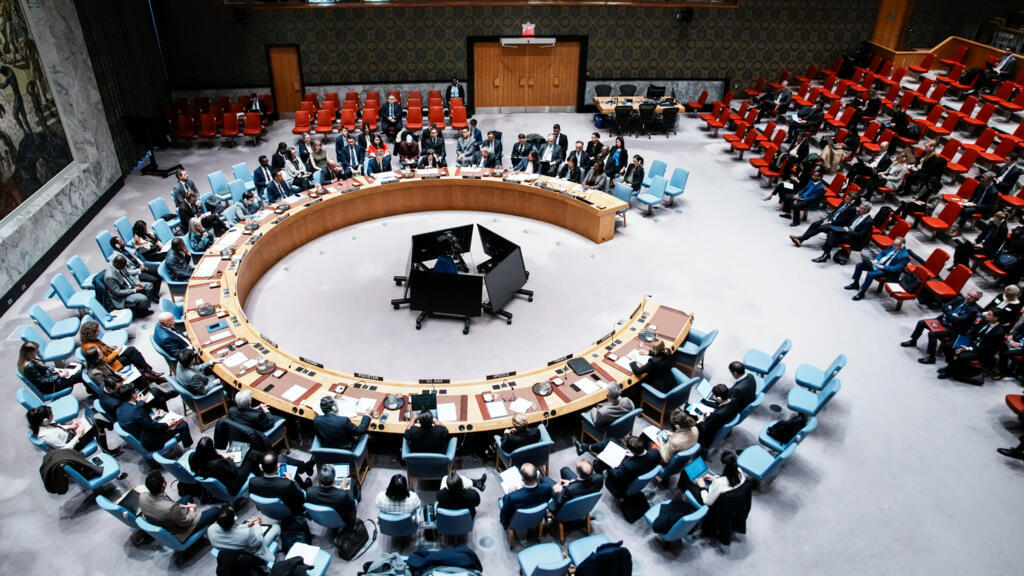
The Democratic Republic of Congo returns to the United Nations Security Council as a non-permanent member for the 2026-2027 term for the first time in more than three decades, hoping to keep the armed crisis in its eastern provinces high on the council's agenda.
A third of the non-permanent seats on the UN Security Council change hands each year – and from January 2026, Algeria, South Korea, Guyana, Sierra Leone and Slovenia will be replaced by Bahrain, Latvia, Colombia, Liberia and the Democratic Republic of Congo (DRC).
Elected in June 2025 as a non-permanent member for the 2026–2027 term, the DRC won 183 votes out of 187 at the UN headquarters in New York.
DRC's seat at the table coincides with Somalia’s rotating presidency and marks its third term on the council, following two mandates in 1982-83 and 1990-91.
“We will carry the voice of the DRC, but also that of Africa,” said the country's foreign minister Thérèse Wagner.
Its return comes as Kinshasa described the security situation in the east of the country as a “war of aggression waged by Rwanda”.
The DRC authorities aim to keep the crisis high on the United Nations agenda and to secure the implementation of Resolution 2773, adopted in February 2025, which calls for the withdrawal of the AFC/M23 armed group and Rwandan forces.
Boys recount 'torment' at hands of armed rebels in DR Congo
DRC's agenda
The non-permanent seat is a timely win for Congolese diplomacy. Kinshasa will sit alongside Liberia and Somalia, as part of the so-called African three or “A3” caucus.
In previous sessions, the A3 has acted as a swing bloc capable of bridging positions between permanent and elected members.
Since the conflict in eastern DRC broke out between the Congolese army and rebel forces in 2022, securing decisive action from the UN has “proved difficult for Kinshasa”, a source close to the presidency said.
Rwanda and DR Congo begin complex peace process after signing US-brokered deal
By joining the "A3" group in its own right, Kinshasa now hopes to reverse that trend and “keep the Congolese issue on the Security Council’s agenda”, says Christian Moleka, coordinator of the DRC Political Scientists’ Network (Dypolrdc).
“There is currently a dynamic of mediation and conflict resolution in [DRC] that continues to attract international attention, even if other priorities are taking precedence, with tensions today in Venezuela and probably tensions in the Middle East,” he told RFI.
“The Congolese issue could disappear overnight, given the evolution of global security challenges. So for [DRC], the aim is to keep the Congolese agenda on the Security Council table so that Resolution 2773, which was adopted unanimously, can be implemented and allow a return to peace.”