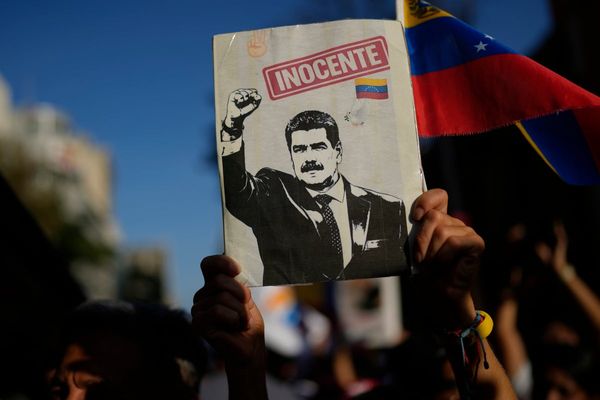
Banned ... Chairs with portraits of
Bin Laden and Mao by Shen Jingdong
have been banished to a
storeroom. Photograph: Jonathan Watts
Jonathan Watts reports from the Dashanzi International Art Festival.
There is an intriguing battle between the forces of commerce and politics in the Chinese art world, and Dashanzi is slap-bang in the middle.
Artists, curators and gallery owners generally hate talking about such worldly matters, but they are often caught between communism and capitalism, the authorities and the market, the pressure to obey and the pressure to sell. In a microcosm of Chinese society as a whole, the frontline between the two is constantly moving - creating confusion among censors and curators alike.
During this year's festival, so many politically sensitive pictures have been removed from view that they could form a separate exhibition all by themselves. Some were ordered down by the censors ahead of the opening, but several more pieces have suffered a similar fate since.
The Mobile Socialism exhibition at 798 Space now includes empty wall space recently occupied by Sheng Qi's painting of a tank on Tiananmen Square and Zhang Fangbai's spooky picture of an ectoplasmic Karl Marx about to be bashed by a worker with a mallet. One of these pieces was self-censored by the curator, the other ordered down by propaganda officials.
The censors have also revisited the Beijing New Art Project. Last month, Gao Qiang's portraits of Mao swimming in a blood-red Yangtze were deemed unacceptable. Yesterday, Shen Jingdong's set of chairs decorated with historical figures - Lenin, Stalin, Mao, Hitler and Bin Laden - had to be put back in storage.
Anticipating a prolonged backlash, at least one gallery cancelled plans for an exhibition of work about Tiananmen. Even the Timezone 8 bookshop has had to remove sensitive publications from the shelves after coming under official scrutiny.
To put this in perspective, the vast majority of work is left untouched. Some of it is extremely shocking. The White Space Gallery, for example, is showing a video by Hermann Nitsch of blood and entrails being poured over naked men and woman. That is non-political and foreign so it is permissible.
Much political work also remains on view. Artists and galleries cannot resist Mao and the Cultural Revolution. Even Tiananmen is increasingly tempting. Some tackle these subjects out of a sense of idealism, others from commercial instinct. Politics sells pictures, especially to foreign buyers who make up 80% of the market for contemporary art.
Which creates a headache for the poor censors in Dashanzi. The government has told them it wants to promote this district, which is at the forefront of China's efforts to improve its cultural trade deficit with the outside world. But they will not permit anything that threatens political order or social morals.
How to draw a line that keeps moving? That must be one of the toughest - and most inspiring - artistic challenges in the world today.