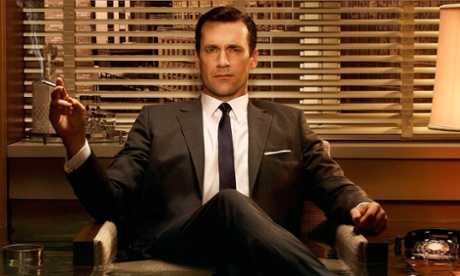
Mad Men, a show about ad guys trying to navigate a changing world, ends on Sunday in the US after a run marked by countless awards and think pieces about its cultural impact. As the season wraps up, antihero Don Draper has looked increasingly at odds with the world he helped create.
As TV networks pull out all the stops to impress advertisers, the real-life Madison Avenue that inspired the show is changing too, thanks in large part to Mad Men and other shows like it.
TV isn’t just about televisions any more. Most US homes used to get their TV via a cable package. You no longer need a cable TV package to watch Mad Men – or even a TV. Mad Men is available via Netflix as well as on the website of AMC and its cable channel. It is available via Amazon and iTunes.
With the rise of HBO and streaming services like Hulu Plus, Netflix and Amazon Prime, the US’s biggest cable operator, Comcast, now has more internet subscribers than cable TV subscribers.
It is a fundamental shift to a new world that will be recognised by anyone who has watched the music industry or, indeed, the news industry struggle with the rise of digital. The ad rates for online content are a fraction of those available on TV and advertisers are taking note. Can TV on a laptop, a tablet or a phone ever be as lucrative as it was on the box? It can certainly never be the same.

Network heads are telling advertisers that change is a good thing: the shift to a multi-screen world has resulted in more video hours being watched than ever before, and much of the popular content is daring, long-form storytelling of the kind Mad Men helped to pioneer.
Outside the reach of censors and schedulers, video programming has grown. It is now leaving the nest, with high-profile shows on nontraditional platforms, like Netflix’s Daredevil and Amazon Prime’s Transparent. For the first time, Game of Thrones is now available without a cable subscription.
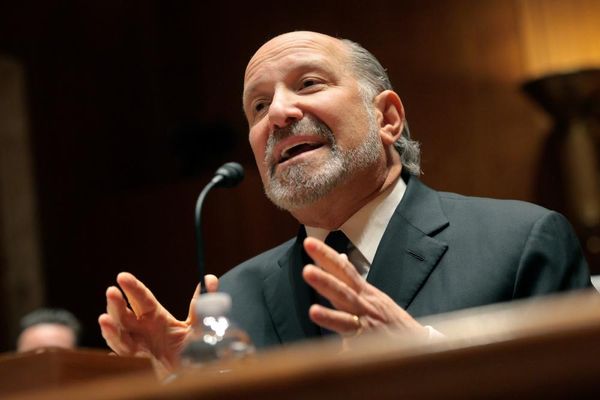
This has taken a bite out of ad-supported television. This week, the industry held its “upfront” presentations, where networks try to convince advertisers to gamble on autumn’s primetime shows. At ABC’s event, late-night host Jimmy Kimmel took the stage for a few minutes of industry-themed stand-up – and some of it hit close to home.
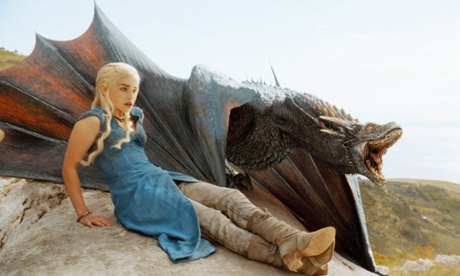
“Our competition isn’t NBC or CBS or Fox,” he told ad buyers. “It’s everything else. You have so many other places to spend your money now. And that sucks for us. We hate that. Now we have to compete with nipples and dragons.”
Networks have tried to entice advertisers to return with new slates of high-budget superhero thrillers, laugh-tracked comedies and police procedurals. But their problems run deeper than that. Fox bragged extensively at its presentation about the average 13 million people who watched each episode of its new hip-hop drama Empire. It’s a big show, but for comparison, in 1983 125 million people watched the series finale of M*A*S*H.
Last season Mad Men averaged 2.5 million viewers an episode; the YouTube video for Gangnam Style has been viewed more than 1bn times.
It may seem like apples and oranges, but advertisers have only so much grocery money to spend. The audience has fractured – the money will follow.
A public binge
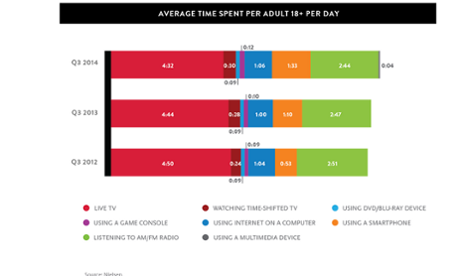
Data suggests that freed from the tyranny of the network schedule, the public has gone on a binge. In the third quarter of last year, according to the Nielsen Company, American adults consumed just under eight hours of video a day.
There’s a lot of overlap with people watching video while they’re watching video, scrolling through clips of makeup tips and talented cats on YouTube and Facebook while Mad Men plays on TV. And TV is the losing screen – people watched fewer minutes of television this year than last. Split into segments by platform, TV is about four and a half hours against Kimmel’s “everything else”.
Darcy Bowe, a vice-president at media agency Starcom USA, said TV networks expecting an increase in rates over last year were likely to be disappointed. Even Les Moonves, CBS’s famously pugnacious chief executive, merely said he expected “very nice” growth in ad rates this year, rather than announcing the network’s demands as he has in years past.
Last year, CBS’s asking price for a single ad on The Big Bang Theory was $344,827, principally because it boasted the highest live viewership of any regularly scheduled show on broadcast – an average of 5.85 million viewers in the coveted 18-49 demographic the year prior. Ads get sold in “CPMs” – “cost per mille”, or per thousand views – so advertisers, if they bought Big Bang at the sticker price, paid a CPM of about $20.21. On YouTube, the average CPM is $7.60.
Companies like Facebook and Google are much, much better at finding people who are likely to be influenced by advertising, and clients are taking heed: Nissan, McDonald’s … pick a traditional brand, they’re all spending on new media, and that money is coming from other budgets even as TV partners up with social media.
“There’s certainly value to TV, but why do you spend $65bn [on traditional TV ads] and not $45bn [and put the rest towards new markets]?” asked Rich Greenfield, an industry analyst with BTIG. “It’s why Facebook is so threatening [to TV] – they know everything about you.”
The fundamental problem is that TV networks need to spend exorbitantly on failure, and it’s getting worse, not better. One buyer groused that, in an effort to bring back viewers, execs were signing huge contracts with ever-more-popular celebrities.
“[W]e have to pay for something that’s only going to be a moderate hit no matter who you put in front of it,” the buyer said.
On broadcast, great shows tank regularly. Even when the networks spot talent like Judd Apatow and Joss Whedon, now among the most sought-after names in Hollywood, the possibility of flame-out remains high. Apatow’s Freaks and Geeks and Whedon’s Firefly were such ratings disasters neither of them ran a full season. In its lifetime, AMC had premiered 10 shows, some scripted, some unscripted, before it tried Mad Men.
It was ever thus. But the way that TV is made and the way it gets paid are changing faster than most TV people can cope with. There’s an ad-world adage that 50% of your advertising works – you just don’t know which 50%. Now, with much sharper data available, Bowe and her team are starting to figure out which 50% they’re making money on.
“The need for flexibility has been key over the past three or four years, and it’s becoming more and more critical,” she said.
The problem isn’t simply that while the creative side will always be an expensive hit-and-miss business, advertisers now have more choices and better metrics for measuring success. The traditional TV business isn’t moving fast enough to address the change, said Greenfield.
“Given the change in consumer behavior, why are brands continuing to buy at the same level and on the same metrics? I think we’ve reached a tipping point,” he said.
‘Adult Swim makes me think of country music and drugs!’
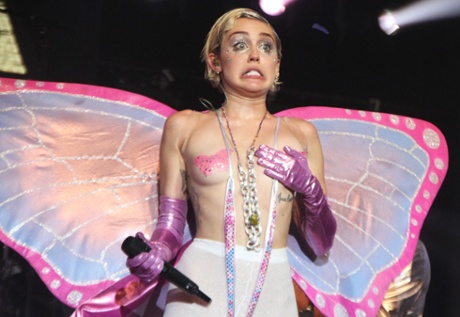
The upfronts are a chance for networks to fete valuable clients at glamorous parties. Presentations over the last few years have featured trapeze artists and fire-breathers (at the BBC America’s 2012 party), and live performances by everyone from Florence and the Machine (last year, A+E Networks) to Kanye West (at Adult Swim).
Trish Chuipek, president of the midwest region for ad agency OMD, was only in town from Chicago for a few days, but she made time for Adult Swim’s now-legendary late-night party, where, every year, a chart-topping artist who could pack out Madison Square Garden performs for upwards of two hours in a mid-sized venue on the West Side. This year’s star was Miley Cyrus.
The bash is thrown by one of the few networks left that can regularly attract young viewers, with a mix of Family Guy reruns and original shows by comedians and cartoonists who float between the art world, stand-up and advertising.
Adult Swim straddles the digital-cable divide with a modicum of success, unlike the majority of the networks on the dial. Some of that success is simple diversity: it makes computer games, has a popular YouTube channel and marathons old content on a website that requires a cable subscription.
“Adult Swim makes me think of country music and drugs!” yelled Cyrus, who, with Flaming Lips frontman Wayne Coyne, performed a set that included covers of Paul Simon, Led Zeppelin, Johnny Cash and the Beatles, along with a new song of her own. She wore gossamer butterfly wings, pink lamé 18-button gloves, glittery, butterfly-shaped pasties, and white leggings.
“You came to a fucking show with me dressed as a fucking butterfly and you’re not fucking high?” she asked the crowd. “This is Adult Swim, motherfuckers.”
Chuipek, decked out in a floor-length white dress alongside coworkers who had also dressed up for the occasion, said she agreed with Bowe’s concerns – flexibility continues to be an issue across the industry. But she was enjoying the party.
“They really know their audience!” she shouted over the din of pre-show music.
The room filled with smoke; ad executives and talent talked and flirted a few blocks away from Madison Avenue. One tall comedian – a guy called Eric Wareheim who (with his partner Tim Heidecker) has made ads for Old Spice and General Electric – towered over the rest of the audience. The network had renewed their strange, hilarious TV show, Tim & Eric’s Bedtime Stories.
Everything had changed, but most of it was the same. For now.