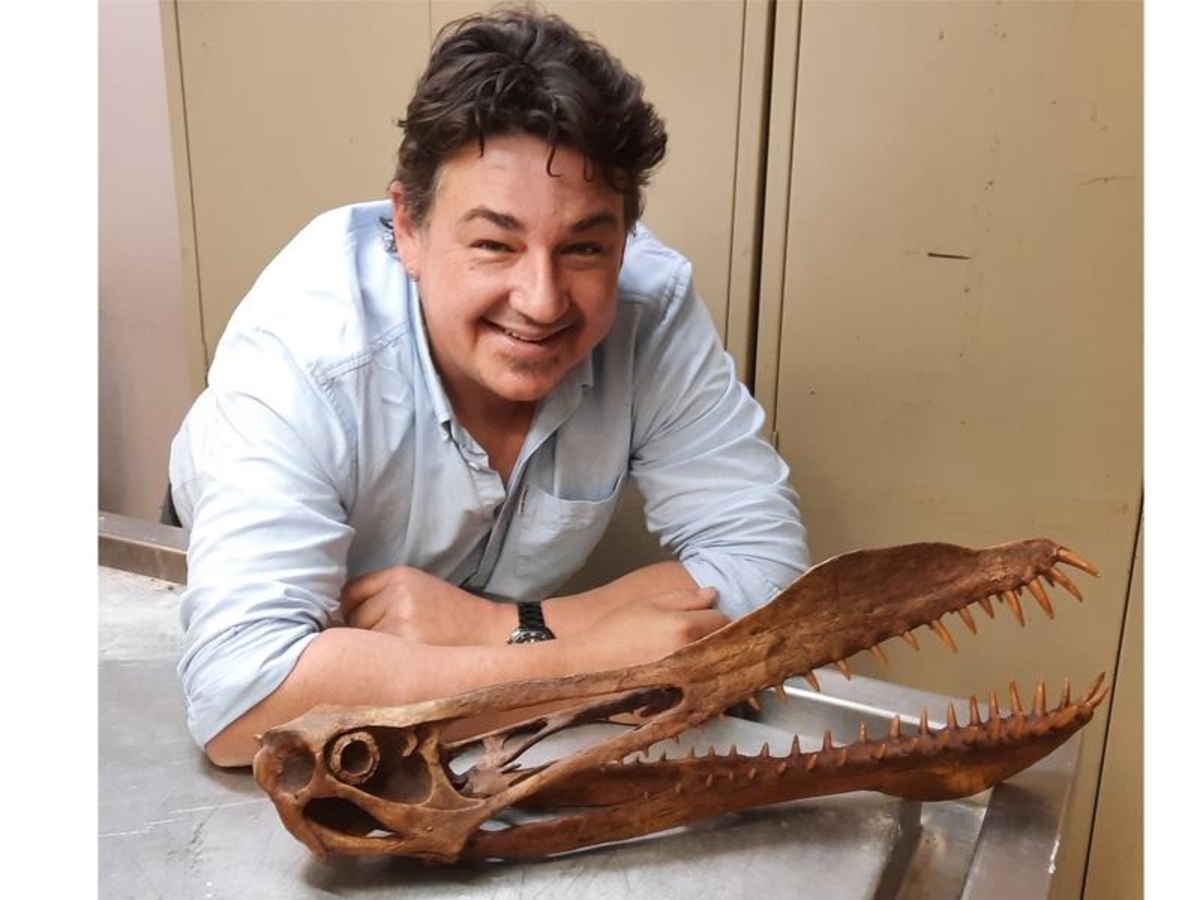
The skull of a dinosaur uncovered in northwest Queensland has been dubbed as the closest thing to a "real-life dragon" by scientists a decade after it was discovered.
Australia's largest flying reptile was found near Richmond, in north Queensland, and is a pterosaur that used to prey on fish known to inhabit the no-longer-existent Eromanga Sea 100 million years ago.
Named 'Thapunngaka shawi', this species of pterosaurs were known as successful and diverse reptiles and were the first back-boned animals to take a stab at powered flight, researchers say.
Tim Richards, from the Dinosaur Lab at the University of Queensland's school of biological sciences, led a research team that analysed a fossil of the creature's jaw, which contained around 40 teeth.
Mr Richards says the the skull alone would have been just over one metre long and the dinosaur had a wingspan of around seven metres.
"It's the closest thing we have to a real-life dragon," he said.
"It was essentially just a skull with a long neck, bolted on a pair of long wings.
"This thing would have been quite savage. It would have cast a great shadow over some quivering little dinosaurs who wouldn't have heard them coming until it was too late."
The new species belonged to a group of pterosaurs known as anhanguerians, which inhabited every continent during the latter part of the Age of Dinosaurs.
It is only the third species of anhanguerian pterosaur known from Australia, with all three species hailing from western Queensland.
Dr Steve Salisbury, co-author on the paper and Mr Richard's PhD supervisor, said what was particularly striking about this new species was the massive size of the bony crest on its lower jaw, which it presumably had on the upper jaw as well.
"These crests probably played a role in the flight dynamics of these creatures, and hopefully future research will deliver more definitive answers," Dr Salisbury said.
The fossil was found in a quarry just northwest of Richmond in June 2011 by local fossicker Len Shaw.
The name of the new species honours the First Nations peoples of the Richmond area where the fossil was found, incorporating words from the now-extinct language of the Wanamara Nation.