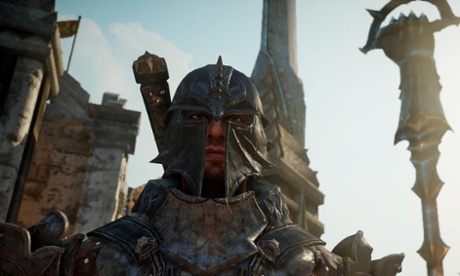
With its ambitious open-world environment and labyrinthine narrative, the newest title in Bioware’s respected role-playing adventure series was always going to be a major challenge. After four years in development, the game has attracted a strong critical response and plenty of attention amid the crowded Christmas release schedule.
To find out more about how such a huge game is developed in the modern industry, we spoke to creative director Mike Laidlaw who told us about the writing process – and the future of the series.
How does a quest make it into the game? Is there a Dragon Age historian who vets each new entry for content and references?
Kind of. We have an internal wiki which is divided into public knowledge, which has shipped, and the hidden knowledge stamped with an inquisition seal. The wiki will check your login and if you’re not in the writing team, or me, you can’t see it.
Every time we release a new game, the editing team – we keep four on staff – pile through it and that becomes our internal reference for names. The editors act as arbiters as they know the world inside and out, which is why they’re involved in the creation of The World of Thedas books we’re publishing with Dark Horse, of which volume two is due next year.
Also the writing team work as a unit, so they sit together and call out “has anybody done anything with this name?” and someone will remember. Plus, a lot of our team have been with us all the way back to Origins so they know it in their bones.
As with previous games, a huge part of the experience is talking to your party and getting to know them. But there’s an interesting innovation in Inquisition in that there’s no bar telling you how your party feel about things – you have to intuit it from their reactions to your decisions. What’s your thinking behind scrapping that gauge?
The presence of a bar to me implied there was a win/loss condition. It encouraged minimaxing thoughts. We still want to give the player cues because sometimes characters react to things off screen, and we want you to know if they approve or disapprove to get a sense of their changing moods. But this has moved from a bar of “you are warm with this person” to noticing how they greet you, whether they open up about their past or trust you enough to ask for help.
We also made the conscious decision when we were designing the characters to have them be more interactive with the core story. So their stories aren’t separate, instead it’s a case of “now we’ve done this ancient temple I feel conflicted about something and I need to pursue something triggered by that”.
With the bar, a player would reach a seeming milestone on it and be asking why a character isn’t talking to them or why there isn’t more content, because it wasn’t just driven by approval. Making it seem like a simplified mechanic when it’s actually far more complex seemed a little disingenuous or overly gamey. Now we make sure approval and game events work together. We put work into reactions: the difference between Sera saying “hey you!” or “what?” when you walk up to them is pretty clear. It adds a sense of reality.
In tandem with that, at times Inquisition feels like an online RPG with its open world of smaller side quests that feature very little interaction. You meet an NPC and he tells you he wants 10 pieces of ram meat. You go get it and return with little fuss, earning some XP. Do you feel there’s a balance between those two things in the game?
There is. Having small quests means you aren’t constantly under pressure to make massive decisions. And yet what we tried to do is tie those into the larger concepts of the inquisition, its power and the overall space. I’ve seen a fair number of people mention ram meat, thinking it’s the most classic fetch quest. But here’s the thing, completing that quest is part of a larger chain of quests, and if you complete all of those you can recruit a new agent who speeds up your time for all soldier operations on the war table.
I did not know that.
Yep. So making it part of a larger system, while it may seem very simple, an emergent sense of complexity comes out of that. If you never fetch the ram meat you never get to see that, and I’m okay with players potentially missing it, but I think the folks that do stumble across it are going to think it’s kinda cool.
Taking it beyond fetch quests, the Hinterlands or Storm Coast have themes running through them and you can explore those themes as part of a larger structure, even if the individual moments themselves are quite simple.
Do you have a particular quest you’re most fond of?
There’s a bunch of story beats I think are really cool. There’s one around the breach that is nice because it does a good job of making the villain more active than we’ve done in the past.
When it comes to side-quests, probably my favourite is the quest for Lord Woolsley. He is a ram kept by a farmer and he’s gone missing. A big part of Lord Woolsley’s charm is I’ve seen so many emergent things happen because he’s not what he seems. Once in a while a bear goes to attack him while you’re on your way to send him home, and calamity ensues. I find that hilarious. The best part is, as people stumbled across Lord Woolsley, his legend grew. Someone on the team would say “I had a bunch of bandits go after him” and so on. There are usually set predators and prey, but this has a rather different conclusion.
What do you see as the future for this series and RPGs more generally? Are you going to keep pushing towards emergent content, story-driven quests, or both?
We’re going to continue to explore the mixture. Dragon Age needs to have big story moments. It is a game about character first and the party is an absolutely central part of that. I want to keep pursuing interactivity with the world: taking crowds to the next level or having things catch fire because you indiscriminately cast a fireball into a wheat field. There’s an old D&D trope about how fireballs go off too fast so you can’t light things on fire, but it would be more satisfying if you could.
I want more environmental interaction and realistic systems you don’t have to tutorial, that are in the world for obvious reasons. If we can get there we’ll have a world that feels even more vibrant, living. That’s my next goal.
And is a sequel definitely happening?
At this point no, nothing is ever definite. That said, I’m never allowed to sit back and say “whatever man, I don’t even know”. Story wise, we’re looking at least two games ahead and gameplay wise I’m always looking at the horizon: where could we go next and what prototypes should we be doing? It doesn’t really matter if another game is coming or not. The thing that keeps a team moving is the thought that there is still unconquered land, mysteries waiting to be solved, for us as developers and for what we can deliver to players.