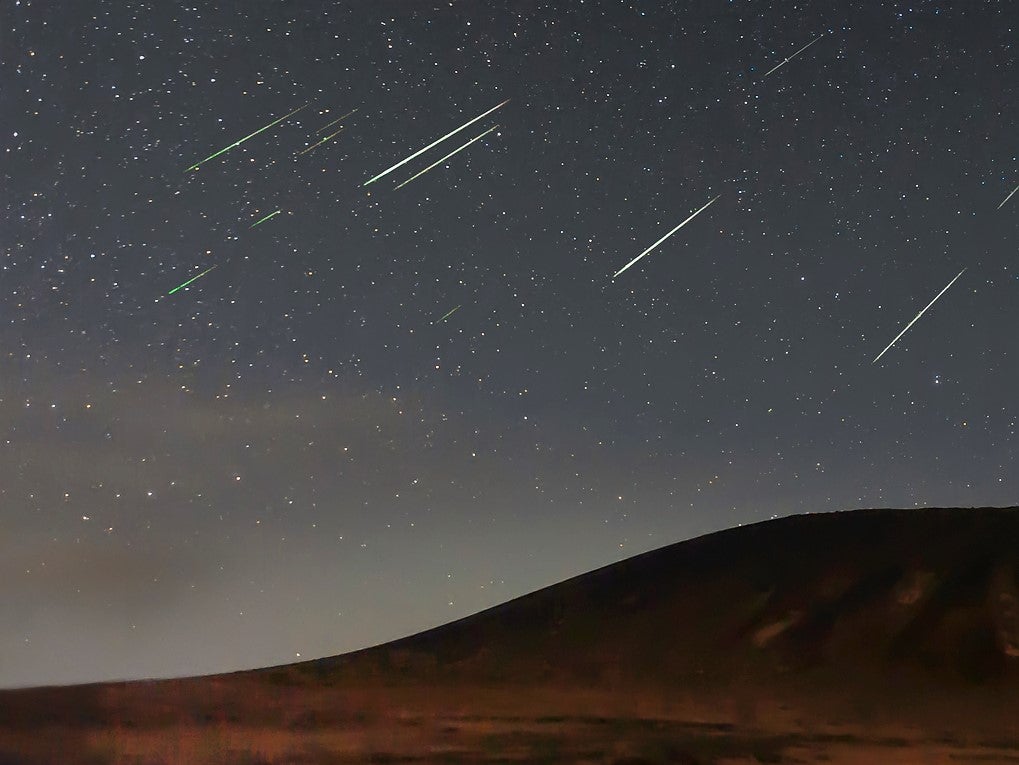
The Draconid meteor shower will peak on 7 October, offering skygazers the chance to see an unusually active display of the annual event.
Astronomers predict that up to five meteors will be visible per hour, with early evening being the best time to view them.
The meteors – commonly referred to as shooting stars – appear each year when Earth passes through the tail of the comet 21P/ Giacobini-Zinner.
The Draconids are named after the Draco the Dragon constellation from which they appear to radiate.
The strength of the meteor shower depends on how close Earth’s orbit is to the comet’s orbit in early October.
In 1933 and 1946, observers in Europe witnessed thousands of meteors each hour, while 2011 brought with it more than 600 per hour.
2020 will not see such a spectacular display, however astronomers at the American Meteor Society (AMS) said that it could be more active than usual.
“All potential observers with clear skies are encouraged to view the sky for potential Draconid activity around 7 October," wrote AMS member Robert Lunsford.
“These meteors are often faint so it would help to observe from rural areas where interfering lights are less of a problem. The more stars you can see, the more meteors you will witness.”

The best time to view them will be shortly after nightfall on Wednesday, though some meteors are expected to still be visible on 8 October.
Weather in the UK is forecast to be partly cloudy across large parts of the country on Wednesday evening, though skies over the East Midlands and North East should be clear.
This month will also see the arrival of the Orionid meteor shower, which takes place between 2 October and 7 November, peaking on 21 October.
At their peak, Nasa said to expect around 20 “prolonged explosions of light” per hour.
October also brings with it two full moons, with the Harvest Moon followed up by a rare Blue Moon on Halloween.