The Democratic Republic of the Congo (DRC) has rebuked the African Union (AU) over its calls to suspend the announcement of final results from its presidential elections, insisting that the Constitutional Court assessing the vote's legality was impartial.
The court is poised to rule on Friday on an appeal over the outcome of the December 30 vote to choose a successor to outgoing President Joseph Kabila, with runner-up Martin Fayulu claiming he was cheated of victory.
"The court is independent," government spokesman Lambert Mende said on Friday. "I don't think it is the business of the government or even of the African Union to tell the court what it should do."
At a summit in Addis Ababa, AU leaders announced late on Thursday that they would dispatch envoys to Kinshasa in a bid to end the crisis.
AU commission chief Moussa Faki Mahamat and Rwanda's President Paul Kagame, currently the AU chairman, are expected to fly in on Monday.
The summit also said there were "serious doubts" about the vote's provisional results.
They called for the announcement of the final results to be suspended - a matter currently in the hands of the Constitutional Court, which must issue a ruling ahead of the scheduled swearing-in of the next president on Tuesday.
"I don't know if there are countries where people can interfere like that in a legal procedure," said Mende.
"The court will do what is right for showing the truth. We should all trust it."
Appeal
On January 10, the electoral commission declared opposition leader Felix Tshisekedi provisional winner with 38.57 percent of the vote against Fayulu's 34.8 percent.
But Fayulu denounced the figures as an "electoral coup" forged by Tshisekedi and Kabila, and filed an appeal with the Constitutional Court a day later, claiming to have won 61 percent of the vote.
The Financial Times and other foreign media have reported seeing documents that confirm Fayulu as the winner.
"If the court declares Tshisekedi victor, the risk of isolation would be enormous and untenable for a country positioned right in the middle of the continent," wrote Adeline Van Houtte of the Economist Intelligence Unit on Twitter.
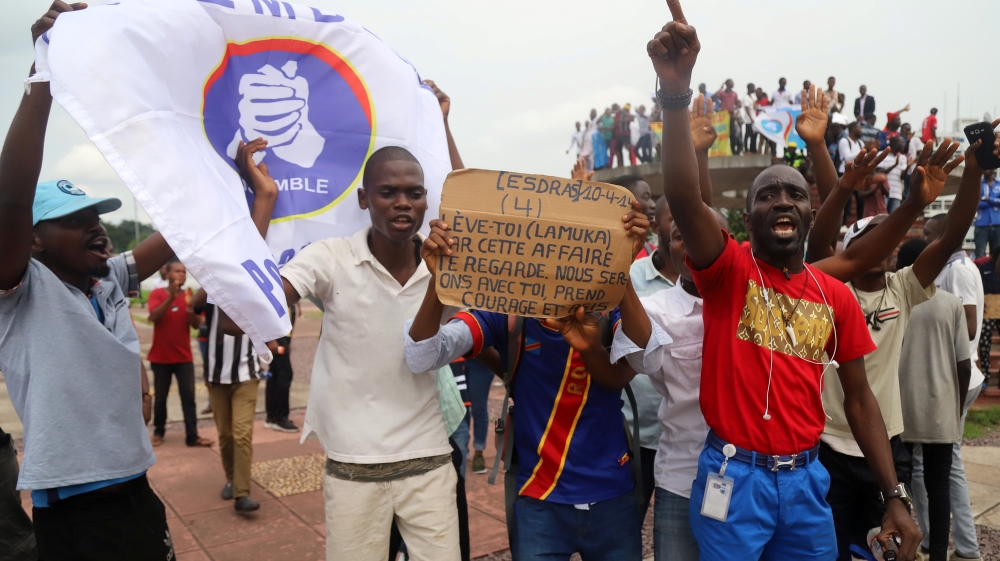
Fayulu's camp hailed the AU appeal for the final result to be put on hold, but Tshisekedi's entourage lashed it as "scandalous".
His lawyer and deputy chief of staff Peter Kazadi denounced the AU's appeal as having "no legal basis".
It was, he said, the result of maneuvering by "a small number of countries", which he did not name, and "shamed the institution" of the AU.
Mia Swart, research director of South Africa's Human Sciences Research Council told Al Jazeera that there is concern that the court will disregard the AU's calls to suspend the announcement.
"The constitutional court will most probably act in insulation or isolation from regional factors. The court has no history or track record of being independent," Swart said, adding that the judges were all appointed by Kabila.
"It seems even that even Martin Fayulu - the losing candidate who got the most votes by many accounts - that he was even uncooperative with the constitutional court process. It's unfortunate any which way you look at it. That court doesn't deserve the status it has."
Swart said that it's difficult to predict a positive outcome as it's highly unlikely that a recount will be ordered.
"Even if they order a recount it will be a manual recount... part of the problem is the primitive ways in which things are being done.
"There's been so many questions around credibility of these elections that the whole process is a complete mess. It's almost impossible to see that Kabila is going to yield to the demands of African Union," Swart said, adding that she expects many more weeks of "great instability".
Fears of violence
The dispute has raised fears that the political crisis that began when Kabila refused to step down at the end of his constitutional term in office two years ago, could turn into a bloodbath.
The vast and chronically unstable country lived through two regional wars in 1996-97 and 1998-2003, and the previous two elections, in 2006 and 2011, were marred by bloody clashes.
Since provisional results were released on January 10, at least 34 people have been killed, the United Nations said.
Its rights office in Congo also documented 59 people wounded along with 241 "arbitrary arrests".