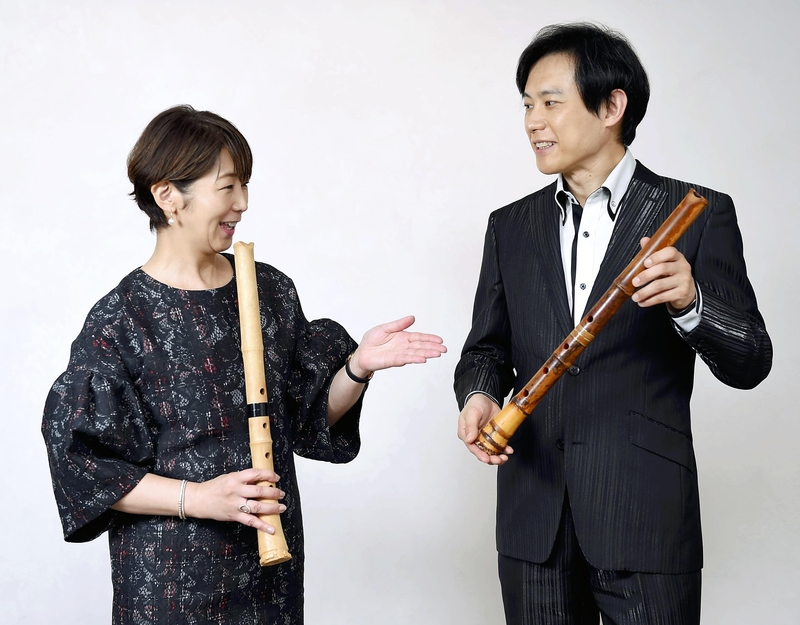
Shakuhachi bamboo flute player Dozan Fujiwara freely transcends different genres of music, from classics with traditional Japanese roots to pieces in modern styles aimed at the instrument's fusion with pop songs, Western classical music or other different types of music.
Fujiwara, who comes from Tokyo, graduated from the Tokyo University of the Arts department of traditional Japanese music and released his debut album "Uta" in 2001. He has performed with artists of various genres, such as the Steude Quartet, and provided music for theatrical productions, including a Super Kabuki II production starring kabuki actor Ichikawa Ennosuke.
A grand master of the Tozanryu Shakuhachi Foundation, he talked to The Yomiuri Shimbun about diverse topics, from characteristics of his instruments to his open views on music. The interviewer was TV announcer Miho Nakai.
Miho Nakai: The other day, I went to a concert by Kobudo (a trio featuring Fujiwara, cellist Nobuo Furukawa and pianist Takeshi Senoo). I really enjoyed the performance with such diversity on display-- jazz, classical, tango and original works by the three of you. I was surprised that a traditional Japanese instrument and Western instruments could be played together in beautiful harmony. How do you make arrangement for the music?
Dozan Fujiwara: With Kobudo, all three of us do [arrangements] because we all write scores.
N: You were playing many shakuhachi of different sizes. It felt really fresh when you played high notes like a flute.
F: In fact, the sound range of the shakuhachi is the same as that of the flute.
N: I see. What are the key technical points in playing the shakuhachi?
F: Breath, fingers and neck -- those three are the keys. You can change the tone of the sound by your breathing. You play a melody by fingering. And you change the pitch or add vibratos to the sound by moving your neck. A shakuhachi performance is constructed by a combination of these three.
(Fujiwara plays the same melody twice, each time with a different playing style.)
F: See? They are completely different, aren't they?
N: Hmm. I've got an image of a landscape sprawling behind the sound of your shakuhachi. Is it because of the color of the tone?
F: It could be. Shakuhachi has so many different tone colors, that's why it is an instrument that directly expresses the player's feelings.
N: Why did you start playing shakuhachi?
F: My grandmother was a "so" [or koto] player. That's why traditional Japanese music was familiar to me even when I was a child. When I started going to school, I got hooked on playing a recorder. I used to play anime songs and other music on the instrument on the way to and from school. Then I became interested in the shakuhachi and began taking lessons when I was 10. I was shocked at first because I couldn't make any sound at all.
N: You were taught by Hozan Yamamoto, who was a living national treasure.
F: That was when I was in the second year of junior high school. It was more like you must steal his art rather than learn it. Other students of his would meticulously analyze his playing method and teach it to me. Naturally, I also began studying the master's performances.
N: You became successful very early and released your first album while at a young age.
F: First of all, I put a lot of effort in encouraging people to get to know the charms of the shakuhachi. Although the instrument is not widely known, it is attached with less favorable images, such as a sound effect for period dramas on TV. I wanted to overturn them. Around the time I made my professional debut, I even deliberately played in un-shakuhachi-like tones.
N: You defied the boundary of classical repertoire from the beginning and adopted a wide range of musical elements.
F: To me, various kinds of music around me were on the same horizon: traditional Japanese music that surrounded my grandmother, jazz and rock music I listened to influenced by my parents, kayokyoku pop songs I heard on TV music shows, and so on. In any case, my teacher Hozan would often play with jazz musicians, so it came very natural to me to have exchanges with other genres.
N: Has there been any criticism that you don't pay enough attention to classical repertoire?
F: I think I'm allowed to be adventurous because I do work on classics properly by performing classical repertoires and training young players. Classical repertoires grow along with the thoughts of their successors through the times and become more and more expanded. The weight that comes with the expansion is their beauty as well.
N: You can understand that probably because you've been playing various kinds of music. In doing so, have you ever had an experience that's given you a particularly vivid impression?
F: That's probably when I played on a precipice with a safety rope around my body, as part of a TV project to record a performance taking advantage of the echoes of sounds in a rocky area.
N: You've recently formed a group called Fugachikuin with young players and are working on a shakuhachi-only ensemble.
F: That's something I was planning to do for a long time. My students have finally grown up, so it became possible for us to form the ensemble that I had in mind. That's why I went forward with the project.
There are things you can do only after you've had enough experiences and achieved certain things. I'd like to continue being eager in all my pursuits from now on, too.
Read more from The Japan News at https://japannews.yomiuri.co.jp/