I’d just been forced to take a buyout from my middle management position in a once-bustling Los Angeles newsroom. My girlfriend and I were splitting up after six years. I had no income and no home, so I took a vacation.
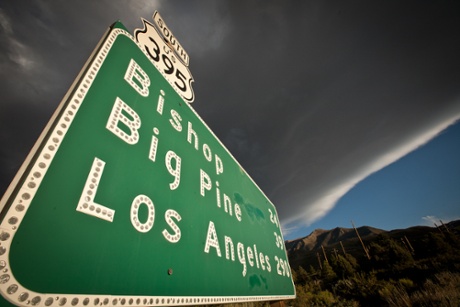
I followed a whisper halfway to Reno, to a little town on the eastern side of the Sierra Nevada. It was January, and the dry atmosphere charged my hair with static electricity. The cold mountain breeze was so delicious, I found myself gulping it down. I went back home, threw everything I owned into storage – except my cats, my bike, my snowboard, some books and my laptop – and moved to Bishop, a town of 3,500 people at 4,000 feet on the way to Mammoth Lakes, known only for Schat’s Bakkerÿ and the annual Mule Days celebration.
My plan was to stay a year. I found a job as a graphic artist at a pencil factory in town. It was pleasant enough, and with one-third of my former newsroom salary, I rented a 240-square-foot studio built on the back of a garage for $475 a month. I had a view of the White Mountains to the east, as well as a yard with a dog in it.
His name was Taro, a polite but protective blue merle Aussie, and he became my best friend. I took him everywhere, on long hikes ending with me having to bathe him with the garden hose as he shook off darts of freezing water.
At night I taught myself how to build websites. I’d been a journalist since 1989, the year the Los Angeles Herald-Examiner’s presses stopped spinning. So I’ve had to constantly reinvent myself to stay employable in a job market spoiled by scarcity and change.
Before the year was up, I’d left the pencil factory and was cobbling together a living walking dogs and introducing little town businesses to the internet. I became the de facto webmaster for homeless animals, maintaining sites for a rabbit rescue, the local animal shelter and a dog rescue, which were my first three clients.
Snow fell that first Christmas, and I spent it feasting at a neighbor’s house before taking their three dogs on a muddy, slushy romp along the canal.
At that time, I think I may have had the perfect, simple life. So I began another year in Bishop. I found other clients, including a business association of contractors and vendors that consisted of about 50 proud conservative plumbers, electricians and builders who were trying to keep their boat afloat in the high desert. Their logo was a simple line drawing of a construction worker in hardhat flexing his bicep, to which I added a tattoo of the American flag.
Bishop’s own stock is a flustered mix of conservatives and Native Paiute Indians, who own a casino in town. Some of the locals have decent jobs at the department of water and power, Cal Trans, or the school district. Lots of them like to fish in the Owens River or the miles of canals that channel increasingly precious snow melt down to Los Angeles. Because the LADWP owns all of the land, and thus the rights to its water, the landscape stays vacant like it is, covered in rabbit brush and cow patties and not much else.
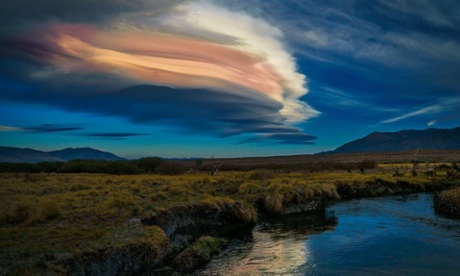
I developed the uncontrollable habit of raising both arms to the heavens each time I climbed a hill. From the surrounding peaks, you could see open space all around you in a palette of purples and greens, smelling of sage, Yosemite onion and lupine. Above, a weird cloud formation known as the “Sierra Wave.”
Maybe better than the sights were the sounds, or absence of them – no planes or traffic or (sadly for the contractors) construction, just red-winged mockingbirds and tanagers at dusk and dawn.
Aside such scenery, the town is not anything special: a few Mexican restaurants, a Christian BBQ called Holy Smoke, the country’s second-most expensive Vons, an old twin movie theater, a few stores and a few coffeehouses that cater to dirtbags (the nickname for the climbers who come from all over the world seeking the Eastern Sierra’s famous granite playgrounds). Mostly, people just drive through on their way to or from Mammoth or Yosemite, and they all stop at Schat’s.
My brother, a geologist and author of books on the Eastern Sierra, spends weeks there every year doing fieldwork, and I have wondered why it is I did not recognize at an early age that I should have been a scientist, too. Not just any scientist – an ornithologist, so I could study the pelicans that are sometimes aloft high over the Owens Valley floor. Whoever heard of a pelican in the desert? Why are they there?
I had lots of time to think about such things while hiking with Taro, and my days took on a nice rhythm that included running, fetching and playing.
Many times I heard a small knock on my door and answered to find someone with a handful of Bible literature to share with me. To spare myself the lecture one day, I just opened the door and said, “I’m gay.” A well-dressed man and woman stood there in astonishment, blushing. “You should go to the next house,” I told them. “Hurry now.” Comically, they did.
But several months later, that same man knocked again. He was in his 60s, balding with a slight moustache and sad eyes, but instead of a suit, this time he was wearing a T-shirt and jeans. I knew instantly what he had come to say. “I’m … in the closet,” he sputtered as I smiled at him through the screened door.
I went outside and we sat on the lawn while he told me his story. After his first sexual experience with another boy in his high school, he’d managed to live his whole life up to that very moment without telling a single person, including an ex-wife, that he was gay. I was thrilled to know that, besides myself and the guy at the salon who cut my hair, there was a third homosexual in town.
Socially, I fell in a little with the cool people, the climbers and mountain bikers and mountaineers – all transplants who got together every Tuesday night for family dinner night, a spectacular, moveable potluck feast that often took place in backyards around a fire pit. There were always handmade tortillas or homegrown vegetables, hand-stitched linen or homespun guitar. They all worked at the Eastern Sierra Land Trust or Friends of the Inyo – meaningful jobs that made me wonder why it is I did not recognize at an early age that I should have pursued a career in land conservation, too.
In my second year, I sold my TV and emptied my storage unit. By that time, I had completely stopped following the news. When I passed a newsstand, I averted my eyes, and nearly buckled at the knee when I accidentally saw a headline about nuclear meltdown in Japan.
I was no longer taking a break in a small mountain town; I was putting off reality. I was filtering information from the outside, and using Facebook to project a less isolated version of my life. I was actually becoming lonely, especially the night I drove into the high desert to watch a rare meteor shower by myself. I tracked Venus and Jupiter across the sky that whole summer, once walking the circumference of the town at 2am to take in as many stars as I could.
I met a woman who had worked hard for 15 years as a $400-an-hour attorney so she could retire early and spend the rest of her life living in Bishop and climbing every peak in the Eastern Sierra. I climbed two of them with her. I sometimes find myself wondering why I didn’t realize at an early age that I, too, should have been a highly paid attorney.
After another Christmas feast with my neighbors, I entered a third year, and decided to invest myself in a plot at the new Bishop Community Gardens at City Park. I was lucky enough to find a guy happy to rototill its hard, salty clay soil for free. One night, after an early frost bit the tomato crop, I collected all the green ones still on the vine and fried them up at family dinner night.
Before my fourth Christmas, I finally had to move back down to Los Angeles and get back in line. I loved Bishop, but there were just not enough jobs to go around.
For better or worse, my uneven career as a journalist has enabled me to go deep into other worlds, the same impulse that drove me to the backside of the Sierra. And one day, I am moving back there, getting my own dog and writing full time.
Until then, there are three perennial artichoke plants clinging to the salty soil at Bishop City Park that are my legacy.