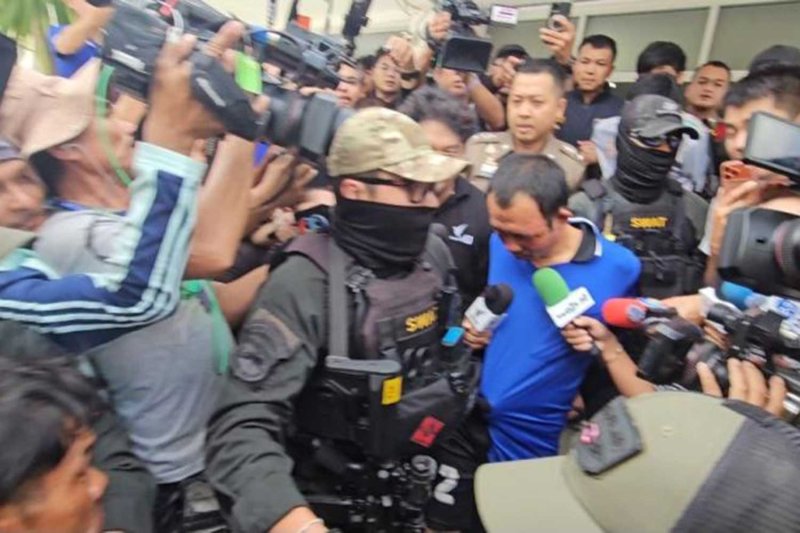
A series of grisly murders has reignited one of the country's most enduring and divisive public debates: whether the death penalty remains necessary to protect society or whether the justice system should instead focus on improving law enforcement, rehabilitation and post-release supervision.
The latest discussion follows the murders of two Russian siblings in Chon Buri, killed in a motorcycle robbery, and the subsequent discovery of another case involving the murder of three members of a Thai family.
The incidents have led to renewed public calls for capital punishment, particularly after it emerged that some suspects in recent high-profile crimes had previously served prison sentences before allegedly committing new violent offences. Although Thailand retains capital punishment in its criminal code for more than 50 serious offences, actual executions have been exceedingly rare.
The country has carried out only one execution over the past decade, while offenders convicted of serious crimes continue to receive sentence reductions, parole or royal pardons under existing legal procedures. Critics argue this has heightened public concern over repeat offenders and confidence in the justice system.
No prevention
Pol Lt Col Krisanaphong Poothakool, a criminologist and expert in criminal investigation, said the death penalty should not be viewed as a cure-all for violent crime. He acknowledged executions may satisfy society's demand for retribution and can temporarily deter would-be offenders.
However, decades of criminological research suggest the certainty and swiftness of arrest, prosecution and punishment are far more effective in preventing crime than the severity of punishment itself.
The larger problem, he said, lies in weak enforcement, inconsistent supervision of released offenders and insufficient coordination among state agencies. He pointed to the Prevention of Reoffending in Sexual and Violent Crime Act 2022, saying the law established an integrated framework for monitoring high-risk offenders but lacks a clearly designated lead agency responsible for undertaking supervision after inmates leave prison.
He suggested local administrative leaders, police and community authorities jointly monitor former inmates rather than relying solely on probation officers, whose resources are often stretched thin.
He also proposed using technology, including electronic monitoring devices for high-risk offenders and a nationwide digital database allowing authorities to track offenders who relocate after release.
While he believes capital punishment may still be appropriate in certain exceptional cases, Pol Lt Col Krisanaphong cited Singapore and Japan as examples where public safety stems not merely from retaining the death penalty but from efficient policing, urban management and consistent law enforcement.
He also proposed creating an independent review committee comprising representatives from the Justice Ministry, Interior Ministry, police, prosecutors, psychologists and human rights advocates to assess whether death-row inmates should be eligible to petition for royal clemency before such requests reach the monarch.

Senator Angkhana Neelapaijit, a former member of the National Human Rights Commission, argued that human rights principles require equal protection of life for victims, suspects and convicted offenders alike. She said many countries have abolished capital punishment partly because of concerns over judicial errors and wrongful convictions.
Although Thailand still retains the death penalty, it is widely regarded internationally as a de facto abolitionist state because executions have become extremely infrequent.
Thailand's last execution took place in 2018 after a nine-year hiatus. Since then, no executions have been carried out.
Ms Angkhana said public frustration often stems less from the existence of the death penalty than from widespread perceptions that dangerous offenders receive sentence reductions and are released too early.
She suggested authorities study alternatives such as life imprisonment without parole for the most serious crimes. However, she acknowledged that overcrowded prisons have prompted successive governments to pursue measures reducing inmate populations, including treating some drug users as patients rather than criminals.
She also highlighted chronic manpower shortages among probation officers, particularly in provincial offices, making effective supervision of released offenders difficult.
Rather than focusing exclusively on executions whenever shocking crimes occur, Ms Angkhana urged society to examine weaknesses throughout the criminal justice system--from police investigations and court procedures to corrections and rehabilitation.
She said Thailand continues to receive recommendations from the United Nations during periodic human rights reviews calling for abolition of capital punishment, although successive governments have not amended the law accordingly.

Pol Maj Gen Cherngron Rimphadee, deputy commissioner of the Immigration Bureau and a respected police academic, said public concern today centres less on the legal existence of capital punishment than on repeat offending by violent criminals released from prison. He said the Criminal Code provides five categories of criminal punishment: death, imprisonment, detention, fines and confiscation of assets.
Rising recidivism
Death sentences undergo multiple levels of judicial review, including automatic appellate consideration even when defendants do not appeal. Courts may also commute sentences under specified mitigating circumstances.
The more troubling issue, Pol Maj Gen Cherngron said, is the country's persistently high rate of recidivism. Department of Corrections data says nearly one-third of released inmates reoffend within three years.
The recorded rates were 31.91% for inmates released in 2019, 32.00% in 2020, 27.06% in 2021, a record-high 33.77% in 2022, 30.59% in 2023 and 20.64% in 2024. "Every percentage point represents innocent victims and grieving families," he said.
As of 2026, there are 480 inmates facing death sentences, including 419 men and 61 women. Most remain in the appeals process, while only 28 inmates have exhausted all legal avenues and are under final death sentences. Pol Maj Gen Cherngron cited several notorious cases in which offenders originally sentenced to death or life imprisonment later secured reduced sentences before committing new murders after release.
These include serial killer Somkid Pumpuang, widely known as "Kid the Ripper", and other convicted murderers whose subsequent crimes intensified public criticism of sentence reductions and rehabilitation policies. He questioned whether rehabilitation programmes genuinely reform violent offenders or whether society fails to provide adequate opportunities after release.
At the same time, he argued that while human rights discussions rightly focus on offenders' rights, victims and their families permanently lose their own fundamental right to life. "The question society must answer," he said, "is whose rights deserve greater protection".
Beyond capital punishment
The renewed debate illustrates that the heavy discussion over the death penalty extends well beyond the simple question of whether executions should resume. Supporters believe capital punishment remains an appropriate response to the most heinous crimes and serves justice for victims' families. Opponents counter that no evidence conclusively proves executions reduce violent crime and warn that irreversible punishment carries the risk of wrongful convictions.
Yet despite their differing views, criminologists, police experts and human rights advocates interviewed for the report converge on one critical point: the effectiveness of the criminal justice system ultimately depends on more than the death penalty itself.
Prompt investigations, professional policing, reliable prosecution, meaningful rehabilitation, close supervision of released offenders and effective use of technology all play essential roles in preventing repeat offences and protecting the public. As the country once again confronts public outrage following horrific crimes, the debate is increasingly shifting from whether the country should execute more offenders to whether its justice system can prevent dangerous criminals from causing tragedies.