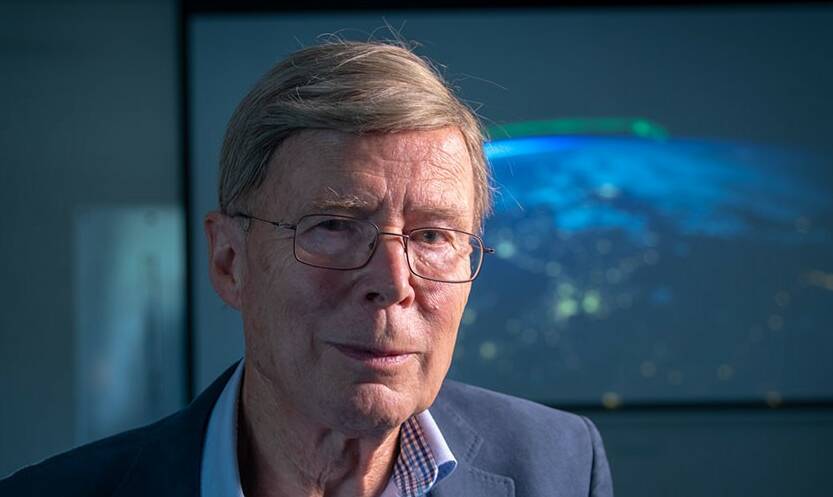
Professor Kurt Lambeck is quietly proud that he has been awarded Australia's highest honour. "I'm pleased about it," the ANU scientist said of his new appointment as a Companion of the Order of Australia.
"It's a recognition of a lot of work. I hope it will be seen as a recognition of the importance of science."
But despite a stellar career as one of the world's top scientists, he retains a modesty: "I'm not going to jump over the moon. I'm too old for that," the 79-year-old said.
Were he not so modest, he would have much to shout about. On top of getting AC after his name, he had already been made a Chevalier of the Order of the Légion d'Honneur, France's highest honour. He is also a Knight of the Order of Merit of the Italian Republic.
In Australia, Professor Lambeck also won the Prime Minister's Prize for Science.
For more than four decades, he has researched how the Earth has changed over millennia. Some of his work led to accurate planning for space missions. His research also underpins the GPS technology on which vehicles, from space craft, to tanks, to the family car, rely for accurate navigation.
Sometimes he uses brilliant but simple ideas - like studying Roman fish tanks on the coast of Italy to work out how sea level has altered since they were constructed.
The ponds had to be exactly placed - too high and the fish wouldn't swim in at high tide; too low and the fish would swim out easily even at low tide. They show where the sea level was in Roman times.
His calculations show that the rise of sea level has been relatively recent - since humans have been burning fossil fuels like coal and oil - and that is "consistent with what we understand about global warming", Professor Lambeck said.
If the level of the oceans had been rising consistently for the whole 2,000 years, the fish ponds would by now be much deeper under water than they are.
Kurt Lambeck arrived in Australia with his parents and three siblings just after the war. They had been in the Dutch resistance to the Nazi occupiers of Holland and left for a new life.
His journey of discovery started at university when he studied surveying at the University of New South Wales and then at Oxford University in Britain where he studied space geodesy (the exact measuring of the Earth using satellites). This was in 1967 when the space race was under way.
He said he was not a glittering student in high school in Wollongong but then realised in university that there were questions that simply didn't have answers. That fired his imagination and his desire to learn.
Professor Lambeck started at the ANU in 1977, rising to become Director of the Research School of Earth Sciences and President of the Australian Academy of Science.
He has worked for periods in Europe, particularly France where he was Professor at the University of Paris. He has also worked at the Smithsonian and Harvard Observatories in the United States. He has also worked in Belgium, Britain, Canada, France, Netherlands, Norway and Sweden.
MORE HONOURS:
- Departing DFAT boss among droves of women honoured
- Peta Credlin, the accidental political warrior, lands Queen's Birthday honour
- More than a game: Stuart's legacy honoured on the Queen's birthday
- Australians marvel at honours recipients Hemsworth, archbishop
- Canberra doctor recognised for sacrificing fees to build hospital
- Stephanie Copus-Campbell recognised for work in PNG
- Queen's Birthday Honours for Canberra scientists
- AM for Harriet Elvin, champion of our 'creative city'
- OAM honour for league's legendary 'Brick with Eyes' prop
- 'I was part of a team': public service medals bring achievements into the limelight
- Gallantry award for corporal who led heroic rescue in 'extreme danger'
- Activist's non-linear journey reaps rewards
- Astronomer sees virus as small blip in the universe
- AM appointee calls for funding boost for drug and alcohol services
- Bombings' lessons for AFP analyst
- Record rate of women in Queen's honours
- Australians share in Queen's honours
- Leading melanoma researcher appointed AO
- Disaster recovery pioneer awarded OAM
- Tough but rewarding time as top woman cop