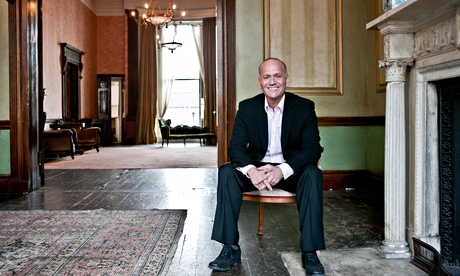
Midway through Dragons’ Den’s twelfth series, Doug Richard, the first Dragon to leave the show, is busy preparing for the new school year. Nestled in the west wing of Somerset House and with a focus on sharing best practice, School for Startups is a far cry from the competitive, entrepreneurial microcosm that flung the investor into the spotlight in 2005.
Richard failed to successfully invest in the second series – “it’s such a terrible thing this, I did try, they just didn’t take my money” – and quit the show: “I got bored. An investment fund was my next big thing.” It was 2008, the beginning of the downturn and Richard says he decided to give something back.
Rebelling against the notion you can’t teach entrepreneurship, Richard “had the observation that many people think that entrepreneurship is some sort of magic, that you had to be born an entrepreneur or something”.
“My own experience had been that I’d seen people from every walk of life, of every age, of every description, of every level of academic ability and some people not even very smart all become quite successful at business,” he explains.
Teaching entrepreneurship drives up confidence and the knowledge to be more successful, according to Richard, and has some “lovely other consequences” too. “People aspire to greater things. They end up with businesses with greater potential. And they’re more likely to go out and do it.” The school now provides curriculum, consultancy and runs programs around the world.
It aims to offer an holistic understanding of business that Richard says is distorted by shows like Dragons’ Den and the Apprentice: “I think Dragons’ Den is both truth and fiction. The truth in it is very hard to get release stage money. I think the problem with Dragons’ Den is it sends two messages that are probably simply not true. One message it sends is that you start your business by raising money. But you don’t actually. And the other is that you’ve won when you raise the money.”
Richard adds: “So much happens before and so much happens after that it makes that moment seem like it’s the moment and it’s not. It’s like on the X-Factor they go ‘If I don’t get this now, I’ll never be a singer’. Well actually 99% of singers don’t go through the X Factor, do they? Well guess what? 99% of entrepreneurs don’t go through the Dragons’ Den.”
Most people are not as angry and as dark as Lord Sugar
Richard is even more critical of the Apprentice: “The problem is that it [business life] is just not like that. Most people are not as angry and as dark as Lord Sugar.”
“Unfortunately, I think it [the Apprentice] represents all the worst in business. It’s not the way I run my company. It’s not the way I treat my staff. It’s not the way I expect an entrepreneur to act.”
Richard adds: “At the same time, the conflict in my mind is this. If somebody can do well at the tasks that Alan Sugar presents them, doing well at some of those tasks are not bad indicia of being a successful entrepreneur but doing so at the same time as you stab someone else in the back is pure TV and nothing else.
“And that’s a problem because I think we’re clouding what could be a lovely message, which is, it takes persistence, and initiative and creativity,” he concludes. Nevertheless, Richard confesses to watching the show with his son, if only because they get “great joy yelling at the TV”.
Discussing the commonalities between entrepreneurs around the globe, the Californian adds that he was “bewildered” by the behaviour of Brits when he first moved to the UK: “The things people said didn’t seem to line up with what I thought they meant. The British are polite to a fault and I don’t mean that as a compliment.”
But all is not lost. Innovate UK (formerly the Technology Strategy Board) has been establishing a network of ‘catapults’ over the last twelve months. Spearheaded by the Cambridge venture capitalist Hermann Hauser and modelled on the German Fraunhofer Institutes, the catapults, specialising in the future of cities, a connected digital economy and renewable energies among much more, aim to translate raw research into valuable innovation.
The notion that ‘I’m an internet business and I’m not’. Give me a break!
Richard says that while they might sound obscure “these are actually key entities because all of a sudden we’ve got these engines of commercially viable, quite intense businesses and companies, manufacturing, high value manufacturing, process industries, digital industries and these are potentially huge EVA”. “You have to look to the future. I think that this is going to be tremendously impactful.”
The internet’s capacity to carry innovation forward cost-effectively is key in Richard’s mind. Writing a government programme on Web Fuelled Businesses, he went through every stage of business life to find out how it could be improved using online services. “The notion that ‘I’m an internet business and I’m not’. Give me a break! I don’t care if you’re a small store or a guy with a handcart or you’re trying to run a multi-national. Focus on every single element of your business and say ‘how could the internet change that?’ It’s a fascinating exercise.”
Richard adds: “You have to stop asking the questions, ‘how do I get them to me?’ and start asking the question ‘how can I be where they are?’”
Looking ahead, the angel investor is awash with optimism about the possibilities that the internet can offer young enterprises: “The words of business are now changing. 20 years ago I didn’t use the words collaborate, partner. These days I seem to be using them all the time. Because the web creates weird levels of deep connectivity with no marginal cost.”
He adds: “You can be small and global now in a way that you never could have been 20 years ago.”
To get weekly news analysis, job alerts and event notifications direct to your inbox, sign up free for Media Network membership.
All Guardian Media Network content is editorially independent except for pieces labelled ‘Advertisement feature’. Find out more here.