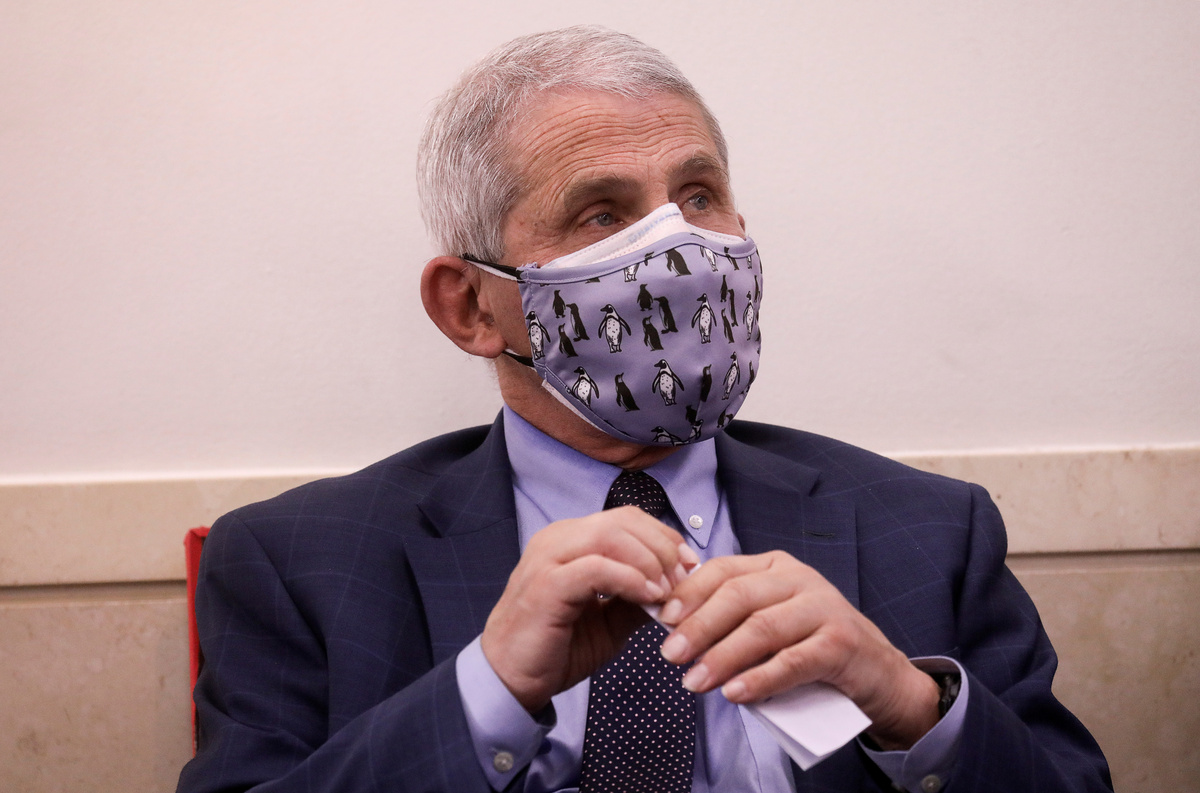
Making sure a mask fits snugly on the face and use of two masks is likely to significantly reduce a person's exposure to the coronavirus, laboratory experiments described by U.S. health officials on Wednesday showed.
The U.S. Centers of Disease Control and Prevention (CDC) in January conducted experiments to see how well wearing a cloth mask over a three-ply medical procedure mask, and knotting the ear loops of a surgical mask and then tucking the excess material close to the face, protects against COVID-19.
They found that both these methods helped reduce the exposure to potentially infected aerosols by more than 90% in laboratory simulations.
The data also showed that wearing a mask helped reduce exposure to aerosol particles that were the size of droplets that spread COVID-19, when compared to wearing no mask at all.
The experiments highlight that "masks work, and they work best when they have a good fit and are worn correctly," CDC Director Rochelle Walensky told reporters.
Walesnky added that re-useable devices known as mask-fitters were also an option to improve a mask's fit.
Results from one experiment demonstrated that the un-knotted medical procedure mask alone blocked 42.0% of the particles from a simulated cough, and the cloth mask alone blocked 44.3%.
The double mask combination blocked 92.5% of the cough particles.
In another experiment, the CDC tried to simulate the spread of COVID-19 during breathing when one or both people are properly masked. In the first scenario with only the source of the aerosols wearing a mask, they found coronavirus exposure was reduced by 82.2% when double-masking, and 62.9% with a snug fitting, knotted and tucked surgical mask.
When the source and receiver of simulated breathing aerosols were both fitted with double masks, or knotted and tucked medical masks, the exposure of the receiver was reduced 96.4% and 95.9%, respectively, the experiments found.
With more highly contagious virus variants circulating, CDC medical officer John Brooks told the Washington Post, "whatever we can do to improve the fit of a mask to make it work better, the faster we can end this pandemic.”
(Reporting by Manas Mishra in Bengaluru; Editing by Bill Berkrot)