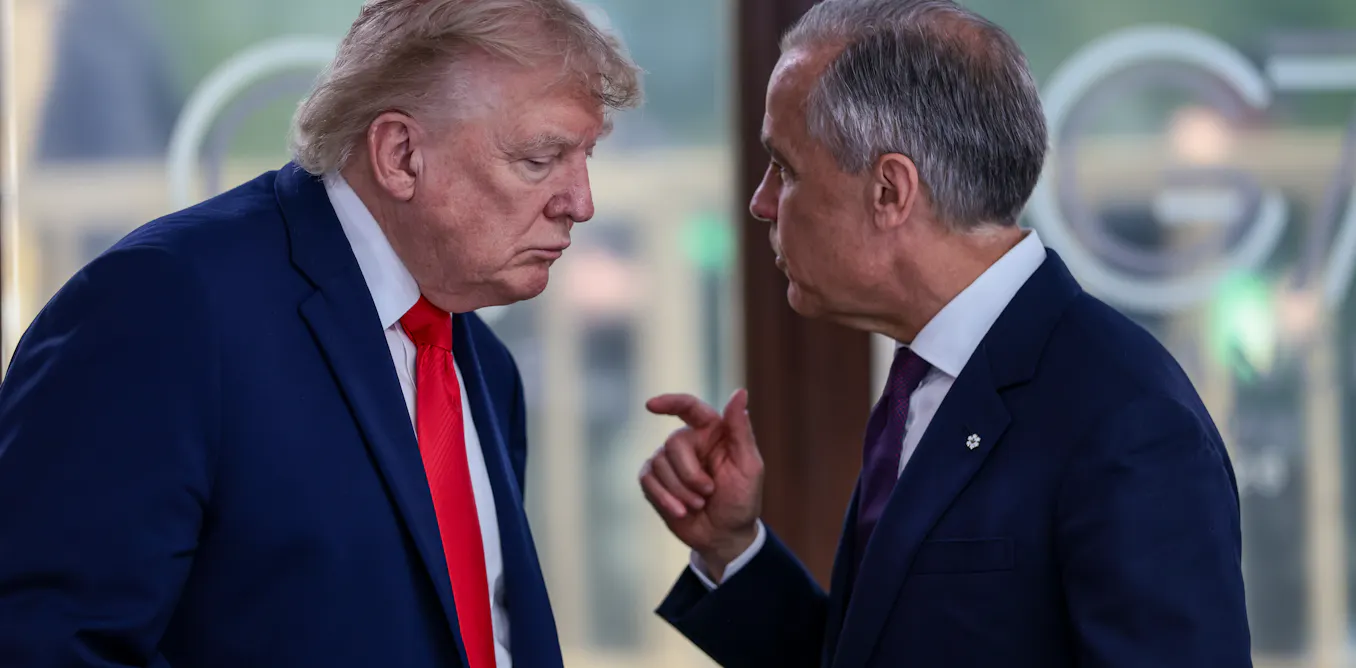
Donald Trump’s administration has announced plans for fresh tariffs on hundreds of Canadian goods. Covering close to $28 billion in goods, and with none of the exemptions previously covered under the Canada-United States-Mexico Agreement (CUSMA), the new tariffs are a clear escalation in the American president’s beef with Canada.
This move has reignited calls for Prime Minister Mark Carney’s government to strike a deal with the United States to end the ongoing trade war. Some are even calling for Canada to offer more concessions if it will help secure a trade deal.
The problem, however, is that Trump’s deals don’t amount to much.
The issue is not that Trump’s deals are typically short on detail — though they are. Nor is the issue that they contain vague and ambiguous language — though they do. Nor is it that they have tenuous relationship to law — none of Trump’s trade deals during his second term have been ratified by U.S. Congress.
The problem is that Trump himself never feels constrained by any deal he makes.
Countries that sign deals with the Trump administration are quickly finding out that the stability and certainty they hoped to purchase was an illusion.
A tenuous deal with the EU
Last summer, the U.S. and the European Union reached what was called the Turnberry deal after months of conflict over trade. As part of the deal, the EU would accept a punishing U.S. tariff of 15 per cent and commit to purchasing hundreds of billions in American goods and energy.
Despite this, European Commission President Ursula von der Leyen praised the deal as delivering “stability and predictability.”
That stability was short-lived. Months later, Trump aggressively pushed for the annexation of Greenland and threatened new tariffs on EU members who opposed him. Only after EU members mulled activating the Anti-Coercion Instrument — more colloquially known as the “trade bazooka” — did Trump back off.
Read more: As Trump’s threats over Greenland escalate, will Europe use its ‘trade bazooka’?
During the U.S. war with Iran, Trump singled out European allies he perceived as unhelpful. Spain, in particular, was targeted by the president as he threatened to “cut off all trade.”
More recently, Trump has threatened fresh tariffs after the EU imposed a $1 billion fine on Google for violating EU law. If the Trump administration follows through on its threats, it could spell the death of the Turnberry deal.
A 24-hour deal
The U.S. and Saudi Arabia also recently announced a landmark civilian nuclear agreement. The deal would have expanded co-operation on nuclear power and allowed Saudi Arabia to construct its own domestic nuclear enrichment facility.
The morning after the deal was announced, however, Trump changed key details.
Saudi Arabia would have to join the Abraham Accords — a series of joint agreements brokered by the U.S. between Israel and several nations: the United Arab Emirates, Bahrain, Morocco and Sudan — and normalize its relations with Israel. The Saudis have refused in the absence of a guaranteed path to Palestinian statehood. Trump also denied the agreement would include nuclear enrichment.
One Democratic senator, Chris Van Hollen, slammed the deal as a last-minute “bait-and-switch” attempt on the Saudis.
Violating Iran ceasefire deal
In mid-June, Iran and the U.S. signed a memorandum of understanding for a temporary ceasefire in the war. The memorandum itself, however, was deeply flawed with vague and ambiguous passages and virtually none of the monitoring and dispute resolution mechanisms typical of modern ceasefire agreements.
Who exactly bears responsibility for the collapse of the ceasefire will determined by historians. What is clear, however, is that Trump began violating the agreement almost immediately.
Read more: Iran ceasefire was always going to break – here’s why
The first article of the memorandum states that the parties will “refrain from the threat or use of force against each other.” On June 21, just days after signing the deal, Trump posted on his Truth Social account threatening to “hit Iran very hard again, just like we did last week, only harder!!!”.
The Gordie Howe Bridge shakedown
After long delays, the Gordie Howe Bridge linking Windsor and Detroit was supposed to open on June 12, 2026. Under the original agreement, Canada would finance the construction costs and the toll revenue would be split 50/50 between Canada and the U.S. after Canada recouped the initial construction costs.
Citing “unfair trade practices,” the Trump administration intervened at the last moment and blocked the opening of the bridge. Holding the $6.4 billion bridge hostage, the Trump officials leveraged a new agreement, one in which the U.S. will now receive 50 per cent of “net bridge and crossing related revenues” for 15 years. The result is that it will take Canada longer to recoup its initial construction costs.
What’s in a deal?
International deals typically evoke a specific image: dense agreements spanning hundreds of pages, painstakingly negotiated over years by diplomats, trade specialists and lawyers. These binding treaties are backed by domestic and international law, carrying severe reputational consequences for non-compliance.
It’s precisely these features that make a deal a key source of confidence, certainty and stability — not just for today, but for years to come.
The Trump administration provides none of that. Any sense of binding obligation can be wiped away with a few choice words on Truth Social. This is true regardless of whether the deal was signed by Trump personally or simply inherited from his predecessors.
Canadians rightly want an end to the exhausting melodrama of the last 18 months. And a grand bargain with the U.S. offers the alluring promise of a reset in the relationship.
But they should always remember that for the Trump administration, a deal is generally not worth the paper it’s written on.
This article was originally published on The Conversation. Read the original article.