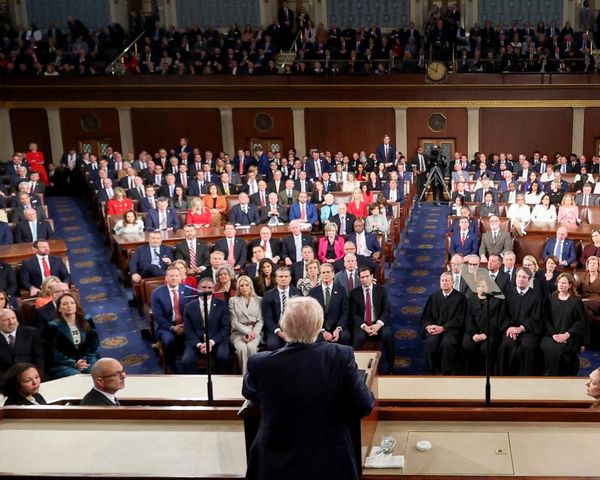

Donald Trump has declared a national emergency and promised to roll out large scale coronavirus testing after criticism that not enough was being done.
The US president made the dramatic decree in order to “unleash the full power of the federal government”, including $US50billion ($80 million) to fight the virus.
It comes as the World Health Organisation warned Europe was the “new epicentre” of the global pandemic, with more reported cases and deaths than the rest of the world combined, apart from China.
“More cases are now being reported every day than were reported in China at the height of its epidemic,” said WHO director-general Tedros Adhanom Ghebreyesus.
Mr Trump will give emergency powers to Secretary of Health and Human Services Alex Azar to waive federal regulations and laws so doctors and hospitals have “flexibility” in treating patients.
He also announced a new public-private partnership to expand coronavirus testing capabilities following criticism his administration was too slow in making the test available.
The partnership will include drive-through testing in some locations and an online portal to screen those seeking to get tested.
Nations have begun ramping up measures to contain further spread of the pandemic, including placing bans on large public gatherings and closing schools.
Australia on Friday advised against mass gatherings of more than 500 people which will apply from Monday after a number of high-profile events were cancelled, including the Australian Grand Prix.
Spain has declared a state of emergency while the UK has postponed local elections for a year.
The Canadian parliament has been suspended for more than a month after Prime Minister Justin Trudeau’s wife tested positive, forcing the leader into self-isolation.
Australia’s own Home Affairs minister Peter Dutton tested positive on Friday after a trip to the US in which he met Ivanka Trump and government officials before returning to Australia and meeting with Scott Morrison and cabinet members.
Australia’s Home Affairs minister Peter Dutton has tested positive. This picture was taken seven days ago in Washington. Meeting Ivanka Trump and US Attorney General William Barr #coronavirus pic.twitter.com/S8oDpnPOhV
— Nick Bryant (@NickBryantNY) March 13, 2020
Mr Dutton spent several hours behind closed doors with the prime minister and federal cabinet on Tuesday and also spent time with several state premiers and senior ministers.
However the prime minister and others who came into contact with the infected MP will not have to undergo testing or self-isolation according to medical advice.
So if Peter Dutton was at Tuesday’s full cabinet meeting, and the fund-raising dinner that evening, will all cabinet members busters have to self isolate?
And Scott Morrison shook the hands of all the premiers today, them too?— Malcolm Farr (@farrm51) March 13, 2020
- Related: How the prime minister dodged a virus test
- Related: Peter Dutton tests positive for coronavirus
- Related: Australia bans mass gatherings of more than 500
Trump targets virus testing
US officials and lawmakers have been struggling to get a sense of how many people in the country have contracted the virus, which they attributed to low testing rates.
So far 1268 people in the USA have tested positive and 33 died.
The country’s testing regime hit the spotlight after a top American health official said the system was “really not geared for what we need right now”.
Since January just over 11,000 tests have been performed in America compared to about 20,000 per day in South Korea.
Mr Trump criticised the Centers for Disease Control and Prevention, one of the US organisations leading the fight against the deadly infection, for having a testing system that he said would “always be inadequate and slow for a large scale pandemic”.
COVID-19 around the world
Italy’s new infections soared by more than 2500 and virus-related deaths increased by 250, their biggest single day jump.
On Friday, the country reached 17,600 confirmed cases and 1266 deaths.
Tens of millions of students on three continents face weeks without classes.
New infections also rose sharply in Spain and the government put 60,000 people in four towns on a mandatory lockdown on Friday.
Spanish Prime Minister Pedro Sanchez announced a two-week state of emergency beginning on Saturday and pledged to “mobilise all resources,” including military, to contain the country’s sharp rise in coronavirus cases.
In China, where new infections have tailed off, authorities mobilised to prevent a boomerang effect, quarantining new arrivals for 14 days.
But the intensifying spread of COVID-19 beyond Asia dashed any hopes for containing the virus, despite drastic curbs on travel and social events.
-with AAP