WASHINGTON _ By now, you've heard that a populist demagogue whose nativist agenda was supported by the alt-right and other white nationalist forces will be the next president.
And your next thought might've been: "What?"
With so many "isms" associated with supporters of President-elect Donald Trump, it's time for a refresher class on the ideologies and historical references that crop up most often in analysis of the incoming administration.
Do the labels fit? Decide for yourself after reading the dictionary definitions, which in some cases are bolstered by the works of historians, sociologists, journalists and political scientists. Where noted, input from advocacy groups is included.
White nationalism and the 'alt-right'
White nationalists espouse white supremacist or separatist ideologies, often focusing on the alleged inferiority of nonwhites, according to a basic definition by the Southern Poverty Law Center, a group that tracks extremist groups. The Ku Klux Klan, neo-Confederates and racist skinheads could be described as white nationalist.
The same goes for the so-called "alt-right," a movement that holds white ethno-nationalism as a fundamental value. Hate-group monitors say the term "alt-right" is a euphemism for what they've dubbed "suit-and-tie racists."
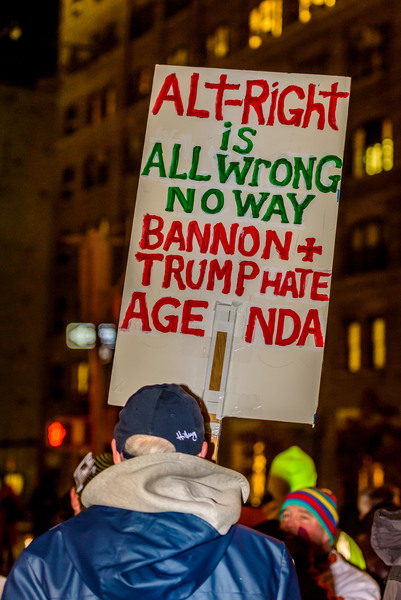
Steve Bannon, the former Breitbart executive who was named Trump's chief strategist in the White House, has described Breitbart as a platform for the alt-right. The movement's leading figure, Richard Spencer, made ripples with a Trump victory party in Washington last week where guests were filmed giving Nazi salutes. In an interview with The New York Times, Trump disavowed the alt-right movement, but critics accuse him of helping to bring the racist underground into the mainstream.
Fascism
This is a right-wing belief system that calls for a totalitarian, one-party state in rejection of the idea of liberal democracy. It emerged in early 20th-century Europe, originating in Italy during World War I.
Under a fascist regime, the state is led by a strongman-style leader whose goal is to keep the country orderly and stable by quashing dissent and mobilizing the masses under a single banner. Adherents reject the idea that violence is automatically negative; fascists argue that it can be used to bolster national security and achieve national rejuvenation.
Robert Paxton, a leading authority on the history of fascism, offered a mixed review to Slate when asked whether Trump is fascist. Paxton said Trump displayed some traits consistent with a fascist leader: invoking ethnic stereotypes, exploiting a fear of foreigners, hyping a narrative of a nation in serious decline and exhibiting a jaw-jutting bluster so pronounced that "he even looks like Mussolini."
However, Paxton stressed, there are also ways in which Trump diverges from fascism. For one, he and the Republican Party in general celebrate individualism; fascism opposes it. Also, Paxton said, the circumstances of Trump's rise are totally different from those preceding fascism's heyday, when Germany had been defeated and Italy was on the brink of civil war.
Populism
While most often associated with conservatives today, the original definition of a populist was simply a believer in the rights, wisdom or virtues of the common people. Politically, a populist candidate claims to represent the common people.
Historians say populism dates to Andrew Jackson but entered a modern era about 50 years ago with the rise of Alabama Gov. George Wallace, the notorious segregationist who carried five Southern states when he ran for president under the American Independent Party in 1968. Former White House adviser Pat Buchanan and the televangelist Pat Robertson both sought the presidency as conservative populists, but failed to win Electoral College votes.
Critiques of Trump call his style "authoritarian populism," which one commentator explained as "a cultural backlash in Western societies against long-term, ongoing social change." Another reading is that Trump's populism has broadened the Republican Party, attracting new voters by breaking from old conservative GOP stances. As Politico noted in a piece that cast Trump as "the perfect populist" for these times, the president-elect is indifferent to issues of sexual orientation and has defended Social Security, universal health care and economic nationalist trade policies.
Demagoguery
One dictionary definition of a demagogue is "a political leader who tries to get support by making false claims and promises, and using arguments based on emotion rather than reason."
Demagoguery has gone hand in hand with democracy since Ancient Greece, when the charismatic Cleon persuaded his fellow Athenians to slaughter every man in a rebellious city. Aristotle would write of Cleon: "He was the first who shouted on the public platform, who used abusive language and who spoke with his cloak girt around him, while all the others used to speak in proper dress and manner."
Demagogues are back in the news these days, thanks not only to Trump but also to an emerging class of combative, break-the-rules populists such as Rodrigo Duterte of the Philippines and Geert Wilders of the Netherlands.
While some of the other labels for Trump are hotly debated, there's little argument that he engaged in demagoguery during his campaign. He gave outlandish promises, made hyperbolic threats against real or perceived enemies, used false statistics about crime and traded in fear and blame with his rhetoric against foreigners and Muslims. The speech Trump gave as he accepted the Republican nomination for president, a Washington Post columnist said, "officially secured his place as one of the most capable demagogues the country has ever seen."
In recent interviews, Trump walked back on some of those statements, including threats to jail his campaign opponent, Hillary Clinton, and to deport 11 million migrants in the country illegally.
Hate groups
A hate group is an organized group or movement that advocates and practices hatred, hostility or violence toward members of a race, ethnicity, nation, religion, gender, gender identity, sexual orientation or any other designated sector of society.
According to the Southern Poverty Law Center, which monitors racist organizations, there were 892 active hate groups in the United States in 2015, mostly white racist and neo-Nazi factions such as the KKK, but also around 180 black separatist groups, including the New Black Panther Party.
Hate-group trackers and prominent politicians _ Democrats and Republicans alike _ have warned of the implications of Trump's popularity among white extremist movements. A Huffington Post piece before the election cautioned that Trump was "winning the support of America's most prominent white supremacists and neo-Nazis _ and in so doing, reviving dark forces in American politics that had become increasingly marginal in recent decades."
Trump and his surrogates have shrugged off his popularity among hate group as an issue exaggerated by the news media. He's disavowed such groups, typically after coming under pressure to do so.
Nativism
Nativism, in general, refers to a policy that favors the interests of the native population of a country over those of immigrants. In U.S. history, nativist movements coincided with 19th-century European immigration to the United States _ there was a strong anti-Roman-Catholic strain _ as well as with the arrival of Chinese immigrants on the West Coast. The most famous American nativist group was the Know-Nothing Party of the late 1800s. The KKK also espouses nativist beliefs.
Trump is widely described as nativist for his immigration stances _ ruling out legal status for immigrants here illegally and proposing a wall on the border with Mexico _ as well as his ideas for a ban on Muslim visitors and a stop to refugee resettlement.