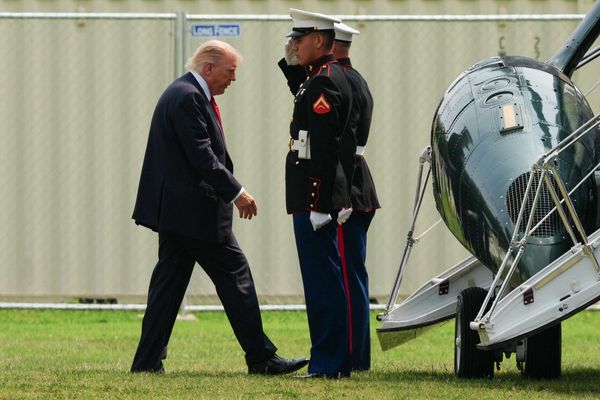
The timing, as they politely put it in diplomatic circles, is sub-optimal. The King of the Falkland Islands, Charles III, and his consort Queen Camilla will visit Washington on Monday, to be greeted by a number of people who, we discover from a Pentagon leak, don’t actually think he should be the King of the Falkland Islands at all.
After almost two hundred years of settlement and a clear British right to sovereignty, His Majesty’s distant realm and his loyal subjects would, it seems, be at threat from American pressure to cede the territory to Argentina. How the Foreign, Commonwealth and Development Office must dread the president of the United States making one of his famous wisecracks about how he’s seriously considering developing a nice new Trump International golf resort on the Islas Malvinas once they’re under the control of his friend and ideological soulmate president, Javier Milei.
The threat to side with Argentina in the long-running dispute over sovereignty is a typically Trumpian act, driven purely by what might be termed misguided spite, tragically ahistorical, contrary to American national interests and deeply ironic. It is a bizarre idea – but, then again, no more crazed than Mr Trump’s ambition to invade Greenland, part of Denmark, or annex Canada – both supposedly Nato allies. Given their geographical location and under the “Donroe Doctrine”, perhaps President Trump might fancy the Falklands and their fabled oil reserves for himself?
The decision to reassess US diplomatic support for longstanding European “imperial possessions”, such as the Falkland Islands, and to suspend Spain’s membership of what is left of the Western alliance comes after Nato allies declined to join in the US-Israeli war on Iran, which was both illegal and lacked any coherent strategic aims, let alone a plan to achieve them.
It was America’s war of choice, far outside Nato’s theatre – but partners might have considered assisting, as they did after 9/11, if the US had been attacked, under Nato’s binding obligations as a defensive pact. In this case, America was the aggressor, and seems still to contemplate committing war crimes – bombing civilian infrastructure.
The UK is not therefore bound unconditionally to send forces to assist in the Persian Gulf – just as, as it happens, neither was the US when British territories in the South Atlantic were subject to unprovoked attack by Argentina in 1982. The US Navy, the celebrated Seals, the feared 82nd Airborne and the rest were not involved in liberating the islands. But no one expected them to be.
As a matter of fact, US support for British sovereignty over the Falklands has always been equivocal. In 1982, the Reagan administration tried its best to prevent a war between two valued allies over what appeared to some to be trivial pieces of rocky land, inhabited mostly by penguins. In the early stages of Argentine occupation, in the four weeks before the British task force arrived in the South Atlantic, the US state department tried to force a flawed UN peace agreement on the Thatcher government. Fortunately, the Argentine junta then rejected that deal, and war was inevitable.
Ultimately, the British forces liberated the islands and saved their people from oppression with considerable bravery. There was some critical assistance from the US in intelligence sharing, but that was under the Five Eyes security arrangements and not a Nato function as such. The US was not entirely wholeheartedly there for Britain when it was in distress.
Sadly, UK-US relations have deteriorated so badly in recent months that even intelligence cooperation is now strained. But it would be under even greater pressure if it were suspected that the Americans were helping the Argentinians to plot another attempt at forcibly acquiring the islands. That is a horrifying prospect, but nothing can be ruled out where this erratic, unreliable White House is concerned.
President Trump is closer to Milei than to Starmer – and, for that matter, closer than Ronald Reagan was to Margaret Thatcher. The diplomatic shift to a more anti-British and pro-Argentine attitude is more plausible in this present era, when personal diplomacy is the way Mr Trump prefers to do things.
The irony in this revived American hostility towards vestigial European “imperial” possessions would logically require the US to back Mauritian claims to Diego Garcia, part of the “imperial” British Indian Ocean Territory. If, as Mr Trump said, it would be “stupid” for the British to cede the island’s sovereignty to Mauritius, then it is equally foolish for the US to force the British to do so.
With luck, the punishment beatings for Spain, the United Kingdom and others will be quietly dropped, not least because of their embarrassing impracticality. Nations cannot be suspended or expelled from Nato by another member; US bases in European allies’ territory are essential for America to project its power; and the UK and France each have a veto at the UN.
Argentina has greater problems with its economy and military than Britain, and can’t afford another war, given that the Falklands are better defended now. But it all leaves a nasty residue of distrust and resentment. The risk that it will rather spoil the royal visit and offend their majesties might just make Mr Trump think again.
I think Keir Starmer would give away the Falklands in a heartbeat
The King and Queen go to America… what’s the worst that could happen?
Prince Harry really wants you to remember Ukraine – and Prince Harry
Loathe Trump if you want, but if he loses to Iran it will be a catastrophe
Prisoners should not be housed in unsanitary death traps
The buck stops on Keir Starmer’s desk for the mistake of appointing Mandelson