Household chores are something that people often don't enjoy doing. But a robot may soon liberate you from tidying up your messy home.
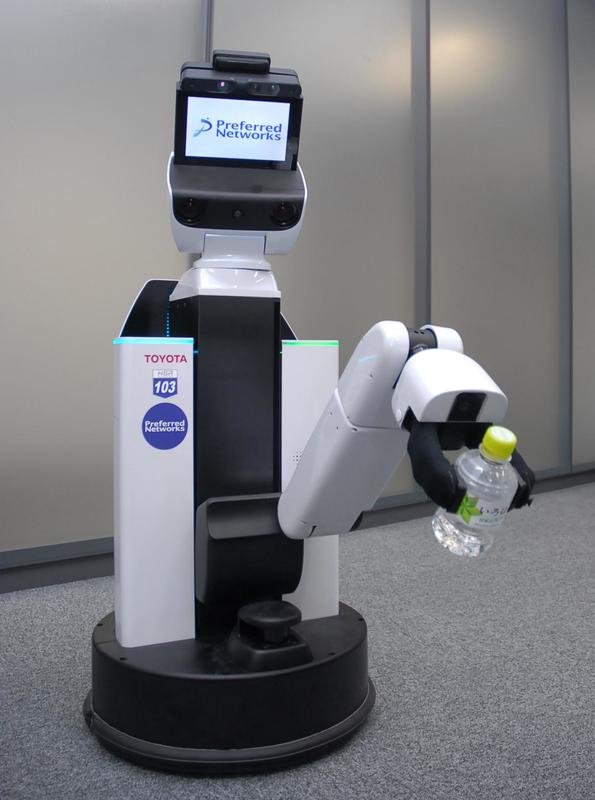
Preferred Networks, Inc., a Tokyo-based start-up, has developed a new system that enables a robot to collect things and put them in the right place, meaning you could have a pair of socks picked up and dropped into the laundry basket.
The system, called Autonomous Tidying-up Robot System, can distinguish 200 different items such as pens, toys and towels and allocate them to 12 different locations. The technology, showcased at the Combined Exhibition of Advanced Technologies Japan 2018 (CEATEC) held in Makuhari, Chiba Prefecture, in October, won the semi-grand prix of Industries/Markets category of the event that featured information technology and home electronics.
According to Preferred Networks, it added its original technology to Human Support Robot (HSR), a cylindrical robot with an arm that can pick up and move items, technology that Toyota Motor Corp. developed.
While HSR, which weighs 37 kilograms and and has a height that ranges from 1 meter to 1.35 meters, needs somebody to control it using a tablet device, the prize-winning system can pick things up and put them away without human control. It can also respond to verbal instructions and finger-pointing gestures. People can later learn where the items have been stored. "That is because the robot can remember such details," said Jun Hatori, an engineer from Preferred Networks.
According to Hatori, the company applied deep learning -- a machine learning technique that teaches computers through examples -- among other technologies to enhance the system, training it to identify items and understand verbal orders.
Moreover, it equipped the robot with capabilities to pick up and hold a variety of household items even if it is encountering something it has never seen before. "This function came as a breakthrough during the process," Hatori said, declining to elaborate further, citing trade secrets.
The new system also enables the robot to move faster, taking about 30 to 60 seconds to pick up an item and put it elsewhere, whereas it took several minutes at an early phase of development.
Hatori said the company, established in 2014, which works on projects related to deep learning, focused on tidying, since the activity included all of the necessary skills to do household chores.
"A robot needs to move around, recognize and hold things when tidying," said Hatori. "Without robots completing these functions, we will never be able to get to the point of having domestic robots cook and clean."
The 34-year-old engineer said his company seeks to distribute the basic software to developers by 2020 and implement it for practical use within five years.
Hatori said the system shown at CEATEC was programmed for the event and there should be more research carried out to have the robots cater to the orders of different households.
Hatori said robots will be able to gather information about households in the future.
"There will be a day when the robot will find out that you're running out of toilet paper and order it for you," he said.
Read more from The Japan News at https://japannews.yomiuri.co.jp/