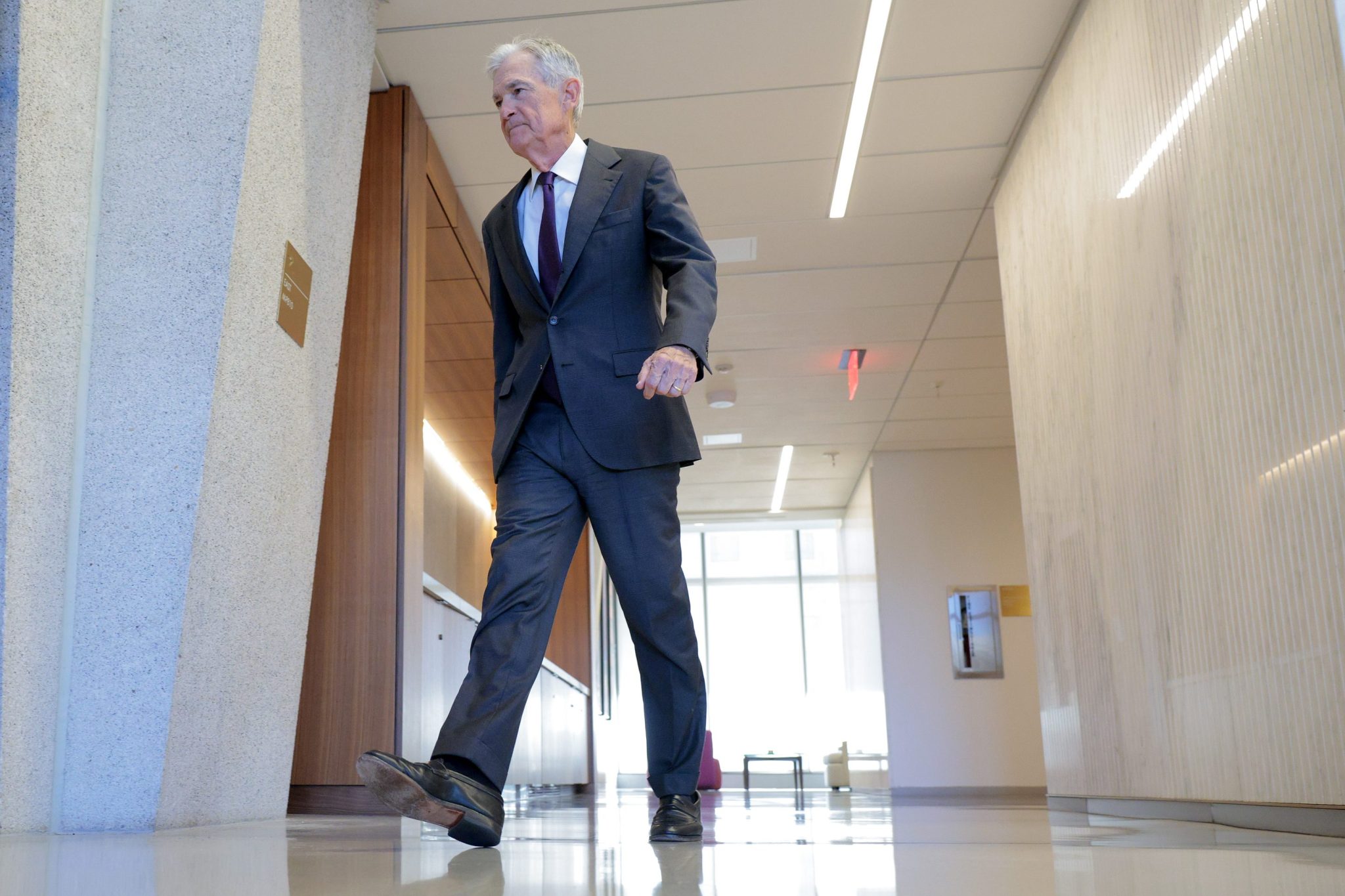
Here we go again. It’s Federal Open Market Committee (FOMC) meeting week, and Chair Jerome Powell is likely to once again disappoint the White House by announcing a hold to the base interest rate.
How fierce the reaction from the Oval Office will be is anyone’s guess, but markets are fairly convinced that the two-day conference concluding tomorrow will result in the interest rate being held steady in the range of 3.5% to 3.75%. Per CME’s FedWatch barometer, there’s a only a 2.8% likelihood of a cut tomorrow, even by the smallest increment of 25 basis points.
But while investors have reached a general consensus on the outcome of this week’s deliberations, they’re not quite so in line on the fiscal path for the rest of the year. Many economists, for some time now, have been expecting 2026 to be the year of further easing.
Their reasoning points to a weakening labor market and relatively low pass-through thus far from the White House’s tariff regime. In addition, Chair Powell will be replaced in the spring by a candidate nominated by President Trump, who has already said he wants a dovish individual at the head of the Fed.
Dissenters to that narrative include investment bank Macquarie, where North America economists David Doyle and Chinara Azizova see the Fed’s next move as a hike to the base rate—potentially in the final quarter of this year.
“Underpinning this is our belief that the labor market is improving, and that unemployment will decline ahead on a trend basis,” the duo wrote in a note seen by Fortune this week. “A key risk to this view is the potential for an incoming Fed chair to sway the committee in a more dovish direction. However, we believe this risk is mitigated by a potential shift in the new chair’s incentives once they assume the role.”
Their view is bolstered by the idea that the Fed may have reached the point of “normalization” of the base rate. In the years following the pandemic, America’s base rate rocketed as high as 5.5% to bring rampant inflation under control. So began the question of how the Fed would “land the plane” and bring down price rises without plunging the economy into a recession—a task in which it was successful.
However, because the years before the pandemic had seen the base rate at around 0.25%, speculators widely expected interest to trend down back toward pre-pandemic levels and even out around the 2% mark.
Questions are now mounting as to the damage that the exceptionally low rate caused, and whether the neutral rate should be a little higher. As the duo wrote: “The continued strength of the U.S. economy and ongoing inflation above the 2% target raises the prospect that the neutral rate may be higher than many at the Fed previously believed. This could be a topic that the chair addresses in his press conference.”
Consensus view
More widely, analysts are expecting the base rate to track downward this year. Goldman Sachs’ David Mericle, for example, wrote to clients this week that he had penciled in a 25 bps cut in June, followed by a final cut in September to within a range of 3% to 3.25%.
He caveated: “Further cuts will be less urgent if the labor market stabilizes, as we expect, and it will likely take a while for inflation to fall enough to create a strong consensus on the FOMC to cut again.”
Meanwhile, over at Bank of America, analysts Mark Cabana, Aditya Bhave, and Alex Cohen wrote that while Powell was likely to return to his “wait and see” approach; they didn’t see that resulting in a hike down the line.
“The labor market is soft, and inflation is elevated. Both are stable, so the balance of risks has not changed,” they noted. “With policy now much closer to the Fed’s assessment of neutral, there is no hurry to act. Especially because the economy is about to get hit with a large dose of fiscal stimulus.”
On a hike—either in relation to inflation spiking or the labor market picking up—they added this would be the “biggest surprise,” adding: “We doubt the FOMC seeks that optionality at present.”