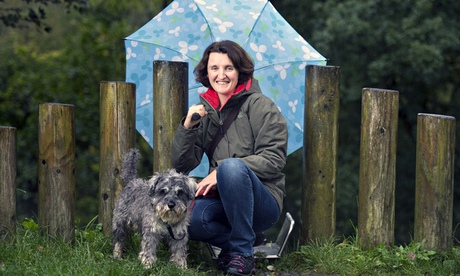
I’ve always been a creature of habit, walking the same walks, working on my laptop in the same cafes. But this summer I decided to mix it up and part of this involved taking my dog, a miniature schnauzer called Henry, to different parks and beaches. I met a new social circle of dog-walkers, all asking the usual questions while our pets sniffed and chased each other: “What breed is he? “How old?” “Do you live nearby?” Then, three times in the past month: “Do you have a family?”
This is a weighty question and yet is asked by strangers so easily, so lightly.
“Yes, I live with my partner and Henry,” I said.
The response, each time, was “Oh.” Accompanied by a perplexed look.
The people I was speaking to weren’t inquiring about a partner or a dog. They were asking if I had children.
Standing on the beach, I felt a twinge of the loss I experience when I remember that I’ll never be a mother. The conversation faltered, perhaps due to the expression on my face or the fact that my answer hadn’t produced any common ground.
“Well, better get a move on.”
“Me too,” I said.
They didn’t mean any harm. It’s just one of those hackneyed questions we all ask, like “What do you do for a living?” and “Where are you from?” It’s a way to bridge a gap. The trouble is, asking about someone’s job is not the same as asking if they have a family. I’m thinking of a friend who lost her baby late in the pregnancy. I’m thinking of friends who were unable to conceive. I know a couple whose child was stillborn and a couple desperate to meet a child at the end of a long adoption process.
Then there’s me, trying to make peace with my own choices. I avoided making a decision about whether or not to have a baby until my late 30s because, as a gay woman, I couldn’t decide on the best route: a donor through a clinic, shared parenting with fathers, adoption. I dilly-dallied and postponed it, and the choice was taken away when I had abdominal surgery in 2011.
Four years later, the magnitude of this is much clearer and I’m trying to come to terms with the consequences of my drifting. This means taking it seriously, talking about it instead of being the queen of denial. But do I want to talk about it with a stranger on the beach? No, I don’t.
The fact is, we never know what someone is going through when it comes to the subject of kids or no kids. We can’t know what it evokes when we identify people as parents or non-parents.
A friend in her late 30s feels passionately about this. “I find the question about family irksome because of the nasty combination of judgment and prurience – there’s the implied ‘You’d better get your skates on before your eggs are scrambled’ – and talking about kids with some virtual stranger means they are inevitably thinking about your sex life.
“Seriously, though, I have friends who have been devastated by the question – silently enduring rounds of IVF and terrible disappointment, only to have their tragedy underscored by someone who isn’t even interested in the answer. People are so invested in the decision they have made to have or not have kids that the subject is inevitably fraught, which is why I often think people make fatuous inquiries about ‘families’ – it’s a subconscious way of validating themselves. People like seeing themselves reflected in those around them. It’s also a way to assess if you’ll have things in common with someone you have just met – you know about nappies, school run, breast pumps, PTA meetings? So do I – great, we can be friends. Maybe that’s just one of the more brutal functions of small talk – assessing compatibility with minimal investment.”
A colleague in her mid-40s hates the question for a different reason: “When I say I don’t have children, people look at me in a pitying kind of way, as if they are thinking that by this age it’s something I should have ticked off the list and either I couldn’t have them or I couldn’t get a partner to have any with. Actually, I never wanted any, but it doesn’t feel acceptable to say so.”
As well as the emotional side of being asked if you have a family, there’s the issue of what happens when our definitions clash with other people’s. When I told fellow dog-walkers that I live with my partner and dog, it was clear from the perplexed expressions that my family didn’t match their idea of family.
Are childless couples not each other’s family? Does a couple only evolve into a family when they reproduce? We expect politicians to speak of family in a broader way – to expand the concept so that it includes married and non-married, cohabiting or living in different places, with and without children, one person, two or more. But what kind of language are we using ourselves? And who defines family – us or society?
There are so many types of relationship, equally loving and supportive, equally loyal through sickness and health. Two neighbours, in their 80s, walk down a hill together to the supermarket each morning, have coffee, then make the climb back to their respective homes. Single parents bring up children with grandparents and friends. A man in his 70s spends 24 hours a day with George, his rottweiler. Two ex-partners are next-of-kin, always there for each other. These are just a few of the families I know. This is just a handful of possible configurations.
The definitions that circulate through our public and social institutions have profound consequences for our experiences of family life. Death shines a spotlight on many of these. Take compassionate leave, often granted by employers after the death of a partner, child or parent – anything else is deemed a lesser loss, so the employer gets to define who is someone’s family. And George, my friend’s rottweiler, is banned from the cemetery where his owner sits and chats to his dead wife every morning. Their local council is more concerned with preventing a few irresponsible owners from allowing their dogs to foul the area than making pets welcome in a place where people come to grieve.
In many ways, our ideas about family have become broader and more progressive. I remember coming out at university and never being able to imagine a society in which gay couples could marry and have children in the way they do now. Ten years ago, I would have struggled to even say that I lived with my partner, wanting to avoid the exposure of coming out that further questions would bring. I remember the oddity of using gender-neutral pronouns all the time – not “she” is away right now, but “they”. Sometimes it wasn’t about exposure, I was just tired of deciding whether to clarify when asked “So what does your boyfriend do?” Because the endless coming out is tiring.
So is explaining – and justifying – why I don’t have children. At a wedding last year, I was baffled by why it felt acceptable to the woman next to me to ask 20 questions about my childfree status. Did I just not want kids? Or was I unable to have them? Had I thought about adoption?
Why are reproductive decisions seen as fair game for public discussion? Maybe it’s time to think twice before we put complete strangers in an awkward position by asking if they have a family – as if it’s always easy to talk about, as if it’s really any of our business.
Rachel Elliott’s novel, Whispers Through a Megaphone, is published by One, an imprint of Pushkin Press, £12.99. To order a copy for £10.39, go to bookshop.theguardian.com or call 0330 333 6846