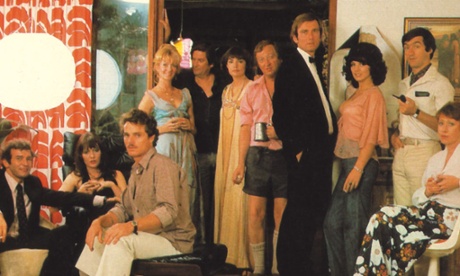
Screenplays adapted from the work of David Williamson, one of Australia’s most popular and prolific playwrights, have led to a number of stage-to-screen conversions that bristle with strong performances. Bruce Spence and Jacki Weaver premiered their feature film careers in the offbeat ocker comedy Stork (1971), Weaver returned with John Hargreaves to explore (and fall victim to) police brutality in The Removalists (1975), and Anthony LaPaglia and Gia Carides confronted the complexities of workplace sexual harassment in Brilliant Lies (1996).
But by far the two most enduring Williamson scripts-cum-films came from the same director, veteran Bruce Beresford (Breaker Morant, The Adventures of Barry McKenzie). Both feature a great cast and memorable supporting character played by TV legend Graham Kennedy. Both are also, to an extent, about politics, but taking very different perspectives.
There’s The Club (1980), which explores backroom machinations and sweaty wheeling and dealing, synonymous with player trading among AFL teams, and features a scene-stealing moustache courtesy of Jack Thompson. But four years before Thompson’s facial hair stormed the grounds there was Don’s Party, a rambunctious drama that feels particularly ripe for rewatching whenever a state or federal election looms.
It is an unusually timeless title to revisit, given its time and setting is so specific. While decor, clothes and casual sexism have morphed a little over the decades, the way the characters perceive Australia’s two-party political system – and how they respond to the consequences of the nation’s decisions – doesn’t feel at all dated.
Mostly taking place in a single location, home of the eponymous Labor-voting host, Don’s Party transpires over the night of the October 1969 Australian federal election. The majority of the characters (perhaps reflecting Williamson’s political orientation) are thirsty for a win for the Labor leader, Gough Whitlam.
Thirsty, too, in a more literal sense. They ply themselves with alcohol, as if in mental preparation for the news that the Coalition incumbent, John Gorton, will retain government. But by the time official announcements come through they barely register: the characters are a little intoxicated, for one, but the film also becomes less about politics in the traditional sense, as more immediate dramas take centre stage.
There are moments of good old-fashioned larrikin behaviour (including goofy anecdotes and a skinny dipping scene) and a surprising amount of raunchiness. Sex and politics don’t usually go so hand in hand, at least when it comes to house parties where ABC broadcasts from the tally room play in the background.
But Don’s Party is ultimately a downer. Marriage issues, debates about class divide and an assortment of relationships that grow gradually more splintered and disconsolate descend into a series of heated conversations and prickly dynamics.
Ray Barrett is greasily effective as Mal, an incongruous Romeo gone wrong who delivers repulsive come-ons to a number of shocked women. Kennedy seems to have a whale of a time strutting around in long socks and sandals, with a pint mug attached to a chain around his neck for ease of access. Graeme Blundell, only three years after immortalising himself as an unlikely sex messiah in Alvin Purple, plays against type as safari suit-wearing dork Simon, who works in the plastics industry.
The sleaziness of the male cast is offset by a bunch of strong female characters and performances. Veronica Lang, as Simon’s posh wife Jody, finds a way to avoid caricature, while the characters around her continually attempt to paint her as one, ribbing her for right-leaning political instincts.
Mal’s wife Jenny is one of the more complex creations. “I’ve been out of the human race for 10 bloody years,” she says, wide-eyed but vulnerable, a character reflecting on her life with more than a modicum of regret. Clare Binney and Candy Raymond, as two varyingly seductive women (a saucy university student and a hoity-toity artist, respectively) also resonate.
Bruce Beresford’s approach is tightly oriented to his cast; the script affords the characters space to breathe while cameras linger closely, absorbing their tics like a high-powered sponge. The director relishes the steady flow and middle-class instincts of Williamson’s dialogue, which is more than just tuned to political feelings of the time. Don’s Party is both a time capsule and something more ongoing and evergreen – a reminder that while faces, names and policies change the general public indulges in the same things every time they put a form into a ballet box and gather in numbers to watch the results.
They hear soundbites about jobs, the need for change and the importance of economic management. There is spirited discourse about policies, the eternal “fair go” and talk of the virtues of big versus small government. And there is alcohol to help them celebrate and/or commiserate.