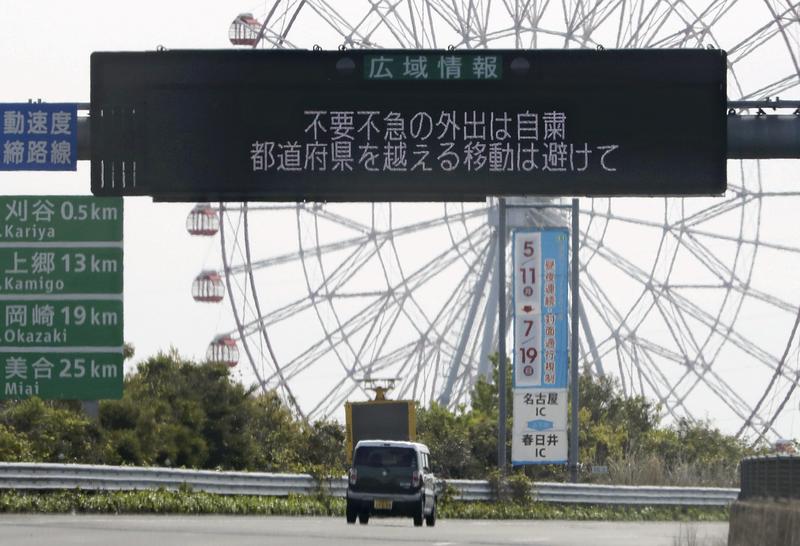
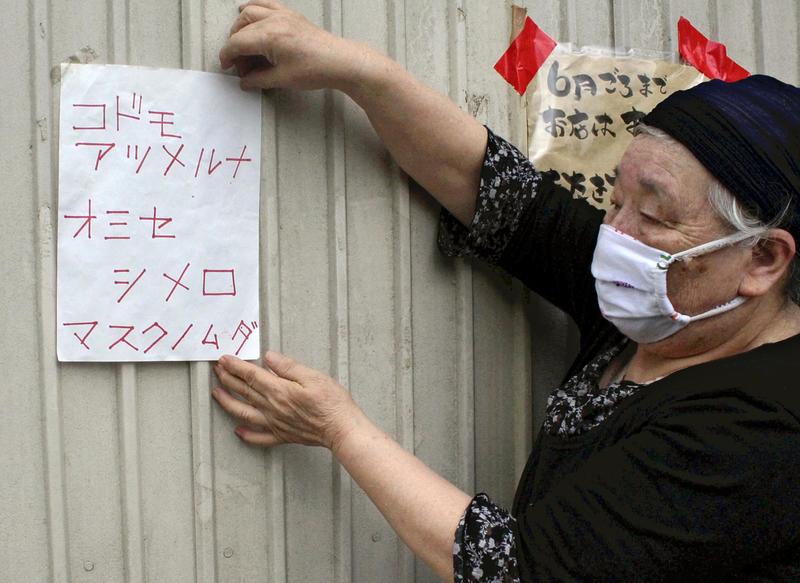
As the novel coronavirus continues to spread, so-called self-restraint police have emerged, ordinary people who adamantly demand that others refrain from such activities as going out or operating stores and restaurants.
A number of books have been published examining this trend, featuring such terms as "dominance of the atmosphere" and "peer pressure." The Yomiuri Shimbun interviewed three intellectuals about the situation that has emerged amid the pandemic.
-- Unspoken coercion
First published about 40 years ago, "'Kuki' no Kenkyu" (Study of "air") by Shichihei Yamamoto is drawing renewed attention.
Yamamoto argued there is an "air" that tends to govern Japanese people's behavior. It is "a criteria for decision-making that is very strong, almost absolute in its power," he wrote. It "has a supernatural power that is capable of expelling those who resist it."
Amid the coronavirus crisis, there is said to be an atmosphere in which no one can say no to demands that they practice self-restraint, and people are controlled by this "air," which does not allow any objections.
Stage director Shoji Kokami has been interested in the principles behind Japanese people's behavior and co-authored "Docho-atsuryoku" (Peer pressure) published last month. In the book, Kokami defines peer pressure as the act of tacitly forcing minorities and objectors to behave in the same way as the people around them.
"[People who turn into vigilantes] use the government's requests for self-restraint to justify themselves and believe they won't be blamed even if they attack people who don't follow [the requests]," Kokami said.
Amid World War II, Kokami says, such slogans as "you can't live lavishly if you're Japanese!" imposed limitations on people's lives, and groups like the tonari-gumi (neighborhood community associations) and the women's associations for national defense patrolled to check if people were violating the "July Seventh Ban," or anti-extravagance ban.
There is a tendency to excessively adhere to such phrases as the "Three-Cs" of closed spaces, crowded places and close-contact settings and "social distance."
"We're doing the same today [as in wartime]," Kokami said.
-- Resignation promotes dominance
"'Kuki' no Kenkyu" warns that people will end up harming themselves if they get carried away by the dominant atmosphere.
During WWII, military operations were often decided in accordance with the atmosphere rather than logical judgment. Kyoto University Associate Prof. Keita Shibayama, who specializes in political and economic thought, said: "Negative effects within an organization grow huge when people believe the atmosphere can't be changed and give up. This attitude makes it unclear who's responsible for decisions."
Asked why so many people are submitting to the dominant atmosphere this time, Shibayama said there are growing calls in modern society for politicians to reduce risks related to life and safety.
"Once the level of risk is set high, it can't be easily lowered," Shibayama said. "Public opinion has been focused on who will take responsibility if infections spread."
As a result, everyone limits their actions, afraid more of social stigma and harmful rumors than of actually being infected.
"Such behavior also empowers the dominance of the atmosphere," he said.
-- Social media makes air visible
The influence of social media is strengthening the dominance of the air, said Masanori Tsujita, a modern and contemporary history researcher who has authored such works as "Kuki no Ken-etsu" (Censorship by the atmosphere).
"Social media has visualized the air," Tsujita said, adding that reactions are easily digitized in such forms as the number of retweets on Twitter, and that makes forced self-restraint tend to be perceived as right.
So, how can we fight against the dominance of the atmosphere?
On social media, which attracts people with similar tastes and inclinations, "expertise" is often emphasized, but "comprehensive knowledge" should be reevaluated, Tsujita said.
"We need the intelligence to look at the big picture covering various fields, including society, politics and the economy," Tsujita said.
"'Kuki' no Kenkyu" argues that Japanese society has had the wisdom since ancient times to fight against the dominance of the atmosphere by "throwing cold water on" it. "Water" refers to "the most specific immediate obstacle."
Once that obstacle was brought up, the atmosphere collapses, and people are said to be drawn back to reality.
Read more from The Japan News at https://japannews.yomiuri.co.jp/