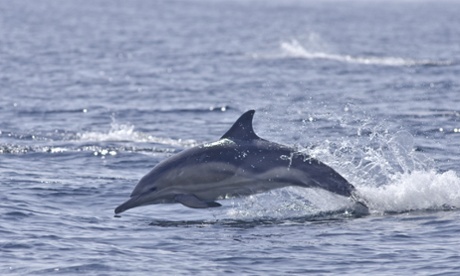
Once rare sightings of the common dolphin off Scotland’s Hebrides have leapt in the last decade, new research has found, giving fans of the popular marine animal new opportunities to see them in the wild.
The rate at which the dolphins are sighted off the islands has increased from just one group a year in 2003 to 34 groups in 2014, said the Hebridean Whale and Dolphin Trust charity.
The scientists are still unsure of the underlying reasons for the increase, but suspect that climate change may be playing a part.
Waters that were once inhospitable to the species, which prefers temperatures higher than 10C, are warming – at the rate of 0.5C per decade in the case of the Hebrides – and also playing host to differing fish species. A study in the journal Nature Climate Change on Monday found that warmer-water species such as gurnard and John Dory are now increasingly colonising northern waters around the British Isles that were once dominated by cod and haddock.
But the Trust warned that more research would be needed to get to the root of the rise in numbers. “An increase in common dolphins means that those wishing to encounter dolphins in the wild are in luck – but further research is needed to explain why this is happening, the extent to which this has been caused by human activity, and the implications for other cetacean species,” said Conor Ryan, sightings and strandings officer at the Hebridean Whale and Dolphin Trust.
Last year, the Trust saw 34 dolphin groups on its research trips, a doubling on the previous year, though it was smaller than the highs of 40 and 44 groups seen in 2010 and 2011 respectively. The number can vary widely from year to year, depending on factors from the number and extent of research trips undertaken, to the water temperatures and weather, to the expertise of the researchers in spotting dolphins.
In 2003, when this research series began, only one group was found and then in 2004 no groups were seen at all, followed by years of double digit sightings from 2007 onwards. But the overall increase in the numbers seen in the past decade appears clear.
Common dolphins – which comprise two species, short-beaked common dolphins and long-beaked common dolphins – were once a relatively rare sight in the Hebrides, where they come each spring to take advantage of seasonal prey. The creatures are gregarious and playful, leading to their Gaelic name of leumadair or “jumper”, approaching boats easily and often swimming and leaping alongside.
These visitors are smaller than the bottlenose dolphins that make the islands their home. In some circumstances, the species even travels in “super-pods” of thousands of individuals.
Similar increases were not recorded for the harbour porpoise, killer whale or minke whale. At the same time, populations in the region of the white-beaked dolphin – sometimes regarded as a competitor for the common dolphin – also increased.
People wanting to view the dolphins for themselves are advised by the Trust to choose tour operators that are WiSe-accredited, which should mean that the tour takes place in safety for the animals to be viewed and does not disrupt their habitat or cause unwelcome disturbance. The Trust is also seeking volunteers to help carry out future surveys.