
NEW YORK (Reuters) - The dollar inched higher from a three-week low on Tuesday, helped by falls in the euro and sterling, even as U.S. data eased concerns about a slowdown in the world's largest economy.
Investors, however, remained cautious about the greenback because of tension in the Middle East and a U.S. trade dispute with China.
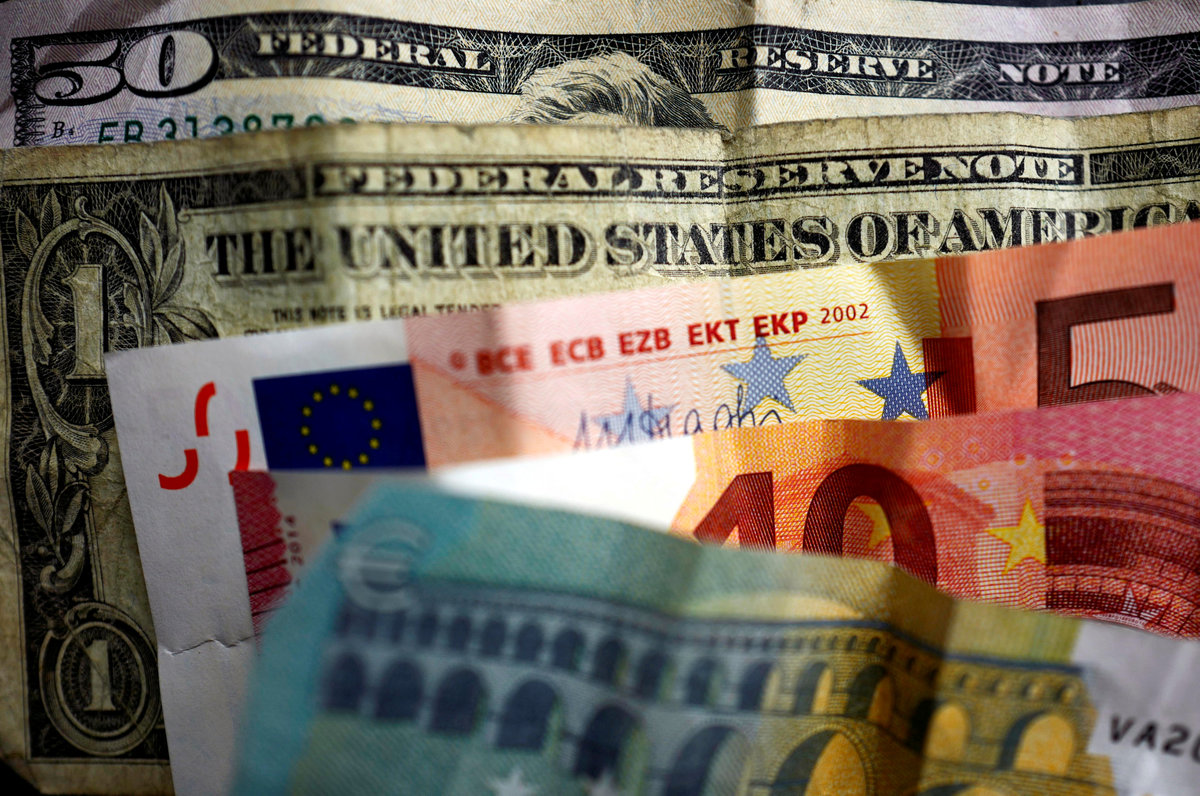
For now though, stronger-than-expected U.S. housing starts in March helped the dollar, as did a positive reading on industrial production.
"It seems like earlier negative readings pointing to a potential contraction have been offset by higher-than-expected U.S. industrial production and housing starts," said Juan Perez, senior currency trader at Tempus Consulting in Washington.
"For the first time in a few weeks of mixed economic data, the dollar is finally being rewarded because the data is finally coming out better than expected," he added.
The dollar earlier fell to a three-week low against a currency basket after President Donald Trump said on Monday that China and Russia were trying to devalue their currencies. Investors interpreted Trump's comments as a nod to having a weaker currency.
Treasury Secretary Steve Mnuchin, however, clarified Trump's comments in an interview with CNBC on Tuesday, saying the U.S. president's remarks were a warning to those countries against devaluing their currencies.
"The dollar found support from comments from Treasury Secretary Mnuchin, who dialed back some of the president's comments from yesterday," said Omer Esiner, chief market analyst at Commonwealth Foreign Exchange in Washington.
The dollar index, as a result, advanced 0.1 percent to 89.526 <.DXY>.
The euro, meanwhile, fell 0.1 percent to $1.2365 <EUR=>, after a monthly survey showed morale among German investors was deteriorating.
Sterling was also down, slipping 0.3 percent to $1.4289 <GBP=>, hurt by data showing British workers' pay is still rising by less than inflation despite the lowest unemployment rate since 1975.
"Today's news did not help the (sterling) bulls as it clearly showed that the UK economy is slowing, which will make the task of normalization more difficult for the BoE (Bank of England)," said Boris Schlossberg, managing director of FX strategy at BK Asset Management in New York.
Elsewhere, the Swiss franc fell to its lowest versus the euro since the Swiss National Bank scrapped its currency peg in January 2015.
Against the yen, the dollar was down 0.1 percent at 107.01 yen <JPY=>, off a seven-week high of 107.78 yen touched on Friday, before a meeting between Trump and Japanese Prime Minister Shinzo Abe on Tuesday and Wednesday. Tokyo is eager to avoid being pushed into talks on a two-way free-trade agreement aimed not only at market access but at monetary and currency policies.
(Reporting by Gertrude Chavez-Dreyfuss; Editing by Chizu Nomiyama)