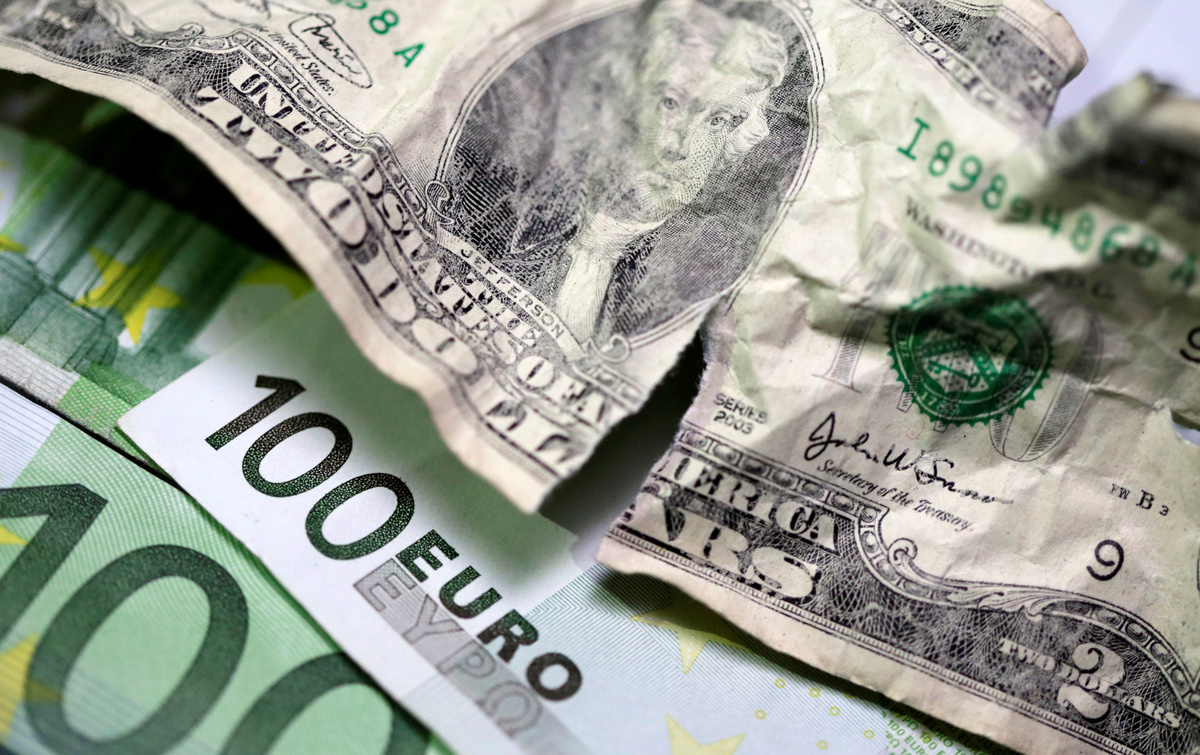
NEW YORK (Reuters) - The dollar ended roughly flat on Friday, retracing the morning's move higher, after worries tied to trade tensions and a Federal Reserve rate cut weighed on consumer sentiment and a report that Germany may run a deficit to boost growth lifted the euro.
Germany's right-left coalition government would be prepared to ditch its balanced budget rule and take on new debt to counter a possible recession, Der Spiegel magazine reported on Friday. The news lifted the euro against the dollar, but the single currency nevertheless remained 0.14% lower on the day at $1.1091.
"EUR-USD reversed from over two-week lows to highs of $1.1106 at mid-morning. The move higher came as reports circulated that Germany may shift to deficit fiscal spending should Germany head into recession," wrote analysts at Action Economics.
"The FX market is geared up for further easing (from the European Central Bank) in September, though more talk like this will keep ongoing pressure on EUR-USD."
Earlier Friday, the euro fell to a two-week low of $1.1067 <EUR=>, shy of the two-year low of $1.1025 it reached on Aug. 1. Friday morning's fall was caused by growing expectations of an interest rate cut by the European Central Bank after Governing Council member Olli Rehn suggested on Thursday the central bank could restart its quantitative easing program and was open to extending it into equity purchases.
"Global markets started Friday in a better mood with sentiment boosted by expectations for the European Central Bank to err on the side of bold stimulus as soon as central bankers’ coming meeting on Sept. 12," said Joe Manimbo, senior market analyst at Western Union Business Solutions.
Also pulling the dollar lower was the University of Michigan consumer sentiment index which fell to 92.1 early this month, the lowest reading since January, from 98.4 in July. The survey's current conditions measure dropped to its lowest level since late 2016.
The consumer sentiment data came after the Treasury yield curve inverted this week, which historically has preceded U.S. recessions. The inversion stoked worries about the impact of the Sino-U.S. trade war. The curve was slightly steeper on Friday at 6.1 basis points <US2US10=TWEB>.
Measured against a basket of six other major currencies, the dollar <.DXY> was higher by 0.05% at 98.197. It has recovered by 1.20% from its three-week low on Aug. 9.
(Reporting by Kate Duguid and Olga Cotaga; Editing by Steve Orlofsky and Tom Brown)