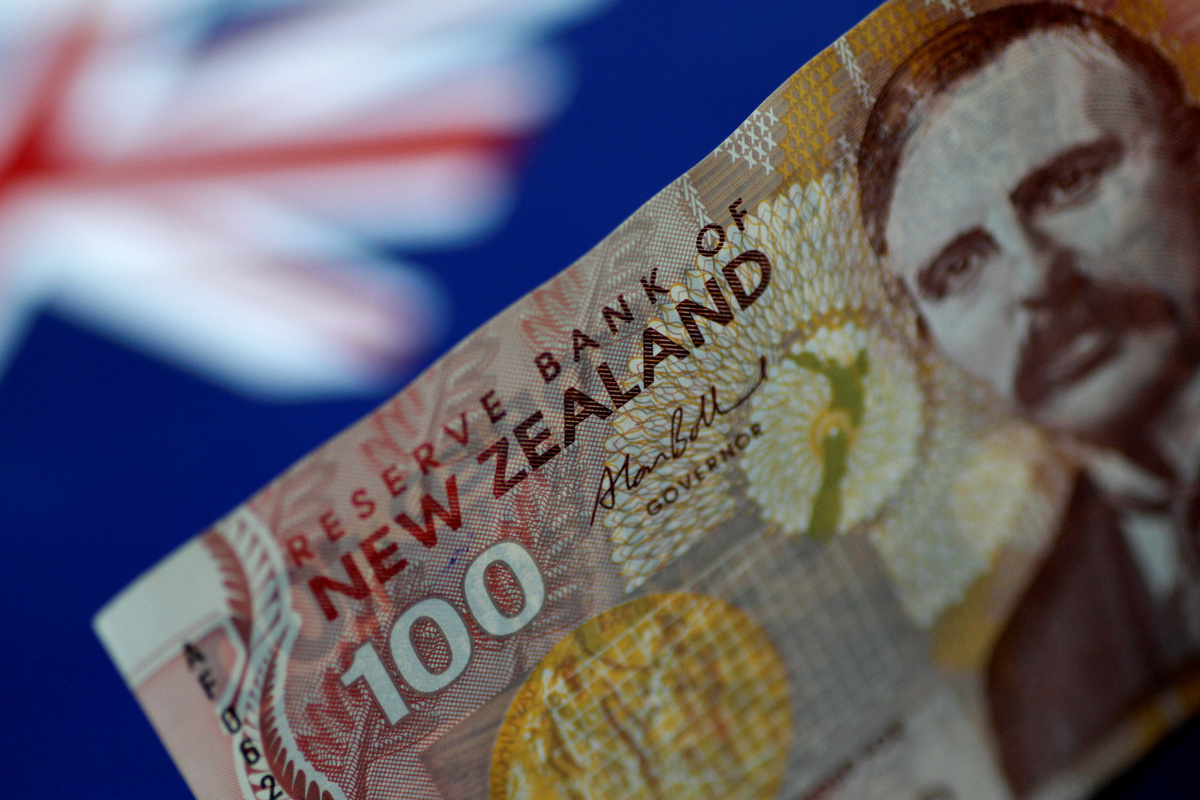
NEW YORK (Reuters) - New Zealand's dollar tumbled on Wednesday, the worst fall against the greenback in seven weeks, after its central bank flagged a possible cut in interest rates, becoming the latest to turn dovish in the face of slowing global growth.
The Reserve Bank of New Zealand (RBNZ) unexpectedly said its next move in interest rates was more likely to be a cut, abandoning its neutral stance at a policy review on Wednesday.

A slowing global economy and abrupt end to U.S. Federal Reserve policy tightening have shifted rate-cut expectations in Asia to probable from possible.
The kiwi was 1.46 percent lower at $0.6804 and the Australian dollar followed suit, falling 0.67 percent.
"The market is anticipating that there is going to be dovishness from (the Reserve Bank of New Zealand) because there has been dovishness from other developed market central banks," said Thierry Wizman, global interest rates and currencies strategist at Macquarie Limited in New York.
"RBNZ follows the Fed into dovish territory, and it's becoming increasingly clear that there are few central banks that want to be caught on the wrong side of the Fed," said Brad Bechtel, global head of FX at Jefferies.
The Fed abruptly ended three years of monetary policy tightening last week amid signs of an economic slowdown. The European Central Bank, Reserve Bank of Australia and the Bank of Japan have all turned dovish since.
The euro zone is facing a more persistent deterioration of external demand, and the ECB stands ready to further delay a planned interest rate hike if necessary, President Mario Draghi said on Wednesday. The euro was 0.04 percent lower against the greenback.
Elsewhere, major currency markets were quiet as risk appetite remained fragile following a selloff last week triggered by fears of slowing global growth. Informing views on global growth later this week and early next, will be the publication of purchasing managers' index data from the United States, China and the European Union. The U.S. data will be released Friday, the EU's on Monday and China's on Saturday, Sunday and Monday.
"It looks like European PMIs are going to be weaker - that is already prefigured in the preliminary PMIs that have been released. We may also get some weakness in the U.S. - the regional surveys have suggested as much," said Wizman.
"If we get a positive surprise it might be in China because some of our private surveys suggest things in March were looking better in terms of business sentiment."
(Reporting by Saqib Iqbal Ahmed and Kate Duguid; editing by Diane Craft)