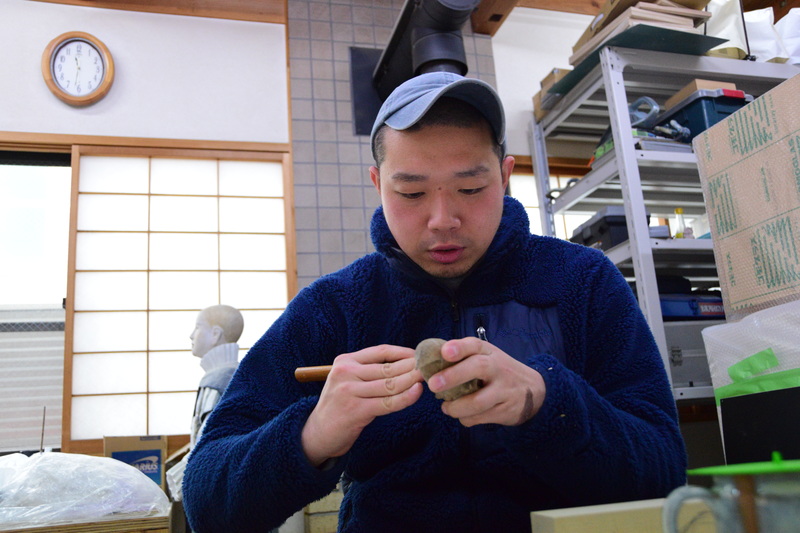
Hiromine Nakamura, a doll craftsman from Chuo Ward, Fukuoka, is bringing a new flavor to the country's traditional world with a series of unique Hakata dolls. His creations have a style not found in other Hakata dolls, such as portraying athletes and animals in glittering costumes.
This originality came from the dedicated pursuit of his own ideas while making figurines. Nakamura is making a global appeal for the beauty of the dolls, and his passion for his craft moved me. I posed a number of questions to Nakamura, who is attracting attention as an up-and-coming young creator, such as how his unique style came about and what he would like to do in the future.
Seto: What made you decide on the athlete motif?
Nakamura: It all started in 2014 when my first son was born. I came up with an idea when I was trying to decide what kind of traditional doll I should make for him for Children's Day in May. In Japanese tradition, these dolls symbolize our wishes for the healthy growth of boys. That's why Momotaro, or the Peach Boy who conquers the ogre, has been traditionally used as a symbol of strength and attracting admiration.
I wondered what it would be like to replace Momotaro with modern characters. Then I thought of athletes, who are a symbol of strength. It was an idea that came to me because I was both the client and the producer.
Q: You have held many private exhibitions. Are you interested in taking your works abroad?
A: I've held personal exhibitions at department stores and galleries in Tokyo about four times now, I think. I'm interested in showing at overseas exhibitions. I was originally keen to study abroad, but I unfortunately missed the opportunity. However, I suppose the hurdles to hold a solo doll exhibition overseas would be high.
Q: Why?
A: In Europe and America, the word "doll" has a childish connotation and it's not seen as an art form. Rather, I guess it's seen as a toy. I think the culture of treating dolls as works of art and cherishing them is unique to Japan. There are many Japanese who feel uncomfortable throwing away dolls, photos and stuffed animals, as they carry images of people or resemble people.
Adults even frequently use emoji in emails and stickers on the LINE messaging app. I think it's a sign of respect and familiarity with the objects to attribute human emotions to them.
Q: I see. Since I'm a fan of anime figures, I see what you mean. But I don't think there are many museums in Japan that display dolls.
A: Sculptures are displayed all over the place, but dolls are often looked down upon in the world of art, something that made me a bit reluctant. As I was contemplating this and that, I reached the fundamental question of "Just what is a doll?"
Then, I remembered an old family saying: "A doll creator gives people's desires shape." The desires of people change through the ages, so I'm going to make dolls that suit all sorts of desires. When I thought about what would be this era's symbol of strength and admiration, the image of an athlete immediately came to mind.
Japanese dolls as global art
Q: Your unique style represents your pride as a creator of figurines, right?
A: The working concept is the idea of 'what if a doll craftsman of the Edo period time traveled into the present day?' For example, what would people of that time think if they saw baseball player Shohei Ohtani playing in the major leagues? In the eyes of modern people, Ohtani's qualities of being "strong, admirable and robust" are the same traits we ascribe to Momotaro.
Q: Was there a moment where you felt glad that you became a doll creator?
A: As you might expect, it's when I'm making a doll after receiving an order. 'What kind of doll would the client like?' 'How do I make a doll suitable for the client's desires?' Thinking about those kind of things makes me feel tense, but these are the core values of a doll craftsman.
Q: What about exhibitions overseas?
A: I would like Japanese dolls to be seen as art. I want foreigners to feel the same way Japanese feel when they see dolls. In order to realize that, I think it's important for the dolls to be seen while knowing the background as to why the Japanese attach special feelings to figures.
Q: I hope Hakata dolls spread more around the world.
A: Actually, my doll is not a pure Hakata doll. Most of the production methods are the same, but they incorporate Gosho dolls for the face and Saga dolls for the body decoration. In order to convey the charm of Japanese dolls to the world, I think it is good to take advantage of various techniques. If that's how people from overseas get to know Japan, that fulfills my wish.
Dreams come true
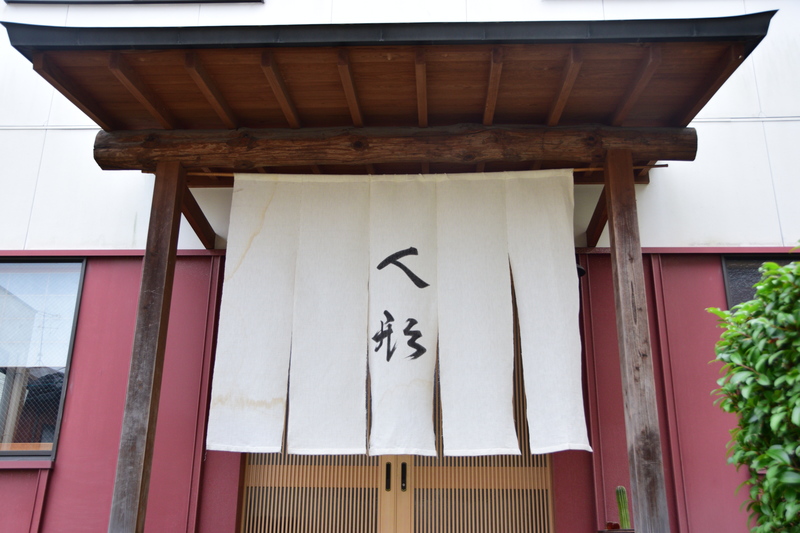
Nakamura is the fourth generation of the long-established Nakamura Ningyo doll-making studio. Nakamura works at his craft every day as an apprentice to his father Shinkyo Nakamura, who is active worldwide. He has even presented his work to the pope.
Growing up in the family of the Hakata doll maker, Nakamura had always dreamed of becoming a craftsman in the same field. With this in mind, he majored in sculpture at university.
Read more from The Japan News at https://japannews.yomiuri.co.jp/