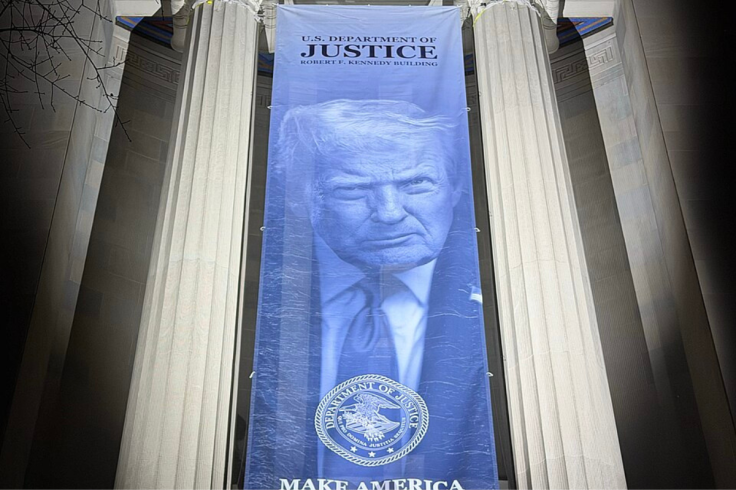
Money is rarely neutral, and the Justice Department's newest grant makes the price of acceptance unusually explicit. To share in nearly £224 million ($300 million) of federal public-safety funding, a handful of American cities must first agree to run their streets, their homeless services and their immigration posture the way the Trump administration prefers.
The Model Cities Initiative, which the Department of Justice is now inviting cities to compete for, will hand two to four mid-sized jurisdictions a share of the pot in exchange for adopting a defined law-and-order agenda.
Applicants are steered toward aggressive, technology-heavy policing, crackdowns on homelessness and public disorder, and active cooperation with federal immigration enforcement, while measures associated with the criminal-justice reform movement are discouraged.
Critics describe it as an attempt to buy the reshaping of local government from Washington; the department frames it as restoring order to cities it says have lost control of their streets.
The Conditions Attached to Nearly $300 Million
Read as a shopping list, the grant framework reveals its priorities. The Justice Department's own announcement, titled 'Making America Safe Again', describes a 'whole-of-city' approach and lists the activities it will fund: intelligence-led policing, real-time crime centres, surveillance technology, and coordination with state and federal law-enforcement partners.
Applying cities are expected to enforce prohibitions on urban camping, loitering and squatting, the mechanisms by which street homelessness is policed rather than housed, and, where the framework deems it necessary, to adopt standards for assisted outpatient treatment that can compel people into care.
The initiative also presses cities to abandon progressive policing approaches and to help federal authorities with immigration matters, including the removal of people from the country.
The immigration condition is the sharpest of the strings. Recipients must cooperate with Immigration and Customs Enforcement, a requirement that turns a public-safety grant into a lever for the administration's deportation drive.
When the terms were first outlined in June, the Department of Homeland Security told NPR that a refusal to work with ICE was 'misguided', while the Justice Department called the notion that immigration is unrelated to public safety 'ludicrous'.
Where the Money Comes From and Who Decides
The initiative is not recycled funding but a new stream, created by the sprawling tax-and-spending law that President Donald Trump signed last year.
Acting Attorney General Todd Blanche has cast it as a corrective to years of urban decline, saying the programme will 'supercharge our law-enforcement partners and restore the rule of law to America's neighbourhoods, towns, and cities'.
How the winners will be chosen has itself drawn alarm from within the field. Amy Solomon, a former head of the Justice Department's Office of Justice Programs, said that the grants appeared to bypass the standard competitive peer-review process that normally guards such awards against political influence, calling the arrangement highly unusual and especially concerning. Cities have 90 days to submit proposals, with initial decisions expected late in 2026.
The concentration of the money magnifies the stakes. Rather than spreading modest sums across many communities, the department will pour a very large award into just two to four cities, making the programme one of the largest place-based public-safety investments in years and turning the chosen jurisdictions into showcases for the administration's model of governance.
What Cities Stand To Gain, and What They May Surrender
For a cash-strapped police department, the appeal is obvious. The funding can pay for new officers, drones, artificial-intelligence tools and real-time crime centres, capabilities many mid-sized forces could never afford on their own, and the framework wraps them in the language of mental-health services, reentry programmes and violence reduction that any mayor could welcome.
The cost is measured in autonomy. A city that takes the money accepts Washington's definition of good policing, agrees to enforce homelessness through the criminal law rather than through housing, and binds its officers to an immigration agenda that many local governments have spent years trying to keep at arm's length from community trust.
Civil-liberties advocates warn that the surveillance infrastructure, once built, does not disappear when an administration changes.
The deeper question the initiative poses has less to do with crime statistics than with who governs the American city.
By making federal dollars conditional on a specific ideological program, the Justice Department is testing whether local leaders will trade the independence of their own streets for the resources to patrol them, and the two to four cities that say yes will become the first working models of an answer the whole country will be watching.