
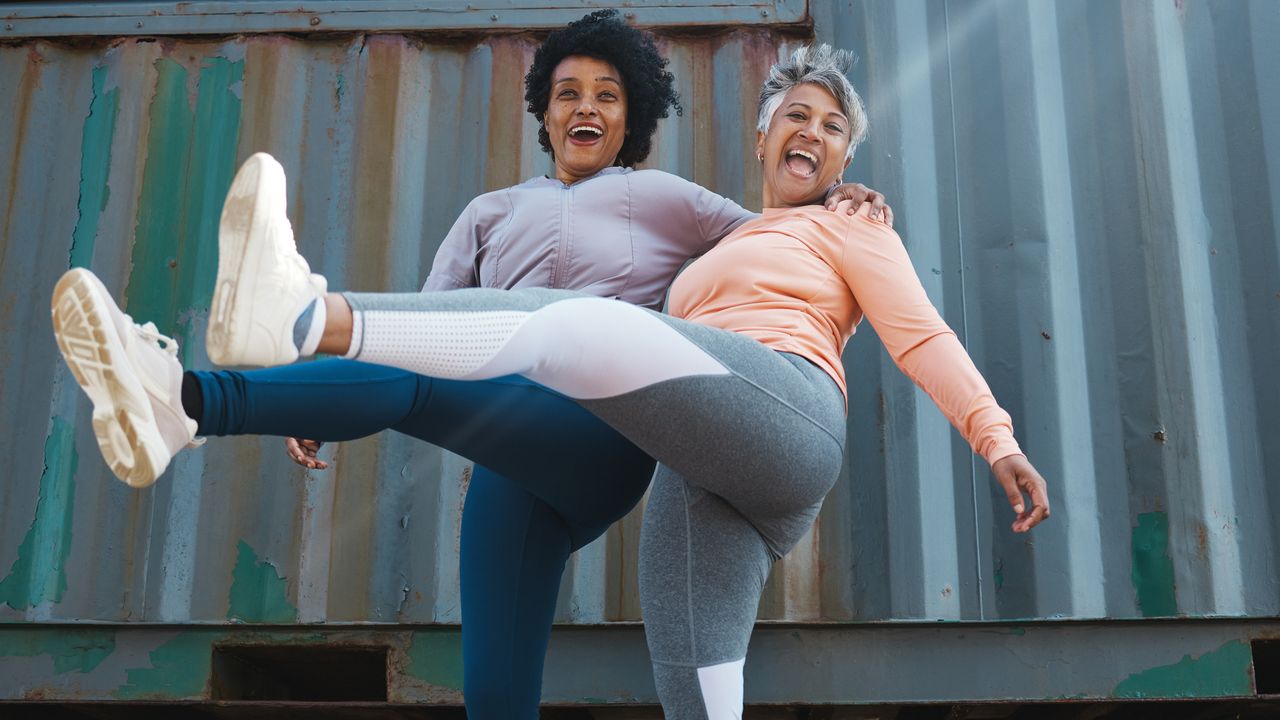
Hip stability and strength are crucial for a lot of everyday movements, including walking, running, climbing stairs, and maintaining overall equilibrium.
If the muscles surrounding the hips are weak and deconditioned, it can make daily tasks harder, affect your balance, and increase your risk of serious falls or injury.
As a personal trainer who works with a lot of clients who are aged over 60, I often recommend standing hip exercises.
Physical therapist, mobility trainer and work-life balance coach Dr Drea Osborne, DPT, agrees that these can be beneficial: “Standing hip exercises are helpful to improve strength, balance and motor control.”
My three exercises of choice to address hip stability and lower body strength are: standing hip abduction, standing hip adduction and standing glute kickbacks.
Depending on your current fitness level, these exercises can be done daily to better condition these important muscle groups. They’re appropriate for total beginners and can be progressed easily as you get stronger.
“There are some situations where these exercises are not appropriate,” says Osborne. “Those include post-surgery with weight-bearing restrictions, a fracture, or severe dizziness.”
Always consult with your physician before beginning any new activity.
How to do the three hip stability exercises
While these exercises don’t require any additional equipment, Osborne suggests using additional support to ensure you’re doing them correctly.
“The way to get all these benefits fully is to make sure you have body awareness and proper form,” she says.
“In order to ensure that, I recommend that people doing these exercises start with their hands on a stable surface: a countertop, couch, handrail, etc. This decreases the need for balance, and people can make sure that their torso isn’t shifting too far forward or to the side to compensate for their improving hips.”
Osborne also suggests that beginners aim to do these exercises three to five times a week to start with. “The exercises are helpful, but our bodies do need rest to get the most out of them in the long term.”
Start by doing each exercise for one set of 10 reps. After a while, you can increase your reps to 15 and gradually work your way up to five to seven days a week, as is comfortable.
Keep a controlled tempo with each repetition, and avoid rushing through the exercises.
“I have seen many patients speed through these exercises too fast and not get the full strength training benefit from it as a result,” says Osborne.
Here’s how to do the exercises.
1. Standing hip abduction
Reps: 10-15 each side
- Stand tall with a neutral spine and your feet hip-width apart.
- Place your hands on a stable surface for support.
- Lift your left leg out to the side, moving slowly and with control, engaging the muscles along the outside of your hip.
- Pause briefly, keeping your toes pointing forward.
- Reverse the movement with control.
- Do all your reps on one side, then switch sides.
Trainer tips: Avoid rotating your leg outwards as you lift it up. Be sure your toes and knees face forward throughout the movement. Maintain an upright posture throughout the movement, and don’t allow your torso to lean to the side as you lift your leg.
2. Standing hip adduction
Reps: 10-15 each side
- Stand tall with a neutral spine and your feet hip-width apart.
- Place your hands on a stable surface for support.
- Lift your left foot forward so it is just in front of your right—this is your starting position.
- Squeeze the inner thigh on your left leg, and lift your left leg to the right, across your body.
- Pause briefly, keeping your toes pointed forward.
- Reverse the movement back to the starting position with control.
- Do all your reps on one side, then switch sides.
Trainer tips: Keep your knees and toes facing forward throughout the movement. Avoid using momentum to swing your leg back and forth. Keep your torso and upper body still throughout.
3. Standing glute kickback
Reps: 10-15 each side
- Stand tall with a neutral spine and your feet hip-width apart.
- Place your hands on a stable surface for support.
- Squeeze your left glute and lift your left leg behind you.
- Pause briefly.
- Return to the starting position with control.
- Do all your reps on one side, then switch sides.
Trainer tips: Keep the torso upright as you kick the leg back, and avoid leaning forward with the movement. Don’t use momentum to swing the leg behind you. Avoid arching your lower back.
Progressing the three hip stability exercises
Once the exercises start to feel easy, there are several ways to increase the difficulty level.
“Use resistance bands around the knees as you kick out,” Osborne recommends. “You can further progress that by choosing thicker bands and/or moving the band further down the leg.”
Additionally, you can perform the exercises without holding on to a stable surface. “This will start requiring more balance, which makes the exercises more challenging,” says Osborne.
“If going hands-free is too challenging, then ease into it by using only fingertips on the surface and gradually reduce the number of fingers until you can go hands-free.
“Finally, doing these standing exercises on an unstable surface—foam pad, a pillow, carpet, barefoot—will further increase the balance demand,” Osborne adds.