WICHITA, Kan. _ There are more 42,500 dogs registered in Wichita.
Only 38 are named Smokey.
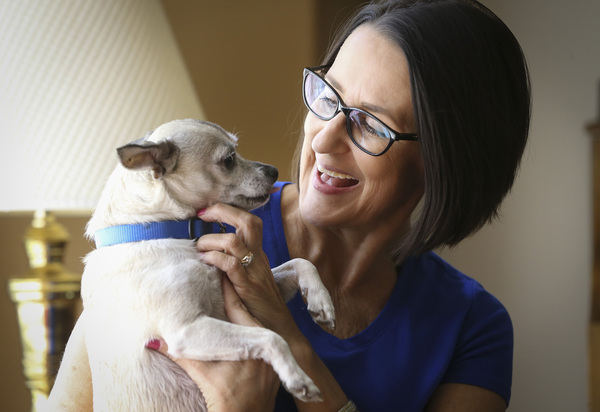
And of those only one _ a shy, fawn-colored, 6-year-old, 7-pound Chihuahua mix, has helped keep Michele Longabaugh alive.
Reach for your hankies, dog lovers:
Smokey is good medicine.
He was just a pup
As told by Longabaugh, a Wichita registered nurse, the story goes like this:
Longabaugh misunderstood six years ago why her doctor had summoned her for an appointment.
She thought the doctor was going to give her a shot to relieve pain in her back.
But the doctor said "cancer."
Longabaugh sat in stunned silence for a few moments, next to her husband, Jerry, and her daughter, Maggie.
Then Maggie spoke.
Maggie had said, days before this day, that Mom needed a dog.
"What?" said husband Jerry then. "Why do we need another dog?"
But now, at the doctor's office, Maggie told Jerry where they needed to go right now:
"We're still on to go to the Kansas Humane Society, right?"
Jerry did not protest.
"Sure," he said.
Maggie had already scouted out a dog there.
Michele and Maggie had previously met a smallish fawn-colored Chihuahua-mix pup that they liked.
Cute. Only 4 months old.
Maggie thought her mom would love this dog. Michele thought Maggie was correct.
And so now, off they went.
But when they reached the Kansas Humane Society, the staff told Longabaugh that the little dog they liked was pledged to someone else.
GOOD EGGS ALL AROUND
Dogs are not just animals, said Suzanne Rice, a professor at the University of Kansas.
They are not even just dogs.
They've been companions and co-workers with human beings for tens of thousands of years, Rice said. "We co-evolved together. There's a relationship there."
For decades now, Rice said, scientists have been studying the intense and mutually beneficial relationship that humans have had with dogs since the Stone Age.
Rice's studies usually center on subjects involving education and philosophy.
But she did a research paper 10 years ago in which she studied interactions between retired dog-track racing greyhounds and inmates who worked with them at a Kansas prison.
She recorded a decrease in behavioral problems. Mental health improved. "The dogs lightened the mood."
She noted that borderline-illiterate inmates, when they were required by her project to write journals about the dogs, began to write prodigiously.
This kind of story is not new to science, or to dog lovers, herself included, Rice said.
Scientists have chronicled the benefits dogs bring to bear when used as companions to schoolchildren, nursing home residents and people with substance abuse or mental health problems.
Perhaps one great attraction about dogs is that "there really isn't a mystery," said Rice, a professor in KU's department of education, leadership and policy studies.
"Even people who don't have dogs always sense that dogs are their friends.
"Dogs will help them.
"Dogs want to befriend them.
"Dogs are good eggs all around."
DARK DAYS AHEAD
At the Kansas Humane Society, less than an hour after she'd been told she had Stage 4 cancer, Michele Longabaugh looked on as her daughter Maggie negotiated and pleaded with the staff to please let her mom have the fawn-colored, 4-month-old Chihuahua mix that she'd met there a few days before.
That dog was pledged to another man at that moment.
Rules are rules.
But one rule at the Humane Society, as spokeswoman Melissa Houston said, is that the Humane Society serves humans _ not just animals.
So the staff went to the man with the news about Longabaugh's illness.
The man was a kindly soul.
And he thought perhaps another dog with another type of personality might be more beneficial to his grandson's happiness.
He let Longabaugh have the little dog.
Longabaugh hugged her new dog.
"He entered my arms at that moment, never to depart," she said.
Longabaugh felt happiness only an hour or so after the worst moment of her life.
She named the dog Smokey.
She and Smokey didn't know it yet, but they faced dark days ahead.
NEVER A DECEITFUL DOG
"Dogs exemplify all of the virtues we say we admire but have a hard time acting on ourselves," said Rice, the KU professor.
"Dogs are always absolutely loyal, for example.
"I have never, ever known a deceitful dog.
"We cannot say that everyone we know is intelligent. But we can say that all dogs have an intelligence.
"They have integrity.
"They are responsible.
"So if a dog has a job helping a person with a disability, helping a blind person, for example, that dog is absolutely trustworthy and responsible.
"What you get with dogs are all those qualities we wish more humans had."
EVERY JOY
It is a story that tells of dark times. And as all good stories do, this story tells of a hero.
Weeks after doctors told Longabaugh she had cancer, they then told her it was likely terminal, that she'd be lucky to live another three years.
But those same doctors then went to work to save her life.
Over the past six years, they put her through the pain and torment of cancer treatments. And Smokey the dog was with Longabaugh all the way.
She endured chemotherapy. Radiation treatments. When the cancer spread to one of her lungs, she endured surgeries that removed parts of that lung.
She endured the depression and shock that cancer brings.
"But I am one of those strange, happy-ending stories," Longabaugh said.
"The story of me and Smokey was born of tragedy, but he is my healer, my salvation.
"For many nights in the last six years, he laid on my lap.
"He knew where my pain was, and curled up to lie on it like a heating pad to relieve my pain.
"Through long nights of misery and pain, he was there for me.
"He was so good that when I was hospitalized, I snuck Smokey into the hospital with me, in one of those zipper bags.
"He is the king of commiseration.
"He's the ultimate best friend."
Michele Longabaugh has been cancer-free for three years now.
She does not know whether the medicines did that, or something else.
"But I know Smokey was good medicine," she said.
"He absorbed every emotion I had.
"Every fear.
"Every worry.
"Every doubt.
"Every joy."