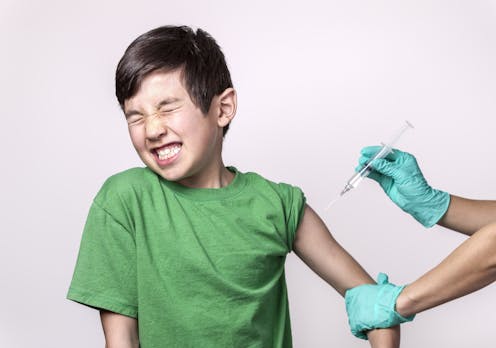
Imagine yourself at the doctor’s office bracing for your annual flu shot. Twenty minutes go by and during that period your fear escalates and you convince yourself the upcoming shot is going to hurt like hell. Does the expectation influence how it actually feels?
I am a professor of psychology and neuroscience who, together with my colleagues at the National Institutes of Health, decided to explore how a child’s expectation of pain influences their actual experience, particularly anxious children. It is well-established that children are highly impressionable and are easily influenced by social media, their friends, and what they watch on television. The question of whether children, like adults, are influenced by expectations has not been studied in a systematic way.
Our goal was to understand the effects of expectation on preparing children for upcoming painful procedures to inform treatment of pediatric pain in anxious patients. We suspected that if children expected pain, that’s how they would perceive it. We designed an experiment to test it.
To prepare for our study, we applied heat to each child’s arm and asked them to rate levels of pain as low, medium or high. Then, during the experiment we focused on just the one temperature that each participant rated as medium.
In our experiment we preceded the medium temperature test with two kinds of tones. One tone signaled to the child that gentle low heat was coming and the other that painful high heat was coming. When we asked children how painful the heat was, they rated the same temperature as more painful when it was preceded by a high tone.
Our findings suggest that parents will reduce their child’s suffering by downplaying the upcoming painful experience. This will make their child’s next visit to the pediatrician less traumatic. Next time your child has an upcoming doctors visit, try reframing their thoughts: “This will feel like an accidental nip from their pet dog, or a minor scratch from their kitten’s paw.”
Of course it is important to be truthful and not discount a child’s worries all together. The point is not to deny that pain will occur, but rather to not hype it up and inadvertently impact children’s experience.
Just as other studies have shown that expectations of pain relief can reduce pain levels in adults even when a placebo treatment is given, our study underscores that pain is a complex phenomenon and can be influenced by a number of psychological factors, including attention, emotion, and beliefs or expectations.

Kalina Michalska does not work for, consult, own shares in or receive funding from any company or organization that would benefit from this article, and has disclosed no relevant affiliations beyond their academic appointment.
This article was originally published on The Conversation. Read the original article.