“A television series unlike any other deserves a send-off unlike any other.” That’s the rationale proposed by Charlie Collier, president of television channel AMC, as he gets ready to stub his advertising drama Mad Men into the overflowing ashtray of history. To that end, he’s initiated a substantial programme of remembrance before the show’s final season airs this April. But is he right? In any way? Whatsoever?
Mad Men’s farewell kunstfest involves festivals, talks and exhibitions around America, but the centrepiece will be the incorporation of antihero Don Draper’s suits into the Smithsonian Institute’s Museum of American History. There, the elegant trousers will sit alongside Kermit the Frog (a replica) and Seinfeld’s puffy shirt (possibly the original) as part of a collection of popular cultural artefacts.
This once-in-a-lifetime event – if you exclude all the other shows that have their bits and bobs put in glass cases – will be followed by a series of screenings and Q&As with cast members, the likes of which have literally never been seen since the last promotional tour.
Now, don’t get me wrong; I’m a fan of Mad Men. Not as much of a fan as I was in the early seasons – something broke after Sterling Cooper Whatever Their Name is Nowadays reincorporated itself for the dozenth time – but I’m waiting for the final episodes with a degree of excitement. Still, such lavish corporate commemoration for the show seems too much. Mad Men is a good serial drama with many strong performances and some great characters, but like other successful serials it also has a tendency towards soapy melodrama (the story of Don and Megan springs to mind). Mad Men is not as much a show apart as its owners might like to suggest.
Perhaps I’m being harsh. Perhaps my spiky feelings are a result of writing two seasons’ worth of Mad Men recaps for the Guardian and getting a fair degree of crap in the comments. The most common complaint I received, though, was one I think speaks to the heart of Mad Men’s delusions of grandeur. This complaint was that I had failed to notice visual references within the show – references to previous episodes and, more significantly, references to cultural artefacts and events. It’s this latter strand that will be celebrated at the Smithsonian: Mad Men’s formidable attention to detail and its ability to stimulate nostalgia for a time few people remember.
I’m not entirely sure such nostalgia means all that much. All the lingering over the fashion, the martinis and the casual sex feels nice, maybe even exotic, but it’s uncomplicated. It’s the same pleasure we get from watching Downton Abbey. Of course, Mad Men also takes pleasure in stimulating feelings of anachronism (all that smoking; the time the Drapers have a roadside picnic and leave all their rubbish). But again, the effect of such moments is a simple one: 21st century citizens goggling at the unreconstructed practices of the past.
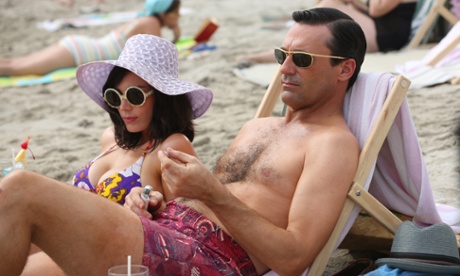
For all the many erudite references in Mad Men – the New York Public Library has a list of all the books read in the show and there’s a blog dedicated to the movies watched – I’m not quite sure they amount to much more than a checklist for viewers to tick off. Does the fact that Don is reading Dante’s Inferno on the beach in Hawaii at the start of season six actually mean anything? Does he, on finding that the lustful are only forced to remain in hell’s second circle (of nine), think: “Well, I might as well keep boffing Sylvia Rosen”? Or does it simply signify that he’s a deep guy, with dark undertones? When Don and his son Bobby watch Planet of the Apes back to back, does it give them perspective on the impermanence of hegemony as the United States is going through civil strife (the scenes take place after the assassination of Martin Luther King), or is the strongest takeaway the one proffered by Bobby, that “people like to go to the movies when they’re sad”?
People like spotting references, and they love doing so with Mad Men. They also like spotting references that are incorrect, as creator Matthew Weiner found when a viewer forced him to acknowledge that Joan had made a booking at a restaurant that wouldn’t be open for six years. But does that amount to a whole hill of beans? Not necessarily.
If Mad Men is to be remembered, if it is to earn “a long and prosperous pop-culture afterlife”, as Vulture has it, then I would suggest that celebrating its attention to detail is not the way to go. No, better to concentrate on the fact that, in Draper, Weiner invented a character as involving and potentially as interesting as one created by his mentor David Chase in The Sopranos. One great difference between Don and Tony Soprano – two characters both riddled with dichotomies – is that Don’s allure is partly created by his enigma. We don’t really know what makes him tick, what he ultimately wants to achieve in his life and whether he can manage it.
In good stories, never mind great stories, the hero goes on a journey that resolves such issues in the end. Don has spent much of Mad Men going in circles (Dante’s circles!). Viewers like me would like resolution in the upcoming final episodes. And if that works out, the AMC suits can fill as many glass cases as they like.