“As we’re approaching the festive season it will inevitably be the case that a furious manager will respond to a devastating result by doing what most of us pray for, and cancel the Christmas party, leaving the players to go out and get drunk with their friends instead of their colleagues,” writes Joseph Chapman. “My question: is there any evidence that cancelling the Christmas party following poor performances leads to an upswing in results?”
It’s a good and seasonal question, Joseph. In December 2012 Alan Pardew put a stop to Newcastle’s festive roistering “out of respect to our fans and what we have served them this year”. At the time, his team had lost six out of seven Premier League games and found themselves two points off the relegation zone. “There’s no party for us and the same for our staff,” he said. “That’s how it should be.”
Pardew’s grinchiness had an immediate, if very short-lived impact. In the match after his announcement that Christmas at St James’ Park had been cancelled, Newcastle beat Queen’s Park Rangers 1-0 at home, before embarking on a disastrous run in which they secured one Premier League point from the next 15 available and got bounced out of the FA Cup by the Championship side Brighton. Although they avoided relegation, there was no suggestion that cancelling the Christmas party led to an upswing in results.
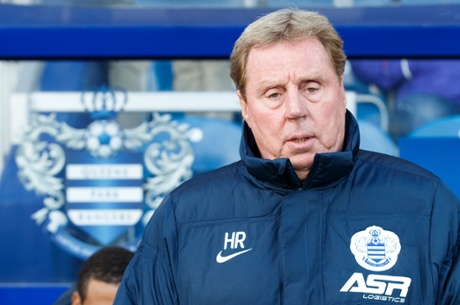
Last week Harry Redknapp announced that his QPR players wouldn’t be having a Christmas party, although he seems to have done so out of concern they might end up getting into trouble while out on the lash, rather than out of anger at recent results. Since making the announcement, his side have won the only game they played, beating Burnley 2-0 on Saturday. Redknapp has previous in the field of curmudgeonly festive bah-humbuggery, having backed his QPR players to cancel their Christmas party in 2012, when they were bottom of the Premier League, seven points adrift of safety and without a win. Following a draw away at Wigan, the elusive victory came at home to Fulham. Again, an immediate but rather abrupt upswing, as they went back to losing ways with three consecutive defeats. How the team will respond to their incident-packed Sunday lunch remains to be seen.
Curiously, in 2009, football’s answer to Bad Santa stole Christmas from his Tottenham players, only to later blow his top on discovering they’d sneaked off to Dublin for a night on the tiles, allegedly organised by Robbie Keane, without his knowledge. The players in question promptly lost at home to Wolves but Harry wasn’t convinced their unsanctioned Christmas jolly was to blame for the embarrassing slip against the team who would go on to finish bottom of the Premier League. “The squad trained brilliantly on Thursday and Friday and there were other reasons why we lost that match,” he said. While our study probably wouldn’t stand up to the strongest scrutiny, it suggests Harry couldn’t be more wrong.
IF YOU’RE IRISH, COME INTO THE PARLOUR!
“What’s the most Irish players who have ever started for one team in a Premier League game?” asked Philip Farrell.
According to our eggheaded and always helpful pals at Opta, the highest number of Republic of Ireland players to have started for one team in a Premier League match is five and it has happened on three occasions. Sifting through the lineups of the games in question, the Knowledge can reveal that in October 1992, five Irishmen lined up for Middlesbrough in their 1-1 draw with Sheffield Wednesday at Ayresome Park. Alan Kernaghan, Curtis Fleming, Chris Morris, Graham Kavanagh and Bernie Slavin were the guilty men. Of the five players in question, it’s worth noting that while all five declared for and represented the Republic of Ireland, only Kavanagh was born and reared there. On the afternoon in question, it’s worth noting Middlesbrough also had Dublin native Alan Moore as an unused substitute.
More recently, on 1 February, 2012, the Aston Villa side who drew 2-2 with QPR at Villa Park boasted five Irishmen, including one named Ireland: Shay Given, Richard Dunne, Ciaran Clark, Stephen Ireland and Robbie Keane. Of the quintet, only Clark was born outside the country he represents at international level. The same five players also started Aston Villa’s next match, a 2-1 defeat at the hands of Newcastle at St James’ Park.
OVER-REPRESENTED CLUBS
“While looking at the wiki for the infamous ‘One Night in Tallinn’ as linked on one of the questions in the Knowledge, I noticed that almost all of the Estonian team that day played for Flora Tallinn,” observed Jerome Cox-Strong last week. “Thus, my question is this: Has there ever been an entire starting lineup, or even squad, comprised entirely of players from one club. And assuming there probably has been considering some of the smallest nations might only have one or two clubs, who’s the highest ranked nation to have completed the feat?”
Robert Sleigh was first to get in touch with the answer to this question, pointing out the entire Scotland team against England for the first international football match played for Queen’s Park. The game was played at the West of Scotland Cricket Club ground at Hamilton Crescent on 30 November 1872 and finished in a scoreless draw, making Scotland the joint top-ranked team of the only two international teams in world football at the time.
In the spirit of kinship and cross-border cooperation, Stijn Picavet got in touch to help us out. “On 30 September 1964, Belgium started their game against the Netherlands with 10 outfield Anderlecht players (Georges Heylens, Laurent Verbiest, Jean Plaskie, Jean Cornelis, Pierre Hanon, Jef Jurion, Jacky Stockman, Johan Devrindt, Paul Van Himst and Wilfried Puis) and the goalkeeper Guy Delhasse from Liège,” wrote Stijn. “Delhasse received an injury and had to be replaced by Jean Trappeniers … from Anderlecht. To top it off, Belgium were managed by Constant Vanden Stock, who would go on to become Anderlecht president and have the club’s stadium named after him. Belgium at the time were ranked 30th according to the Elo rating system, so that’s pretty high as well.”
But if we discount Scotland, the winners, according to Mark Hayden, are the USSR side who beat the Republic of Ireland 2-1 in a European Championship qualifier played in Kiev in May 1975. The team were comprised entirely of Dynamo Kiev players, including Oleg Blokhin, who scored after 11 minutes. Further digging reveals that of the two substitutes used by the former Soviet Union that night, Stefan Reshko also played for Dynamo Kiev, but rather oddly, his fellow bench-warmer Vladimor Fedorov had no ties with the Ukrainian club. The striker, who made his international debut against Ireland, spent his fairly short career with Pakhtakor Tashkent. At the age of 23, he was one of 17 players and staff from the Uzbeki club to perish in the 1979 Dniprodzerzhynsk mid-air collision that claimed 178 victims. At the time of their match against Ireland, USSR were ranked 14th in the world.
KNOWLEDGE ARCHIVE
“Has any team ever won the FA Cup without playing a single home game, being given an away fixture in every round up to the semis and winning each of those games without a replay?” asked Jon from Leeds, over a decade ago. “Also, has anyone won the FA Cup the hard way, being drawn against top flight teams in every round, or the easy way, without meeting a single top division club along the way? Obviously FA Cup winners before the advent of proper league divisions don’t count.”
“Sheffield Wednesday came close in 1966,” wrote Chris Hogg. “They were drawn away in every round and won every match at the first attempt, so there was no replays at Hillsborough. And we led 2-0 in the final.” Sadly, what Chris neglects to mention is the Owls blew their two-goal lead, losing 3-2 to Everton. Close, but no cigar. The correct answer to both parts of the question is, Manchester United, and here’s how they did it. In 1990 they won the FA Cup, beating Nottingham Forest, Hereford, Newcastle and Sheffield United away from home. They then took two matches to see off Oldham and Crystal Palace in the semi-final and final. Both matches were, of course, played on neutral grounds. Of the teams United played, only Forest and Palace were in the top flight.”
For thousands more questions and answers take a trip through the Knowledge archive.
CAN YOU HELP?
“Ashley Young replaced Luke Shaw in the 16th minute of a recent Manchester United game against Arsenal, before being substituted himself later in the same game. Has there ever been a case when all three possible substitutes have replaced each other in the same competitive game?” asks Khosrow Nikkhah in Vancouver.
“Since English football was split up into the pyramid tier system, what’s the highest number of non-League teams to make it to the third round of the FA Cup?” wonders Alan Flynn, who has a follow-up question. “What’s the furthest a non-League team has progressed in the FA Cup before being knocked out?”
“Looking at my team Lincoln City’s fixtures for Boxing Day I notice that they are again scheduled to play at home (against Alfreton),” writes Jeremy in Peterborough. “This seems to happen every year whereas my home town club Peterborough are usually away. Is this a freak of the fixture list or deliberate? Do any other clubs seemingly have their festive games mapped out in advance?”
“Whilst shooting the proverbial, a mate of mine raised an interesting point this morning (Friday 28 November 2014),” wrote Daniel Jackson on Friday 28 November 2014. “As of today, the Premier League table reads: 4: Man United, 5: Newcastle United, 6: West Ham United. Question: Is this the highest that all three “Uniteds” have sat at any given time? Has there been another occasion were all three were positioned in the top six?” [We’ve received a wonderfully thorough and nerdy answer to this query, which we’ll be publishing next week – Knowledge Ed.]
Send your questions and answers to the lovely people at knowledge@theguardian.com