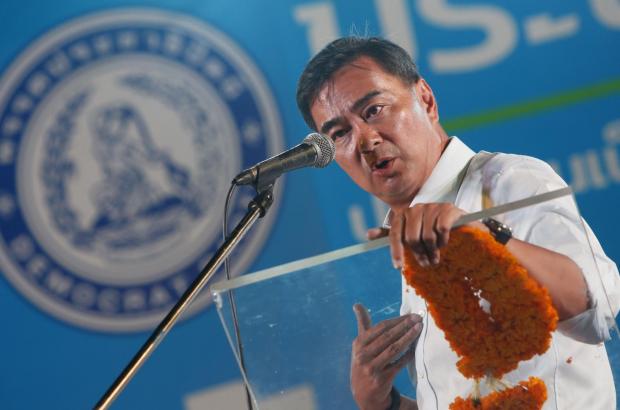
The resignation of Abhisit Vejjajiva as an MP over his party's decision to join a coalition government under Gen Prayut Chan-o-cha is praiseworthy. His move shows he is taking responsibility for his words as well as the political stand he made during the election campaign that he, as then party leader, would not support Gen Prayut in becoming the country's 30th prime minister.
Previously, Mr Abhisit showed political spirit by quitting as leader of the country's oldest political party following its March 24 election defeat that resulted in the Democrats becoming a middle-sized party with 53 seats in parliament.
The veteran politician who entered politics in 1992 announced he had decided to quit parliament, while still keeping his party membership, because he had to keep his promise and maintain the party's dignity. In addition, he believes politics needs people with principle and ideologies. Once the party decided to support Gen Prayut, he had to go.
"I cannot vote for Gen Prayut in parliament," he told reporters.
However, the fact that Mr Abhisit is staying on as a party member indicates that he has not turned his back on politics for good. At the age of 54, he is relatively young and still has a political future ahead of him. If there are general elections in the next one or two years, Mr Abhisit may still have a chance of making a comeback, probably as the party leader. It's also likely he may choose to run in the governor election for Bangkok or switch his focus to international organisations. Either choice would enable him to accumulate experience while maintaining his political profile.
Of the party's seven leaders, Mr Abhisit, who had 14 years at the helm, was the second-longest serving after Kuang Abhaiwong, who headed the party for 22 consecutive years. As the country's oldest political institution, the Democrats have over the past 73 years projected themselves as staunch opponents of dictatorship.
At the age of 27, Mr Abhisit made his political debut as a "new gen" politician with an outstanding academic background and he was elected to parliament the first time he ran in Bangkok. At 44, he became the country's youngest prime minister and is a three-time opposition leader. A man of vision and calibre, he played a crucial role in restoring the party, and under his leadership, the Democrats become a major party with over 100 MPs. The party gained 165 out of 480 seats and 159 out of 500 in the 2007 and 2011 elections respectively.
Even so, during his premiership which lasted two years and eight months, the country suffered a political crisis as red-shirt demonstrators took to the streets in 2010. The prolonged protests that ended with a crackdown that saw more than 90 people, including state officials, killed almost cost him his political career as he was charged with issuing the crackdown order. Yet the Supreme Court found him not guilty.
Despite his failure in making the Democrats the third-largest party in an election that was defined by polarisation, with pro-Thaksin and pro-military supporters at loggerheads, resulting in the loss of his leadership, Mr Abhisit has set a new political example that is rare among Thai politicians by relinquishing his MP status because, as he said, he could not follow a decision that contradicted his stance.
Such a brave decision earned him huge praise even from his foes. It required great courage to let go of his political position in order to stick to his principles. This makes him a role model.
At the same time, the Democrat Party, under new leader Jurin Laksanawisit, will be tested as to whether the decision to join the Prayut-led coalition proves right or wrong.
The party should realise that the Pheu Thai, or Thaksin bloc, is no longer its only arch-rival. Now its main competitor is Future Forward which projects itself as a party for new gen voters fed up with old politics and Palang Pracharath, which shares the Democrats' anti-Thaksin stance. These are the two parties that snatched substantial votes from the oldest party's strongholds in Bangkok and the South.
By joining the coalition, the Democrats have enabled Gen Prayut to fulfil his political ambition of becoming two-time prime minister. On the one hand, this could be an advantage for the party, since taking hold of key ministries, with enormous budgets, may give it a chance to resurrect itself and regain popularity. On the other hand, there might be a disadvantage as the Democrats will find themselves in conflict with the PPRP as the two parties vie for control of the agriculture ministry, a key ministry which commands heavy support from Thailand's farmers who form a large political base.
The emerging squabble could lead to a breaking point for the new coalition. If so, that could begin the countdown to the end of the administration.
But the Democrats will sooner or later find themselves in an inferior position as the PPRP will have more power and resources through populist schemes that will make it easy to win the hearts of the voters. Besides, Gen Prayut will never give in to the Democrats' demand for charter amendments as a condition for joining the coalition. He will use all the regime's connections in the Senate to block this attempt.
Overall, the Democrats will find it difficult to restore public trust given that the coalition has a number of weak spots including abuse of power and lack of unity among its coalition partners. Indeed, if the Prayut-led administration collapses due to corruption committed by any coalition partners, the Democrats may be tarred with the same brush. What we saw from the recent House meeting is that the opposition is quite strong.
Mr Abhisit's political break could be positive for the party if the coalition with the PPRP does not work out. It may well be a smart move that allows him to make a political comeback as party leader.
Chairith Yonpiam is assistant news editor, Bangkok Post.