
In the more than six months that have passed since the enforcement of the Private Lodging Business Law requiring minpaku operators to register with relevant municipalities, the number of such lodging facilities has increased more than threefold.
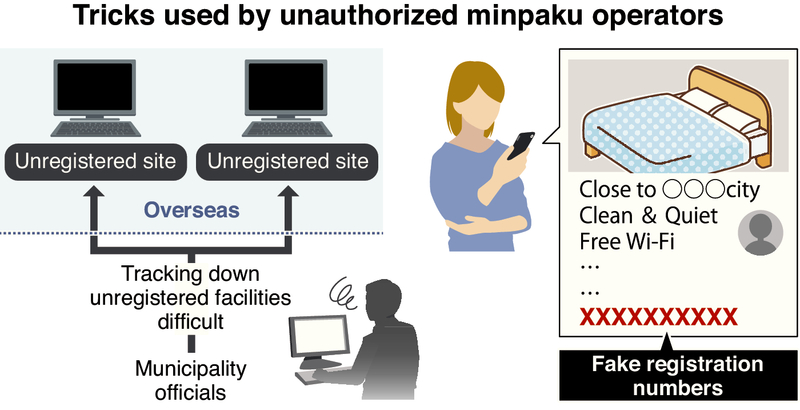
However, violators of the law operating "dodgy" facilities continue to be a problem. This class of operators run private lodgings with falsified registration numbers or post property information on unregistered lodging websites, surviving through illegal acts below the surface.
With growing demand for hotels as well as high expectations for the minpaku business following an increase in foreign visitors to Japan, anyone can operate a private lodging by registering with relevant municipalities, unlike hotel businesses, which require permission. Under the new law, which is also known as the minpaku law, lodging providers are obliged to compile a hotel register and deal with complaints among other responsibilities.
At the end of November, officials from the minpaku guidance section of Chiyoda Ward, Tokyo, and others were standing in front of a five-story condominium building near JR Akihabara Station, waiting for an Australian man to return. When the man showed up, the officials spoke to him in English, identifying a room number and asking if he stayed there.
The man told them that he booked the room via a leading portal site. However, the registration number given for the property on the site did not exist in the ward's list of lodging facilities. The officials therefore deemed that the number was fake.
The Australian man looked perplexed and said he felt safe to stay there because the room was listed on a well-known lodging portal.
On that website, the room's landlord bore a Japanese name, and the Chiyoda Ward office sent an email to the landlord after it was provided with an email address and phone number from the portal site operator. It did not receive any response, but the property listing disappeared from the site right after the office attempted contact with the landlord, according to the ward.
Strict rules
The number of lodging facilities registered in June when the law came into force was 3,728, but had more than tripled to 12,268 as of the end of November.
Meanwhile, about 4,900 facilities that had been listed on online lodging websites at the time of the enforcement were suspected to be illegally operated.
The aim of the new law was to eliminate those facilities. Illegal operators face penalty charges under the revised Hotel Business Law.
Even so, Chiyoda Ward has issued guidance to landlords and those related to dodgy minpaku businesses in more than 60 cases since April.
Tokyo-based information technology company Oscar Inc. has been tracking down suspicious minpaku operators at the request of condominium and apartment management companies.
Oscar has concluded that a main reason why illegal operations are still rampant is that operators are reluctant to meet the minpaku law's strict rules of limiting the number of business days to within 180 days a year, as well as other tougher rules separately set by ordinances of municipalities.
Clever tricks
Illegal minpaku operators have become sophisticated in evading scrutiny since the law's enforcement.
According to the Japan Tourism Agency, the most prominent trick is to post a property on a portal site using a false registration number.
Leading lodging marketplace operator Airbnb automatically detects and deletes properties registered with the wrong number of digits. However, many others carry properties on their websites without scrutiny on the pretext that "human nature is fundamentally good."
The other trick is to post properties on unregistered portal sites. The minpaku law requires portal site operators to be registered, but the tourism agency has confirmed that there are about 10 Chinese and Western unregistered sites listing properties in Japan. So, it is not easy to track down dodgy properties through those unregistered sites.
In one case, Oscar detected that a suspicious property in Tokyo was posted on an unregistered Thai portal site. The company spent two weeks tracking down the site by looking up information about the property in various languages. The company said even if they spend one month searching for such operators, these efforts sometimes end up in vain.
Oscar President Motonobu Nakagomi said: "Since the law's enforcement, it seems that the dodgy operators are doing business below the surface. Illegal minpaku can be a breeding ground for crime, and we must cope with that."
From next fiscal year, the tourism agency will consolidate information about unregistered sites overseas that it has detected and build a system in which municipalities will be able to search properties from their names and addresses.
Nine portal site operators and tourist companies, including Airbnb, will establish the Japan Association of Vacation Rental in January with the aim of sharing information and keeping dodgy facilities from continuing to operate online.
Read more from The Japan News at https://japannews.yomiuri.co.jp/