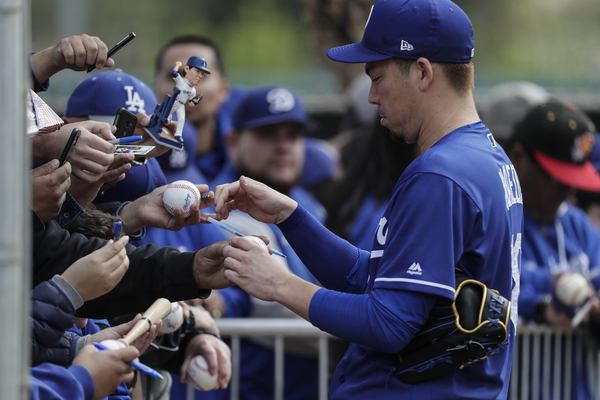
PHOENIX _ The memories of October have not faded for Los Angeles Dodgers pitcher Kenta Maeda. He wore the same jersey and he wielded the same arsenal during his month-long stint in the bullpen, but he could not deny his transformation as a reliever.
"He was pretty good," Maeda said through an interpreter about that version of himself after his two-inning Cactus League debut in the Dodgers' 4-4 tie with the Texas Rangers on Tuesday.
The gap between Maeda's performance as a starter and as a reliever was significant. After fading in the second half of his rookie season in 2016, Maeda never found his footing last season. His earned-run average rose to 4.22 and he pitched beyond the sixth inning only four times. The Dodgers acquired Yu Darvish and never considered starting Maeda in the playoffs.
Instead, Maeda moved to the bullpen, where he became a dynamic force: A 0.94 ERA, striking out 10 batters in 102/3 innings and limiting opposing hitters to a .135 batting average. He earned the trust of manager Dave Roberts and helped the team reach the World Series.
As the team regrouped for 2018, Maeda returned to his spot in the starting rotation. Darvish departed for the Chicago Cubs, but the Dodgers may still shift Maeda to the bullpen for the playoffs. In the interim, Maeda and Dodgers officials indicated Maeda could learn from his cameo as a reliever, hoping he can embrace attacking hitters after seeing how effective he was in the postseason.
"He did a little self-reflection or evaluation this past winter," Roberts said. "Where he saw the benefits of being on the attack from the first pitch. And felt that it can translate into that starter role. His culture, and what he's known in baseball, is (about) trying to go deeper in games, as far as the number of pitches, as opposed to going with the mind-set of going as hard as you can for as long as you can."
On multiple times in 2017, Roberts chided Maeda for withholding velocity at the start of games. Beginnings were a minefield for Maeda, who had a 6.84 ERA in the first inning. Opposing hitters had a .931 on-base-plus-slugging percentage in those at-bats, turning every batter he faced into the equivalent of Cody Bellinger or Justin Turner.
Maeda never wanted to be a reliever. But he saw how his strategy as a starter might benefit from the assignment.
"Throwing max effort for just one inning was something that I haven't done before," Maeda said. "That's something I would like to carry over as a starter. But I think in general, just being aggressive, extremely aggressive in the zone, is definitely something I would take away from it."
Maeda did not exhibit that style Tuesday. He walked second baseman Rougned Odor, though recovered to collect two quick groundouts after catcher Yasmani Grandal threw Odor out on a steal attempt at second base. Maeda picked up two flyouts before striking out outfielder Drew Robinson to end the day.
A sizable contingent of Japanese reporters greeted Maeda after his outing. It was the largest crowd he had hosted all spring. The curiosity of his country has been focused upon Shohei Ohtani, the two-way experiment for the Angels. Maeda did not mind the reduced spotlight.
"I understand that part of the business," he said.
Maeda was reminded that he has more big league home runs than Ohtani. Maeda went deep in his debut outing in 2016. However, in his 108 plate appearances since that day in San Diego, he has yet to replicate the feat.
"Real bad slump," Maeda said. "I'm stuck. After my first year, everybody thought that I was going to drop bombs."