The candidate poised to unseat the Scottish Labour MP Douglas Alexander is a 20-year-old student standing for the Scottish National Party (SNP). Mhairi Black, candidate for Paisley and Renfrewshire South, is the embodiment of the appetite young Scots now seem to have for political activism.
Until last year’s referendum on Scottish independence, students tended to be viewed as apathetic and disengaged. Then, for the first time, voters aged 16-17 were enfranchised, and they showed they were more than willing to rise to the democratic challenge.
Roughly 100,000 under-18s signed up to vote, an estimated 80% of those eligible. On the day, the overall voting turnout was 84%, a figure not seen in a general election since 1950.
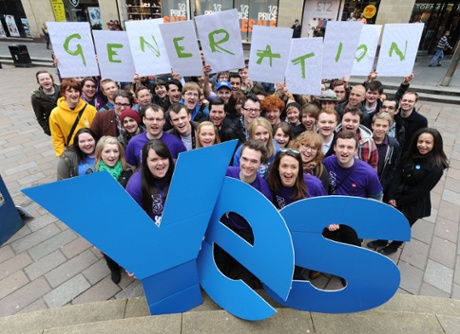
Student activism played a highly visible role on both sides of the campaign, with demonstrations, spontaneous political gatherings in city centres, and outbursts of song helping to turn Scotland briefly into a poster nation for what democratic engagement could look like.
But some were concerned that there might be a return to apathy when 16- and 17-year-olds, the most pro-independence demographic in the country, saw the Yes campaign defeated.
Are Scottish students still politically engaged?
Maggie McCabe, a 21-year-old animation student at Dundee University, is a feminist, a former CND campaigner and “extremely anti-austerity”. The environment, NHS and tuition fees are all very much on her political radar.
Youth apathy doesn’t feature as a worry in the McCabe household: “The amount of times I’ve been told off for arguing about politics over the dinner table is unreal.”
McCabe joined the SNP at 16, long before the run-up to the referendum. She is now president of the Scottish Nationalist Students Association in Dundee, the most pro-independence constituency in Scotland at last year’s referendum.
“Scotland is now one of the most politically charged nations in Europe,” says McCabe. She is currently campaigning hard on campus for Chris Law, the local SNP candidate. Energy is high on her campus in Dundee. Over the last few months, McCabe has seen students increasingly getting involved in politics and with the SNP.
Morgan Horn, an 18-year-old politics student at the University of Glasgow, was an organiser for Generation Yes, a grassroots youth campaign, during the referendum. She says she’s seen a significant boost to membership of Glasgow University’s Scottish nationalist association (Gusna) in the last year.
Part of the SNP’s youth appeal is its commitment to free tuition. “As a working-class student, I would not have been able to attend university if it hadn’t been for that,” says Horn.
But the SNP is not the only party popular with young and engaged Scottish voters. The Scottish Greens have experienced a surge in membership since the referendum. Mark Beattie, a 27-year-old geography student, is currently chair of Glasgow University’s Scottish Greens, whose meetings and Facebook group are thriving.
The referendum was pivotal in shifting youth perceptions about the party, says Beattie. Before they were seen as a protest party concerned with the environment and nothing else. “The bread and butter of why I joined the Greens, however, was the social issues,” he says.
Are young people in Scotland moving away from Labour?
Given the predicted loss of Scottish Labour seats in the upcoming election, it’s perhaps no surprise that my Twitter call-out for a student planning to vote Labour prompted the sarky response: “There must be one left somewhere?”
But Ed Campbell, an 18-year-old politics student at Edinburgh University, is planning to vote Labour – with the NHS, the environment, free tuition fees and better state education high on his list of political priorities.
He arrived at his decision through a process of political elimination: “I knew I would vote for a leftwing party. The Lib Dems are kind of dead, and the Greens are a bit like the Ukip of the left - they hide it quite well, but they are very extreme.”
Some parties, says Campbell, are simply beyond the pale for Scottish students: “Ukip aren’t a thing in Scotland, they are so unpopular. And you can’t really be a young person and vote Conservative. They don’t go hand in hand.”
Jamie McKenzie, a 19-year-old economics student at Edinburgh University would beg to differ. How did his friends react to him joining Edinburgh University’s Conservative society? “Nothing nasty. Shock more than horror – at least to my face.”
His political views are heavily influenced by the economic crisis. “You have to be conscious of youth unemployment, and think what the country is going to be like when you graduate and go out in the world. I feel like Conservatives are more on my side,” he says.
McKenzie comes from a family of Labour voters who live just outside Glasgow, in a traditionally Labour constituency. Beattie, Horn and McCabe also come from families and communities that would have supported Labour.
For Beattie, defection to the Greens makes sense: they are, he believes, the natural successors to Old Labour. “I’ve met so many ex-Labour voters,” says McCabe. “People feel like Labour has failed them. Young people too.”
Both McCabe and Horn have been politicised not only by activism on campus, but by the impact of austerity cuts on their communities in Glasgow. “It’s happened under the Tory government and Labour have done nothing to fight it,” says McCabe.
Campbell, believes Labour still has an appeal as a softer leftwing choice for young voters in Scotland. “If you are a more radical young person in Scotland you will probably vote SNP. They are the party for you, they are anti-establishment.”
While it is unclear how big a role young people will play in the predicted repainting of Scotland from red to yellow, what is clear is that the referendum was not a passing fad in youth political engagement. Rather it was an opportunity for Scottish students to ask themselves, not only whether they wanted independence, but what they wanted from politics full stop.
Keep up with the latest on Guardian Students: follow us on Twitter at @GdnStudents – and become a member to receive exclusive benefits and our weekly newsletter.