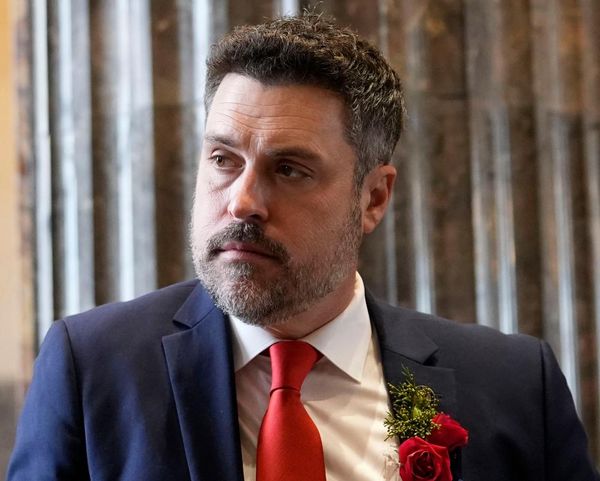
Language is twisted and slippery in Frank McGuinness disturbing new memory play for the Abbey theatre. As an unnamed narrator, Man (Ryan Donaldson) looks back on his 1970s youth during the Troubles in Northern Ireland, he says that the past “does not belong to me”.
The Man’s recollections come in snatches: sometimes hazily with humorous shrugs, then sharply focused. First, his early years with his violent mother, who struggles with alcohol addiction; later his time in a residential care home for teenage boys run by a luridly sadistic sexual abuser known as Beastie Billy. There the boys are subjected to Billy’s Old Testament-infused sectarian and misogynist rhetoric, while being pimped at night to members of the British security forces. “We serve the forces,” the narrator’s teenage self says ironically, as ideas of loyalty and service become increasingly distorted.
In the small Peacock auditorium, our proximity to the self-contained, quietly expressive Donaldson adds intensity to an already bleak narrative. Staging the monologue on a dark, coffin-like slab against a grey panelled backdrop, director Sarah Baxter’s assured production emphasises the shadowiness of this secret underworld of abuse, violence, prejudice and denial, while avoiding being specific with regard to historical facts and locations. In designer Alyson Cummins’ abstract setting it is left to Sinéad McKenna’s subtle lighting to denote changes in time periods and spaces, revealing tones of grey from steel to charcoal to inky blue-black, using the mirrored ceiling and pool of water downstage to create flickers of light and shade.
While the infamous Kincora Boys’ Home in Belfast immediately comes to mind here, it is never named, and institutional sexual abuse and brutality at the time extended beyond its walls. McGuinness’s delicately porous, allusive writing allows the narrator’s painful story to suggest a wider shared experience of gay men coming of age in the years before homosexuality was decriminalised in Northern Ireland. And yet amid all this deep damage there is love too, or at least passionate longing, and it is this that propels the young man onwards and far away – without a backward glance, in case he is turned into a pillar of salt, like Lot’s wife.
• At Abbey theatre, Dublin, until 16 May
• In the UK, the NSPCC offers support to children on 0800 1111, and adults concerned about a child on 0808 800 5000. The National Association for People Abused in Childhood (Napac) offers support for adult survivors on 0808 801 0331. In the US, call or text the Childhelp abuse hotline on 800-422-4453. In Australia, children, young adults, parents and teachers can contact the Kids Helpline on 1800 55 1800, or Bravehearts on 1800 272 831, and adult survivors can contact Blue Knot Foundation on 1300 657 380. Other sources of help can be found at Child Helplines International