
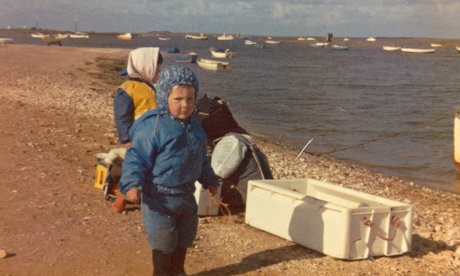
My first memory of the seaside is sitting in a small, varnished wooden boat in an orange lifejacket that was far too big for me, listening to the unfamiliar shrieks of wading birds and the chink-chink-slap of rigging on masts. The exotic tang of oilskins, salt and muddy marsh was overpowered by the blue-smoked stench of the boat’s engine as we chugged up a muddy creek towards a remote island. I was two, although, in reality, this picture may be a blend of memories from four successive holidays we took in the late 1970s on Scolt Head Island, a hump of tawny sand dunes on the Norfolk coast.
So many early childhood and family memories, are formed by the sea. Over the past two centuries, the beach has become our favourite holiday destination; more recently, it has become the last place in the country where children can roam free, the ultimate sand (or shingle) pit, soft-play zone and water park. This is odd because the beach can, of course, be lethal with its hazardous tides and waves.
The near-universal parental enthusiasm for the beach also overlooks the fact that, for many young children, the coast is an uncomfortable place. Many of us have droll photos of ourselves as toddlers playing on a bleak British beach with a grey sea beyond, and my early seaside memories are certainly not idyllic. Scolt Head Island was not an obvious choice for a holiday, except for lovers of bracing solitude, as my parents were. Ever since it was bought by the National Trust for £500 in 1923, its population had been one man – a wind-bronzed nature reserve warden who guarded the island’s colonies of terns, the chalk-winged creatures that nest in their thousands on Scolt’s sandbanks.
We stayed in a wooden shack with no electricity, toilets or running water. The boat trip scared me. The beach was a wind-blasted horror, requiring epic struggles up mountainous dunes, sand blowing in my eyes, marram grass whipping my legs. My one sunny memory is of playing with my Matchbox cars on the cobbled terrace outside, mercifully sheltered from the north wind. But then I lost my orange VW Kombi in the sand and, despite lengthy excavations, it was never seen again.
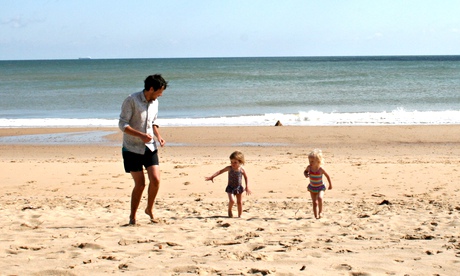
As parents, we seek to recreate the lost idyll of early childhood for our own children, so I should have remembered these traumas more clearly when we took our then 18-month-old twins on their first seaside holiday to Crackington Haven, Cornwall. Its sheltered beach was nothing like desolate Scolt Head Island and I assumed it would be paradise. Milly loved climbing and exploring – so she would adore clambering into the rock pools. At home, Esme’s favourite thing was running wild and eating soil – on the beach, she could scamper free and scoff as much sand as she desired. Plenty of their picture books featured sandcastles and buckets and spades, so their seaside schooling had already begun. Like many overprotective modern parents, we also bought them lurid little wetsuits to help them keep warm when wet, and plastic jelly shoes to ease their passage over the rocks.
It was a shock when we plonked the girls on the wet sand and they clung to our legs, unimpressed by the cold water and unforgiving westerlies. During five days of chilly coastal indoctrination, Milly eventually became enthusiastic about finding rock pool snails, and Esme learned to shout “sea!” from the comfort of our arms. Although she devoured mouthfuls of sand, this was not nearly as moreish as soil and mostly she cried whenever her feet touched this strange stuff. On our final day, after I’d spent an hour gently lowering Esme towards various objects of fascination – strutting herring gulls, slobby pink-and-beige-spotted anemones and strings of seaweed pods you could pop – finally, she was off, on her own legs, futilely chasing gulls like a puppy. But still, there were no tantrums when we headed home. She was far happier careering around the holiday cottage.
So I am not sure that we are born to love the coast. The beach and the sea are too big and frightening, too wet and cold. Conservative adherents to routine and safety, young children have instinctively suburban tastes: they appreciate people, shelter and small things. But time spent by the sea as tiny children must eventually bond us with the coast and we soon develop a check-list of expectations: Milly and Esme are far more enthusiastic for the seaside now they are three and their checklist includes ice-cream and fish and chips.
When we are big enough, the sea’s meeting with the land seems to speak to us independently of the joy adults instruct us to find in it.
I imagined that part of an older child’s attraction to the coast was universal to any holiday: children have more fun if their parents are enjoying themselves. Even the most restrained parents remember to relax on holiday and some rediscover beach play, too (I enjoy building dams on beach rivulets rather more than my children, who at least give me an excuse to do it).
When I interviewed a group of 10-year-olds, most fundamentally, the beach was a place where they could be free: where they could make friends, mess about, or leave their parents lying boringly still on the beach.
If children value free play on seaside holidays, what are adults seeking? Rest, obviously, but sometimes solace or reconnecting with half-buried memories too. Holidays are time capsules, allowing us access to childhood experiences we can precisely place in our personal histories because everyone remembers their favourite summer holiday.
I hoped to find revelatory memories when, shortly after our family holiday at Crackington Haven, I returned to stay on Scolt Head Island, alone, for the first time in 30 years. Instead of the monumental black cliffs of north Cornwall and the vivid rolling Atlantic, I found a muddy smudge of marsh and a flimsy sea washed with a muted palette of olives, duns and pewters. For the first few hours, I was underwhelmed. This empty island of flat marsh seemed bereft of anything alive or arresting. But north Norfolk has a subtle charm that seeps into you like the trickle of the incoming tide, less bombastic than awesome cliffs but soothing and strangely uncompromising.
Most things that loom large in childhood are diminished by the present, but the wooden shack on the sand dunes where we stayed was unexpectedly substantial. I climbed up the dune steps and on to the cobbled patio where I once played with my toy cars. The door opened with a creak and I saw that, oddly, my memory of its interior was a mirror image, the wrong way round. I had pictured the stone fireplace on the right, but it was on the left. Confronting memories with reality can be disorienting, a reminder we are all unreliable narrators.
I expected my three days on the island to unearth forgotten images of those family holidays by the sea but none came, and neither did I dig up the VW Kombi. I felt a profound sense of peace, although I don’t know whether this was an innate quality of this marvellous, lonely island or whether it came from my childhood time here – a trip to Scolt was a comforting coming home.
Philip Larkin’s poem This Be the Verse about parental inheritance describes how misery is handed on, deepening “like a coastal shelf”. The seaside may be mostly the opposite, a place for the accumulation of happy memories, but there is shade as well as sunshine on our shores, not least because the coast can show us how the lost idyll of childhood has truly slipped from our grasp. But the dreamy comfort I experienced on Scolt was a consolation; the fact that I couldn’t recapture the past emphasised to me the compelling power of the present, and the natural world around me. On the beach, it was possible to return to a childlike state at least, alone with the sea and sand and silence, completely absorbed in the present moment.
• Coastlines by Patrick Barkham is published by Granta, £20. To order a copy for £16, including free UK p&p, go to bookshop.theguardian.com or call 0330 333 6846












