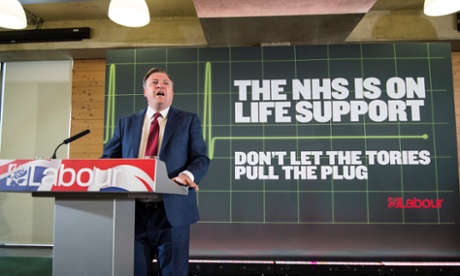
Labour’s latest claims about the Conservatives and the NHS amount to a dire warning that patients’ waits to access key services such as A&E, GPs or planned operations will deteriorate even further if the Tories win the general election.
The health service is already struggling to cope with a relentlessly rising demand for care and Labour claims to be “unveiling the true threat to NHS service standards posed by five more years of the Tories”. Amid florid rhetoric from Ed Miliband, Ed Balls and Andy Burnham, Labour’s key claim is that “if the Tories were given the chance to carry on as they are, services would continue to dramatically decline”.
Certainly almost all the NHS’s key performance waiting time targets, the meeting of which was until quite recently regarded as a must-do for hospital bosses, have gone to pot under the coalition.
The waiting list for elective treatment broke through the 3m barrier last year and has kept on growing; more patients are waiting longer than they should on a trolley in A&E or just to be seen at all; cancer treatment waiting times have been missed for the first time ever; and the number of cancelled operations has risen and risen.
Added to the really significant financial problems that have arisen too since 2013 – 80% of hospitals are in the red – this is all a sorry indictment of the coalition’s stewardship of the NHS.
The NHS is on life support after five years of the Tories. Cameron is planning to double the pace of cuts next year. pic.twitter.com/v72S7neJNm
— The Labour Party (@UKLabour) April 20, 2015
David Cameron promised to keep waiting times “low and stable”. Yet billions of pounds of extra funding and Jeremy Hunt’s micro-management of the bodies that manage hospitals in a desperate bid to avoid widespread missing of targets have done little to prevent growing numbers of hospitals, GP services and mental health providers experiencing serious difficulties, especially last winter.
However, the reality is that – whoever is elected on 7 May – more and more patients are likely to suffer because no party’s plans will magically, immediately halt the NHS’s visible decline.
Labour says, for example, that “on current trends, five more years of the Tories would mean that by 2020 we will see ... 1.5m hospital bed days lost every year to delayed discharges ... over 20 million people waiting a week or more for a GP appointment ... over 4 million people a year waiting over four hours in A&E”.
Labour’s plans to reinstate patients’ right to see a GP within 48 hours should ensure that long waits to see a family doctor are banished. But the mismatch between demand for care, driven by the ageing, growing and increasingly ill population, and NHS’s ability to meet it – because money is tight and too often there are too few staff – is going to continue to become ever more stark regardless of whoever forms the next government.
Miliband is warning on Monday that a “double deceit” by the Tories spells “a double danger for the NHS”. It’s a snappy phrase, but is it true? A key element of that is his claim that the Tories’ planned “extreme” cuts in 2015-20 to non-protected Whitehall budgets will inevitably be felt in the NHS.
As far as social care goes, that is probably right. Cutting it since 2010 at a time of growing need has been arguably one of the coalition’s most short-sighted policies, with – hey presto – the NHS’s workload pushed up and ability to do its job enfeebled as a result.
Labour sees their two main NHS policies – a £2.5bn a year “Time to Care Fund” to hire extra NHS staff and integration of health and social care services so patients receive “whole-person care” – as providing the answer to the NHS’s problems.
They may prove to be that, though the doubters about Labour’s NHS plans include all the health thinktanks, such as the King’s Fund.
But even if they do succeed, they will take time to have any beneficial impact. For example, the £2.5bn for extra medical personnel will not become available until 2017, as the sources of it – the mansion tax, levy on tobacco firms and crackdown on tax dodging – will take time to implement.
Labour reluctantly acknowledged this last year, soon after Miliband unveiled the fund as the highpoint of a party conference speech, which is remembered more for his amnesia. And the promised integration, which will be hugely difficult to implement anyway because it involves bringing together two currently separate services, is part of Labour’s 10-year plan for the NHS. It is unclear exactly when Miliband and Burnham expect that approach to actually relieve the pressure on the NHS. Whenever it is, though, it isn’t any time soon.
The Conservatives’ plans would also not somehow staunch growing demand in the foreseeable future. But at least their answer to the challenge of keeping patients healthier at home and therefore out of hospital unnecessarily – the £5.3bn “Better Care Fund”, which began on 1 April – is already changing how local NHS and social care services work, and has begun incentivising them to work together to offer patients a joined-up illness protection service.
If it works, GP surgeries and A&E units will see fewer mainly older, frail patients with recurrent infections, broken bones and mental health problems, and the NHS should then be better placed to withstand the potentially unsustainable pressures on it. Labour’s pledged full integration is a radical-sounding, though in reality still gradualist, approach along exactly the lines of the Better Care Fund.
Labour’s warning on Monday follows their recent claims that the Tories may introduce charges for NHS services (though the Tory manifesto rules that out) and that there is a secret Tory plan to cut the number of NHS nurses.
But the evidence to back up either charge is thin. It is understandable that Labour is being as creative as possible in its efforts to maximise Tory discomfort over the NHS, their own strongest suit.
Yet their own plans also raise uncomfortable questions for them, such as what extra funding will you give the NHS before the £2.5bn a year kicks in and how do you bring together health and social care while still avoiding yet another unpopular reorganisation of the NHS?