The Sahara is often seen as one of the world's most unforgiving landscapes — a vast desert of sand, heat and isolation. But thousands of years ago, it was a very different place.
Large parts of North Africa were covered with grasslands. Lakes dotted the landscape. Animals roamed across regions that are now barren, and human communities settled in areas that today seem almost impossible to inhabit.
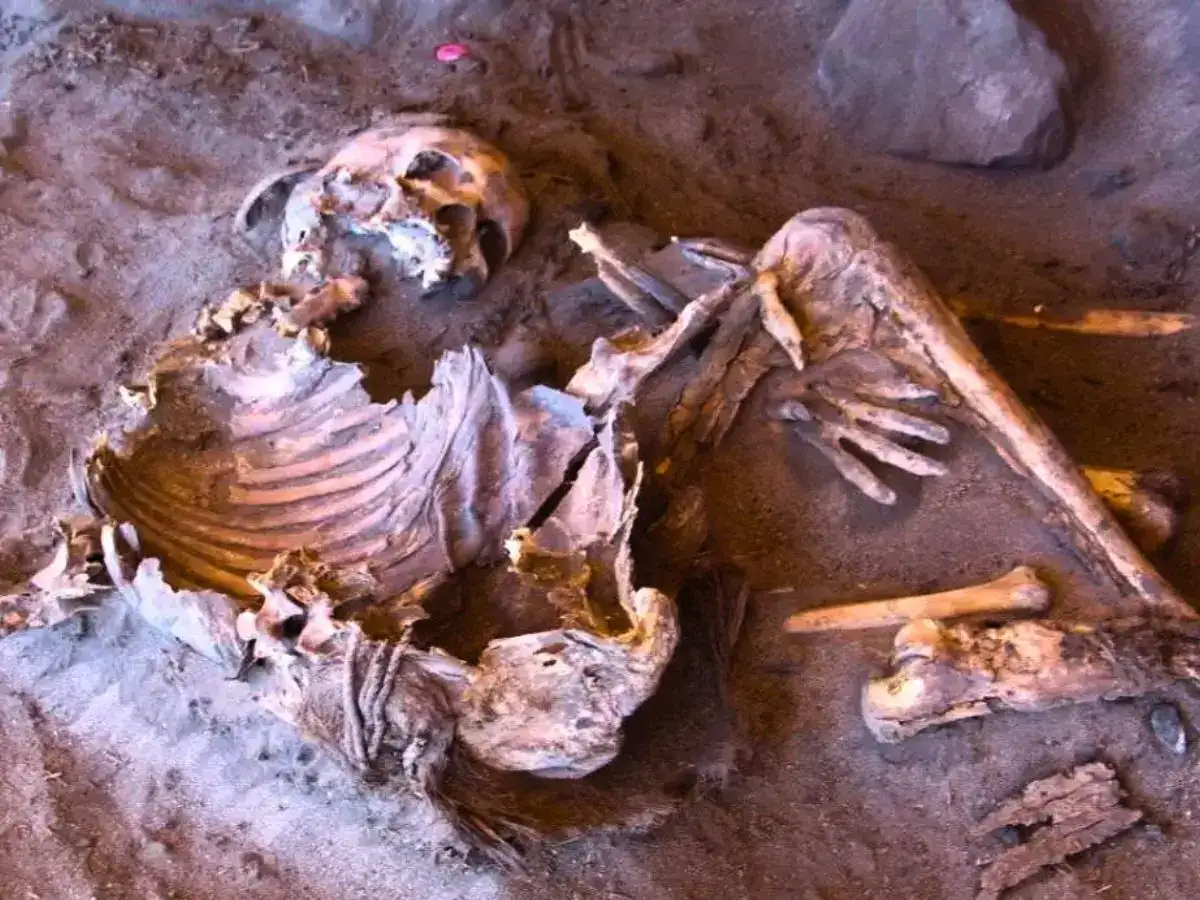
Now, DNA recovered from two 7,000-year-old naturally preserved individuals found in southwestern Libya has opened a window into that vanished world. The findings have revealed evidence of a previously unknown human lineage that appears to have remained largely separate from other populations for around 50,000 years.
The discovery comes from genetic analysis of remains recovered at the Takarkori rock shelter in Libya.
How did scientists discover a previously unknown human lineage?
For years, researchers suspected that traces of an unidentified ancient population were hidden within the DNA of present-day people in parts of Africa and neighbouring regions.
What they lacked was direct evidence.
That changed with the Takarkori remains.
Using advances in genetic sequencing, researchers examined large portions of the individuals' genomes rather than relying only on smaller inherited DNA fragments. The results pointed to a population with a genetic history unlike any previously identified through ancient human remains.
According to Science, the individuals belonged to a lineage that had separated from other African populations tens of thousands of years earlier.
Why is this population surprising to researchers?
Human populations rarely remain isolated for very long.
Over generations, migration, trade, marriage and cultural exchanges typically blend genetic histories. But the Takarkori individuals appear to tell a different story.
Genetic evidence suggests their ancestors split from populations living further south around 50,000 years ago. After that separation, the lineage appears to have remained remarkably distinct.
What surprised researchers most is that these individuals lived only 7,000 years ago. Yet their genetic profile preserved ancestry that seems far older than what scientists would normally expect from that period.
In simple terms, they carried the genetic signature of a population that had managed to persist while many other ancient lineages disappeared or merged into larger groups.
What does the discovery reveal about the Green Sahara?
The findings are also challenging long-held assumptions about the Green Sahara period.
When the Sahara became wetter, lakes expanded, vegetation spread and conditions became more suitable for human life. Scientists have often viewed this period as a time when people could move more easily across North Africa.
The new genetic evidence suggests the story may have been more complicated.
Even though the environment allowed human communities to thrive, it did not necessarily lead to extensive population mixing. The Takarkori individuals show relatively little evidence of large-scale genetic exchange with groups living beyond their region.
Did the Takarkori people have contact with other populations?
The genomes do contain signs of limited interaction with people living further north.
Researchers found small traces of ancestry linked indirectly to ancient Neanderthal admixture. However, the signal was far weaker than what is typically seen in populations outside Africa.
The evidence suggests occasional contact rather than large migration events.
Small groups or individual travellers may have moved between regions, sharing knowledge, goods or partners without significantly changing the genetic identity of the local population.
What makes this discovery important?
The remains have provided something scientists had been searching for for years — direct evidence of a population that had previously existed only as a faint genetic signal.
The discovery not only sheds light on a lost chapter of human history but also highlights how much remains unknown about the people who lived across the ancient Sahara long before it became the desert known today.
(With TOI inputs)